A Video & Podcast Series
Join me for an authentic conversation over wine where we uncover the stories behind the glass.
Episode 1
45 Min
Perfect Ripeness Is a Myth.
with Louis Skinner, Force Majeure & WeatherEye Vineyards, Red Mountain
Presented by Mistral WineCards & WineApp
Louis Skinner doesn't romanticize winemaking. Waiting for perfect ripeness, in his words, is the most bullshit explanation he's ever heard.
We trace the path. Car geek in Los Angeles. Retail at Fine Wines in Redmond. The cellar at Betz Family Winery under Bob Betz, MW. Now he makes the wine at two of Red Mountain's most acclaimed producers, Force Majeure and WeatherEye.
We open a 2022 Épinette, the right bank blend of Merlot and Cabernet Franc from the Force Majeure estate. What came out of the conversation: the Bob Betz feedback loop, the rapid color liberation test, why Red Mountain is Washington's Hermitage, the 2019 harvest he ran on a busted body with a crew that delivered, and what he'd tell anyone planting grapes in this state right now.
Chapter Guide
- 0:00 Cold open
- 0:49 Intro
- 1:10 Louis's origin story
- 10:58 Betz Family Winery and Bob Betz
- 22:10 Force Majeure and Red Mountain
- 26:50 Opening the 2022 blend
- 36:05 Harvest decisions and the rapid color liberation test
- 39:40 Washington wine's future
- 42:45 The wine that changed everything
Episode 2
49 Min
Burgundy in Puget Sound.
with Kim & Larry Harris, Bayernmoor Cellars, Puget Sound AVA
Presented by Mistral WineCards & WineApp
The Puget Sound AVA is the part of Washington wine almost nobody talks about. Most of the state's serious wine sits east of the Cascades in the rain shadow, on land that can grow basically anything. The west side is harder. It's wetter, cooler, more temperamental, and the few wines that come out of it have rarely justified the experiment. Kim and Larry Harris had 100 acres of family land in Stanwood, about 45 minutes north of Seattle, and a hunch that the answer there was Pinot Noir. They paid Washington State University to study the site for two years before planting a single vine. WSU came back with weather-station data and soil pits and a verdict: the growing-degree-days were close enough to Burgundy to take the swing.
Kim and Larry met in law school. Larry still practices; Kim spent years as an attorney in San Francisco before they moved north to figure out what to do with the family property. Larry brought a patent lawyer's brain to viticulture and a math-and-engineering background to winemaking, which translates to records he can pull on every gram of fruit and every barrel decision they've made since planting in 2011. The vineyard is six acres of Pinot Noir at 700 feet of elevation, south-facing, on sandy loam they amended with dolomite to dial in the pH. They're certified sustainable, salmon safe, and herbicide free. Bud break and pruning are done by hand row by row. The Précoce clone and the 777 clone grow eight feet apart and behave like different varietals, two weeks apart on every milestone of the season.
We tasted three. The 2025 White Pinot Noir is sourced from Celilo Vineyard and just being released to their club; this was the first bottle ever opened from that lot. The 2023 Estate Pinot Noir, Clone Précoce, took Double Gold at the San Francisco Chronicle Wine Competition. The 2023 Estate Pinot Noir, Clone 777, won 98 points, Double Platinum, and Best Red in the Pacific Northwest at the Great Northwest Wine Platinum Awards, beating every red from Oregon, Washington, British Columbia, and Idaho. Larry says he is on a mission to make the best Pinot Noir in the world. After tasting all three side by side, the more interesting question isn't whether he can pull it off. It's how many people will be willing to drive 45 minutes north of Seattle to find out.
Chapter Guide
- 00:00 A Bottle of Drouhin and 100 Acres
- 02:46 Why a Vineyard, Not Cattle or Corn
- 04:21 WSU's Finding: Burgundy in Puget Sound
- 06:55 700 Feet, Sandy Loam, and the Fog Line Across the Street
- 09:38 A Patent Lawyer Who Tracks Every Gram
- 12:53 The Vineyard Year and the Précoce / 777 Split
- 19:24 Tasting the 2025 White Pinot Noir from Celilo
- 31:50 The 2023 Précoce: Double Gold at the SF Chronicle
- 36:54 The 2023 Clone 777: Best Red in the Pacific Northwest
Episode 3
Open the Good Bottle on a Tuesday.
with Brooke Delmas Robertson, Delmas, The Rocks District of Milton-Freewater
Presented by Mistral WineCards & WineApp
Brooke Delmas Robertson makes the wine at Delmas and runs the farming at SJR Vineyard, on the southwestern edge of the Rocks District of Milton-Freewater. It is the only AVA in the country drawn around a single soil series, where basalt cobbles run hundreds of feet deep and hand the day's heat back to the vines at night.
She grew up in Napa running through gnarly old Zinfandel, worked vineyards from Napa to the Barossa, and came home to a site that froze to the ground three times in a decade. Her answer was to bury it. She trains the vines low and covers them through winter in a system she calls MHT, mini head trained, and it is the reason the fruit keeps coming.
We taste two wines as we talk, the flagship Delmas Syrah and the new BDR, a blend of every variety on the property that shifts with each vintage. Along the way Brooke makes her case for drinking the good bottle tonight, with pizza, on a Tuesday, instead of saving it for a day that may never come.
Chapter Guide
- 0:00 Open the $100 bottle on a Tuesday
- 1:08 Meet Brooke and Delmas
- 2:54 An AVA built on a single soil
- 4:19 Why draw the line: Steve Robertson and Dr. Kevin Pogue
- 7:08 From Napa's old Zinfandel to the Rocks
- 12:10 Own-rooted, head-trained bush vines
- 13:00 Burying the vineyard to survive winter
- 15:04 Three freezes, cut to the ground
- 19:44 Head training as the long game
- 23:56 The wines: Delmas Syrah and BDR
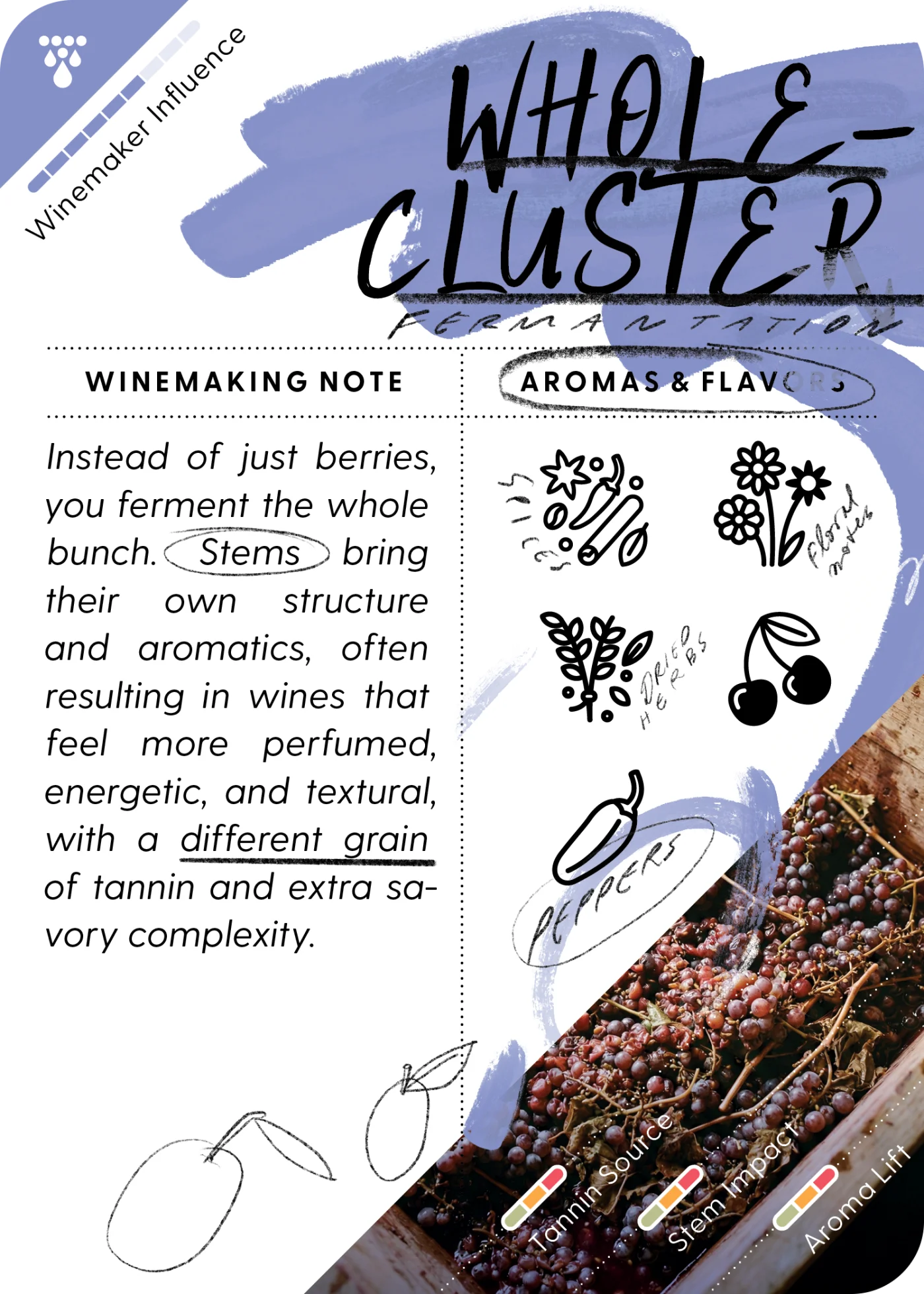
- 26:14 Whole cluster, stems, and structure
- 31:13 Letting ambiguity win in the cellar
- 33:03 The Rocks funk: pretty with a pocket knife
- 35:44 The Cimento Viognier that stopped her cold
- 46:31 Remy and what she inherits
Where to Watch & Listen
Pick Your Platform.
Full video on YouTube. Audio on every major podcast platform. New episodes drop to all three the same day.
The Format
A Real Conversation, Not a Review.
Twenty to forty-five minutes with one guest, one or two bottles, filmed on-location or at the tasting room. No scripts. No scores. No production theater.
01
What It Is
- A long conversation, compressed to the best parts.
- Filmed on-location or at the guest's tasting room.
- One or two wines the guest wants to pour.
- Published on YouTube and every major podcast platform.
- Hosted by a WSET-certified educator with twenty years in the industry.
02
What It Isn't
- A wine review show.
- A scripted interview with prepared questions.
- A sales pitch for the wines poured.
- A studio production with three cameras and a crew.
- A critic scoring a bottle out of a hundred.
03
What Guests Bring
- One to two wines they want to share.
- Roughly 90 minutes of their time on recording day.
- A willingness to go beyond the tasting room talking points.
- Stories from the vineyard, the cellar, or the career.
WineChats × Mistral WineCards
The Conversations Behind the Cards.
Every episode of WineChats is a real conversation with someone who knows their corner of the wine world cold. Deck ONE is where that knowledge gets written down: 55 cards on the grapes, regions, terroir, and winemaking the guests keep coming back to. Watch and listen, then put the card on the table next to the bottle.
Episode 1 · WineChats
"Perfect ripeness is the most bullshit explanation I've ever heard."
For Winemakers, Wine Pros, and Storytellers
Think You Belong on WineChats?
Seth is always looking for the next conversation. Winemakers with something to say. Importers, buyers, sommeliers, educators. People who care about wine past the tasting room pitch.
You make wine, sell it, teach it, or champion it.
You have a story past the talking points.
You can offer roughly 90 minutes on recording day.
You're willing to open one or two bottles on camera.
Typical response time: within one week.