Quinta do Vesúvio
KEEN-tah doo veh-SOO-vyoo
A Douro Superior estate owned by the Symington family since 1989, making its Vintage Ports by foot-treading in granite lagares built in 1827 and Douro DOC reds since the 2007 vintage.
Quinta do Vesúvio is a 326-hectare estate in the Douro Superior, 120 km east of Porto and 45 km from the Spanish border. António Bernardo Ferreira bought the property, then known as Quinta das Figueiras, in 1823, and its winery was built in 1827. The Symington family has owned it since 1989, and it is the family's largest property. Its Vintage Ports are trodden by foot in the original granite lagares, and the estate has made Douro DOC red wines since 2007.
Take Quinta do Vesúvio into the app. Flashcards, trivia and label lookup.
Open the appHistory and Ownership
The property's recorded history dates to 1565, when it held plantations of oranges, lemons, almonds, olives and fig trees. António Bernardo Ferreira bought it in 1823 from the Viscount da Lapa, when it was known as Quinta das Figueiras, and planted it with vines the same year. Over 13 years, 500 men and women planted approximately 150 hectares of vineyards, and in 1827 the winery was built with eight granite lagares, each able to hold 24 pipes of wine. His niece, Dona Antónia Ferreira (d. 1896), then took on the property. Under her ownership the chapel and a school for the workers' children were built and the main house was expanded, and during the phylloxera years she had a stone wall with a circumference of 16 km built around the whole property to keep her workers employed. In 1868 she bottled Vesúvio's port as an estate wine, the Quinta do Vesúvio 1868 Vintage Port. The property then passed to her descendants, principally the Brito e Cunha family, until the late 1980s. The Symington family, which had seen Vesúvio for decades from across the river at Dow's Quinta da Senhora da Ribeira, acquired it in 1989.
- 1565: earliest historical records of the property; 1823: bought by António Bernardo Ferreira and planted with vines.
- 1827: winery built with eight granite lagares, each holding 24 pipes of wine.
- 1868: Dona Antónia Ferreira bottled the Quinta do Vesúvio 1868 Vintage Port as an estate wine.
- 1989: acquired by the Symington family from the Brito e Cunha family.
- 326 hectares in total, almost two thirds of which is preserved in its natural and wild state; the Symington family's largest property.
- Located in the Douro Superior, 120 km east of Porto and 45 km from the Spanish border.
- Winery built in 1827 with eight granite lagares, each able to hold 24 pipes of wine; it still makes all of the estate's Vintage Ports by foot-treading.
- Bought by António Bernardo Ferreira in 1823; held by Dona Antónia Ferreira's descendants, principally the Brito e Cunha family, until the late 1980s; owned by the Symington family since 1989.
- Two Vintage Ports: Quinta do Vesúvio, made in most years, and Capela do Vesúvio, made in 2007, 2011, 2016, 2017 and 2022.
- Douro DOC wines since 2007: Quinta do Vesúvio and Pombal do Vesúvio, launched in 2009, joined by Comboio do Vesúvio and Comboio do Vesúvio White.
The Symington Era
In its early years of ownership the Symington family planted 60,000 new vines and revitalised older parcels. Between 2001 and 2003, 90,000 vines were planted in the Quinta Nova vineyard with a view to producing Douro DOC wines, and in 2009 the family launched the estate's still wine project with Quinta do Vesúvio DOC and Pombal do Vesúvio DOC. With 326 hectares, Quinta do Vesúvio is the Symington family's largest property. For the 2011 vintage, the Symington family announced the release of a classic Quinta do Vesúvio Vintage Port alongside limited editions of Capela da Quinta do Vesúvio.
- Early years: 60,000 new vines planted and older parcels revitalised.
- 2001 to 2003: 90,000 vines planted in the Quinta Nova vineyard for future Douro DOC wines.
- 2009: launch of the Quinta do Vesúvio and Pombal do Vesúvio Douro DOC wines.
The glasses, tools, and cards I stand behind.
A short list. Nothing I would not recommend to a friend.
Browse the WineShopPeople and Roles
The Symington family has owned Quinta do Vesúvio since 1989, and the estate is part of Symington Family Estates. As of April 2024, Charles Symington was head winemaker. The winemakers for the 2022 Vintage Ports were Charles Symington and José Luís Cavalheiro, and for the 2021 and 2022 Douro DOC reds Charles Symington, Pedro Correia and Hugo Almeida.
- Owner: the Symington family, since 1989 (Symington Family Estates).
- Head winemaker (as of April 2024): Charles Symington.
- Winemakers for the 2022 Vintage Ports: Charles Symington and José Luís Cavalheiro.
Vineyards and Terroir
Quinta do Vesúvio has a total area of 326 hectares, almost two thirds of which is preserved in its natural and wild state. Its vineyards have predominantly northern and western exposures and spread across seven hills and 31 valleys, with wide variations in altitude and sun exposure. The Upper Douro climate here is extremely dry, with very high summer temperatures and freezing winters. The soils are largely schist with low amounts of organic matter, with some granite outcrops. Most vineyards are planted with Touriga Franca, Touriga Nacional, Tinta Roriz, Tinta Barroca, Sousão and Tinta Amarela; Alicante Bouschet and old mixed vines are also among the principal plantings. Many mature vineyards planted in the 1970s were some of the first planted in single-varietal parcels, alongside much older mixed-variety vineyards. The Vale da Teja vineyards date from the 1970s, the Quinta Nova vineyard lies at 450 metres with a westerly aspect, and the School Vineyard holds some of Vesúvio's best Touriga Nacional vines.
- 326 hectares in total; almost two thirds preserved in a natural and wild state.
- Predominantly north- and west-facing vineyards across seven hills and 31 valleys.
- Schist soils with low organic matter and some granite outcrops.
- Mature 1970s plantings, some of the first in single-varietal parcels, alongside older mixed-variety vineyards.
Vintage Ports and Foot-Treading
Quinta do Vesúvio Vintage Port is made in most years from the best-performing vineyards across the estate. Capela do Vesúvio Vintage Port comes from three small plots: the 100-year-old mixed vines of the Vinha da Capela, the shaded vines of the Escola vineyard and the half-a-century-old plantings of Touriga Franca in the Vale da Teja. It is made only in selected years: 2007, 2011, 2016, 2017 and 2022. The Vinha da Capela was one of the first vineyards replanted at Vesúvio after phylloxera in the late 19th century, and four terraces of the original vineyard remain. The Vintage Ports are trodden by foot in the original granite lagares, a practice uninterrupted since the cellar was built in 1827 apart from two years during the pandemic. At each vintage 50 treaders work the lagares, and the Capela grapes are trodden in two small stone tanks. From the 2022 vintage the estate made 1,710 cases of Quinta do Vesúvio Vintage Port, 4% of its total production, and 4,320 bottles, 300 magnums and 200 tappit hens of Capela do Vesúvio, 1% of total production.
- Quinta do Vesúvio Vintage Port: made in most years from the best-performing vineyards across the estate.
- Capela do Vesúvio Vintage Port: three plots (Vinha da Capela, Escola, Vale da Teja); vintages 2007, 2011, 2016, 2017 and 2022.
- Foot-treading in the 1827 granite lagares, uninterrupted apart from two years during the pandemic; 50 treaders at each vintage.
Open one bottle, taste it for weeks.
The Coravin Pivot+ is the simpler Coravin, for wines you will finish inside a few weeks, which is how I taste a producer across vintages without finishing every bottle. It takes five seconds to use.$199.
See the Pivot+Douro DOC Wines
The estate's first two Douro DOC wines, Quinta do Vesúvio and Pombal do Vesúvio, were produced in 2007 and released in 2009. The Quinta do Vesúvio red is built on Touriga Nacional and Touriga Franca with a select amount of Tinta Amarela. The 2007 was 70% Touriga Nacional, 20% Touriga Franca and 10% Tinta Amarela, spent 10 months in new 400-litre French oak barrels and ran to 1,000 cases; the 2021 is 58% Touriga Franca, 40% Touriga Nacional and 2% Tinta Amarela and spent 15 months in 400- and 225-litre French oak barrels, 80% new. A principal component of Pombal do Vesúvio comes from the terraced vineyards surrounding the ancient dovecote ('pombal' in Portuguese), planted primarily with Touriga Nacional in 2000; Touriga Franca from the Vale da Teja and Minas vineyards and Tinta Amarela from the Quinta Nova vineyard complete the blend, and the 2022 spent 9 months in French oak. Comboio do Vesúvio, named for the estate's station on the main Douro railway line, is unoaked; the 2022 blends Touriga Nacional, Touriga Franca, Tinta Roriz and Tinta Barroca. Comboio do Vesúvio White, the latest addition, is made from grapes sourced primarily from Quinta da Fonte Branca in Lamego. The Douro DOC wines are produced at the Adega do Ataíde, the home of Symington Family Estates' premium Douro DOC wine production.
- Quinta do Vesúvio and Pombal do Vesúvio: first produced in 2007, released in 2009.
- Quinta do Vesúvio 2021: 58% Touriga Franca, 40% Touriga Nacional, 2% Tinta Amarela; 15 months in French oak, 80% new.
- Comboio do Vesúvio: unoaked red named for the estate's railway station; Comboio do Vesúvio White draws primarily on Quinta da Fonte Branca in Lamego.
House Style
The estate's tasting note on the 2022 Quinta do Vesúvio Vintage Port opens with 'signature Vesúvio floral aromas of lavender and rockrose', and its note on the 2022 Capela calls its powerful structure 'simultaneously lean and taut'. The estate credits the School Vineyard's Touriga Nacional, with its elegant floral characteristics, as an important component of all its ports and Douro wines. For the unoaked Comboio, the estate's stated aim is 'a wine showing balance, with expressive fruit and harmonious flavours, ready to enjoy young whilst preserving some ageing potential.'
Sources and last verified
Primary sources (producer's own site): https://www.quintadovesuvio.com/, https://www.quintadovesuvio.com/quinta, https://www.quintadovesuvio.com/wines, https://www.quintadovesuvio.com/wine-cat/douro-doc-wines/1, https://www.quintadovesuvio.com/wine-cat/vintage-ports/2, and the estate's technical sheets (PDF): https://www.quintadovesuvio.com/files/tech_sheets/quinta-do-vesuvio-2021_file_39_1717434346.pdf, https://www.quintadovesuvio.com/files/tech_sheets/pombal-do-vesuvio-2022_file_52_1717435073.pdf, https://www.quintadovesuvio.com/files/tech_sheets/comboio-do-vesuvio-2022_file_67_1717435507.pdf, https://www.quintadovesuvio.com/files/tech_sheets/capela-do-vesuvio-vintage-port-2022_file_37_1717433719.pdf, https://www.quintadovesuvio.com/files/tech_sheets/quinta-do-vesuvio-vintage-port-2022_file_10_1717432977.pdf, https://www.quintadovesuvio.com/files/tech_sheets/quinta-do-vesuvio-2007_file_49_1717434450.pdf, https://www.quintadovesuvio.com/files/tech_sheets/comboio-do-vesuvio-2018_file_69_1717435534.pdf. Parent group site (Symington Family Estates): https://www.symington.com/vineyard/quinta-do-vesuvio. Secondary sources: Wine Spectator (2011 Vintage Port declarations) and The Drinks Business (24 April 2024). Last verified 2026-10-14. Where the producer's site and a secondary source disagree, the producer's site governs.

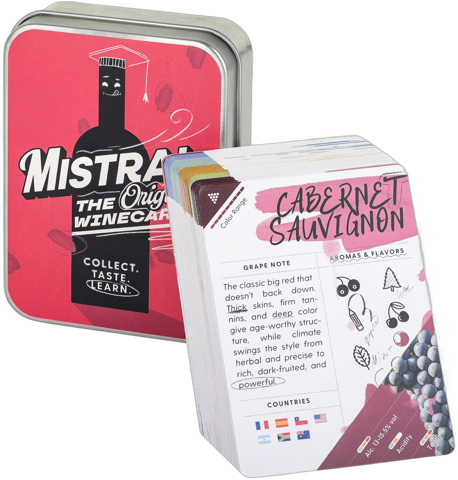
Every concept in this article fits on a card.
Mistral WineCards. Deck ONE: Global. 55 wine education cards covering grapes, regions, terroir, and winemaking. $35.
Get the DeckIn the estate's tasting notes, the 2022 Quinta do Vesúvio Vintage Port shows lavender and rockrose, fresh ripe red fruit led by cherry and fine-grained tannins; the 2022 Capela do Vesúvio shows schist dust, lavender and rockrose, grainy tannins carrying peppery spice, black fruit and hints of dark chocolate; and the 2021 Quinta do Vesúvio Douro red shows roses, thyme and pine resin, black fruit and dark chocolate, with fine-grained tannins.
- Comboio do Vesúvio Douro DOCUnoaked red named for the estate's station on the Douro railway line; the 2022 blends Touriga Nacional, Touriga Franca, Tinta Roriz and Tinta Barroca.
- Pombal do Vesúvio Douro DOCA principal component comes from the terraces around the estate's ancient dovecote ('pombal'); the 2022 is 65% Touriga Nacional, 32.5% Touriga Franca and 2.5% Tinta Amarela, with 9 months in French oak.
- Quinta do Vesúvio Douro DOCFirst produced in 2007 and launched in 2009; the 2021 spent 15 months in French oak barrels, 80% new.
- Quinta do Vesúvio Vintage PortMade in most years from the best-performing vineyards across the estate and trodden by foot in the 1827 granite lagares.
- Capela do Vesúvio Vintage PortMade in 2007, 2011, 2016, 2017 and 2022 from three plots, including the 100-year-old mixed vines of the Vinha da Capela.
New to Wine.com? $25 off $350+ with codeJOVIAL25
Wine with Seth may earn a commission on Wine.com purchases at no cost to you. Wine links are for adults 21 and over.
- Douro Superior estate: 326 ha in total, 120 km east of Porto and 45 km from the Spanish border; the Symington family's largest property, owned since 1989.
- Bought by António Bernardo Ferreira in 1823 (then Quinta das Figueiras); winery built in 1827 with eight granite lagares of 24 pipes each; Dona Antónia Ferreira (d. 1896) bottled the 1868 Vintage Port as an estate wine.
- Vintage Ports: Quinta do Vesúvio (most years) and Capela do Vesúvio (2007, 2011, 2016, 2017, 2022) from the Vinha da Capela, Escola and Vale da Teja plots; trodden by foot in granite lagares.
- Douro DOC reds since 2007 (released 2009): Quinta do Vesúvio, Pombal do Vesúvio and the unoaked Comboio do Vesúvio, produced at Symington's Adega do Ataíde.
- Schist soils with granite outcrops; main varieties Touriga Franca, Touriga Nacional, Tinta Roriz, Tinta Barroca, Sousão and Tinta Amarela.
Tasted a Quinta do Vesúvio wine?
Log it in your Tasting Journal and build your palate over time.
Start your Journal