Maritime / Oceanic Climate (Bordeaux, Champagne, Oregon)
Ocean-tempered warmth, damp air and year-to-year weather swings: how maritime influence shapes Bordeaux, Champagne, the Loire and North America's Pacific coast.
Bordeaux is classed as a moderate maritime climate because of its close proximity to the Atlantic Ocean, and maritime temperate (Bordeaux) ranks among the important mid-latitude climate types of the world's wine regions. The more exposed a vineyard is to the ocean, the cooler and windier it tends to be, and morning mists and fogs can cool it further. The trade-off is moisture: Bordeaux is substantially more humid than the Napa Valley, with much greater rainfall during the growing season, and rain during maturation can increase fungus occurrence. Sauternes relies on noble rot, which forms only when misty autumn mornings from nearby rivers are followed by warm, sunny afternoons.
Take Maritime / Oceanic Climate (Bordeaux, Champagne, Oregon) into the app. Flashcards, trivia and label lookup.
Open the appWhat It Is: Defining the Maritime Climate
At Nantes and in Anjou, the oceanic influence brings mild winters, temperate summers and low thermal amplitude, conditions the Loire's wine trade body calls ideal for fresh, balanced wines. Maritime temperate (Bordeaux) and maritime subarctic (British Columbia) rank among the important mid-latitude climate types of wine regions, and mid-latitude climate types make up the majority (55%) of the world's defined wine growing regions. The Köppen system is the most common climate classification, but general classifications like Köppen lack specific detail in weather and climate parameters, so their use in judging viticultural suitability is limited. Labels such as Mediterranean, maritime, or continental are common but often misunderstood, and latitude is only partially useful: you also need to know whether a region is on the east or west coast and how far inland it is. In Europe, climate types can change over very short distances. In northwest Portugal and Spain (Vinho Verde and Galicia) the climate is more Atlantic maritime temperate, while a short distance south and inland (Douro, Rueda and Toro) it is more Mediterranean.
- At Nantes and in Anjou, the oceanic influence brings mild winters, temperate summers and low thermal amplitude.
- Maritime temperate (Bordeaux) and maritime subarctic (British Columbia) are among the important mid-latitude climate types of wine regions.
- General classifications like Köppen lack specific detail in weather and climate parameters, which limits their use in judging viticultural suitability.
- Vinho Verde and Galicia are more Atlantic maritime temperate; a short distance south and inland, Douro, Rueda and Toro are more Mediterranean.
- Bordeaux sits around 45° latitude, at the cooler end of latitudes suitable for grape growing, with a moderate maritime climate due to its close proximity to the Atlantic Ocean.
- Bordeaux averages 950 mm of rainfall a year, so its soils need good drainage.
- Bordeaux has relatively low daytime and high nighttime temperatures due to higher humidity, while the Napa Valley has much higher daytime and much lower nighttime temperatures due to lower humidity.
- Champagne has a dual climate subject to both continental and oceanic influences, with an average annual temperature of 11°C; Reims lies at a latitude of 49°5 north.
- Burgundy sits at the confluence of continental, Mediterranean and oceanic influences, with around 1,300 hours of sunshine between April and September.
- The Van Duzer Corridor AVA, effective January 14, 2019, covers approximately 59,871 acres inside the Willamette Valley AVA, where low elevations let cool breezes flow from the Pacific Ocean through the Coastal Ranges.
- Noble rot in Sauternes needs misty autumn mornings from nearby rivers followed by warm, sunny afternoons; without the afternoon warmth, destructive grey mold forms instead.
How It Works: Ocean, Wind, and Humidity
At vineyard scale, the mechanism works like this. Proximity to a cold ocean can provide some relief in a warm region, and the more exposed a vineyard is to the ocean, the cooler and windier it tends to be. The air is often damp, so mists and fogs may build up in the morning, which can further cool the vineyard and provide protection from the strong sunshine. The land-sea breeze, affecting coastal regions or those near large bodies of water, is among the most common local winds in viticultural areas. Humidity follows the same geography. Relative humidity is normally highest early in the morning and at a minimum during the maximum heating of the day, and the contrast between morning and afternoon values is smallest along coastal regions and greatest inland. Humidity also shapes the day-night rhythm. Bordeaux has relatively low daytime and high nighttime temperatures due to higher humidity, while the Napa Valley has much higher daytime and much lower nighttime temperatures due to lower humidity, a difference that mostly has to do with the ocean temperatures offshore and the orientation of the coastlines. Local shelter matters too. Bordeaux's Left Bank vineyards are protected from the Atlantic Ocean's weather systems by a large pine forest, the Landes, while in the northern Médoc the forest is less of a feature and the landscape is more open to maritime influence, so its climate is cooler. Médoc vines are sheltered from the wind thanks to the nearby forest and benefit from a mild climate shaped by the waters of the Gironde Estuary and the Atlantic Ocean.
- The more exposed a vineyard is to the ocean, the cooler and windier it tends to be.
- Morning mists and fogs can further cool a vineyard and protect it from strong sunshine.
- The morning-to-afternoon contrast in relative humidity is smallest along coastal regions and greatest inland.
- The Landes pine forest protects Bordeaux's Left Bank from Atlantic weather systems; the more open northern Médoc is cooler.
Effect on Wine: Ripeness, Acidity, and Style
Pinot Noir requires cool climates, which tend to be clustered near large bodies of water in North America. West Coast producers benefit from a strong Pacific Ocean influence, leading to cool nights and fog in key regions, which moderates temperatures; one wine education body links this with preserving the acidity and delicacy of the wines. The majority of cooler climate cultivars achieve greater typicity in ripening periods with higher diurnal temperature ranges, whereby daytime temperatures are high enough to facilitate ripening while nighttime temperatures slow respiration and metabolism. Many warmer climate cultivars, by contrast, typically require warmer nighttime temperatures. Cabernet Sauvignon contains a high concentration of methoxypyrazines, responsible for green, herbaceous or vegetative aromas from under-ripe fruit, and regions with lower diurnal temperatures or higher nighttime temperatures tend to allow for greater metabolism of these compounds. Cabernet Sauvignon is associated with growing seasons of roughly 61-68°F (16-20°C), as in Bordeaux or Napa, and Pinot Noir with roughly 57-61°F (14.0-16.0°C), as in Burgundy or the Willamette Valley. Ripening at the cool margin has become easier in places. In Bordeaux, the challenge was historically to ripen grapes, but with today's warmer climate this is now rarely an issue. In Champagne, the vines are planted to soak up as much sunlight as possible, so the grapes retain their natural acidity even when fully ripe.
- A strong Pacific Ocean influence brings cool nights and fog to key West Coast Pinot Noir regions, which is linked with preserving the acidity and delicacy of the wines.
- Most cooler climate cultivars achieve greater typicity in ripening periods with higher diurnal temperature ranges.
- Lower diurnal ranges or warmer nights tend to allow greater metabolism of Cabernet Sauvignon's green-smelling methoxypyrazines.
- Champagne's grapes retain their natural acidity even when fully ripe.
The Classic Regions: Bordeaux, Burgundy, Champagne, Oregon, and Beyond
Bordeaux lies in the southwest of France around 45° latitude, with a moderate maritime climate and an average of 950 mm of rainfall a year; there the Garonne and the Dordogne merge to form the Gironde estuary. Burgundy sits at the confluence of continental, Mediterranean and oceanic influences, with around 1,300 hours of sunshine between April and September, summer temperatures around 20°C in July and August (average from 1981/2010) and an average of 700mm of precipitation annually, mainly in May and June. Its hillside plantings protect the vines from westerly winds which can bring humidity, while Chablis and Le Grand Auxerrois have a more semi-continental climate that is wetter and are often susceptible to springtime frosts. Champagne has a dual climate: thanks to the oceanic influence the vineyards have fairly mild temperatures, neither too cold in winter nor too hot in summer, with an average annual temperature of 11°C, while continental influences can bring freezing winter temperatures without warning, with temperatures below -10°C recorded in places. There is a steady and moderate amount of rainfall through the year. Reims lies at a latitude of 49°5 north and Épernay at 49°, close to the 50th parallel, where it is generally considered difficult to obtain quality grapes. In Oregon, the Willamette Valley is cooler and wetter than most Californian AVAs, and one wine education body likens its wines in style to Burgundy. Much of western Oregon is a cool climate region, under 2,500 growing degree days annually. The federal Alcohol and Tobacco Tax and Trade Bureau (TTB) established the Van Duzer Corridor AVA, effective January 14, 2019, covering approximately 59,871 acres within the Willamette Valley AVA. Its low elevations allow cool breezes to flow relatively unimpeded from the Pacific Ocean through the Coastal Ranges, and the petition behind the AVA links its consistent high winds with thicker grape skins and higher levels of phenolic compounds in the fruit. Farther south, Russian River Valley and Sonoma Coast are the key Pinot Noir areas of Sonoma County, and Santa Barbara County is a cool, ocean-influenced region. New Zealand's climate is temperate maritime, and Marlborough has a cool yet high sunshine climate with low rainfall.
- Bordeaux: around 45° latitude, moderate maritime climate, an average of 950 mm of rainfall a year.
- Burgundy: at the confluence of continental, Mediterranean and oceanic influences, with around 1,300 hours of sunshine between April and September.
- Champagne: dual oceanic and continental climate, average annual temperature 11°C, Reims at 49°5 north.
- Willamette Valley: cooler and wetter than most Californian AVAs; in the Van Duzer Corridor, cool Pacific breezes flow through the Coastal Ranges.
Humidity, Rain, and Disease: The Maritime Grower's Risk
Atmospheric moisture is very important in regulating the evaporative demands put on the grapevines and the occurrence of fungal diseases. Because lower temperatures give higher relative humidity and cold air pools in valleys, humidity levels and the associated fungal problems can be enhanced in these zones. Timing matters. During bloom, rain can reduce or retard flowering; during berry growth it can enhance the likelihood of fungal diseases; and during maturation it can increase fungus occurrence and growth, dilute the berries and severely limit the yield and quality. Growers answer in the vineyard. Top-quality Bordeaux producers tend to plant at a high vine density of 10,000 vines per hectare, where soils are relatively infertile and rainfall is generally sufficient; competition between vines reduces vigour and gives a balanced canopy open enough to reduce the threat of fungal disease. Many of the best Left Bank estates sit on gravel mounds known as croupes, which give better drainage after showers and storms. Noble rot, Botrytis cinerea, forms only when misty autumn mornings from nearby rivers are followed by warm, sunny afternoons, which lets the fungus perforate grape skins and concentrate the sugars; unless the sun follows, the feared grey mold appears instead. In Sauternes, the cooler water of the Ciron tributary flows into the larger, warmer Garonne, creating the morning mists, and thin-skinned Semillon grapes are prime targets. Sauternes and the surrounding areas of Barsac, Cérons, Cadillac, Loupiac and Sainte-Croix-du-Mont are regarded as having perfect conditions for noble rot.
- During maturation, rain can increase fungus occurrence, dilute the berries and severely limit yield and quality.
- Top Bordeaux producers tend to plant 10,000 vines per hectare, giving a balanced canopy open enough to reduce the threat of fungal disease.
- Noble rot needs misty autumn mornings from nearby rivers followed by warm, sunny afternoons; otherwise grey mold appears.
- In Sauternes, the cooler Ciron flows into the warmer Garonne, creating the morning mists.
The map that explains this region.
The World Atlas of Wine, now in its 9th edition, is the book I open before any trip and after any bottle I could not place. Every region on this page has a map in it.$70.
See the AtlasVintage Sensitivity: The Maritime Climate's Double Edge
Some parts of Chile have warm and dry summers almost every year, while the Bordeaux region experiences much greater vintage variation, with some years noticeably cooler and wetter than others. The best Bordeaux wines tend to come from years with gentle heat throughout the growing season, sufficient rainfall, and fine, relatively dry and warm autumns that allow for steady and complete ripening, and wines from these vintages can age for an incredibly long time. Champagne manages the swings by blending. Because the region has a cool climate and variable weather, growers cannot always rely on grapes to ripen fully each year, so many Champagnes are blended from a few different years; a vintage on the label comes from one exceptionally good year. Climate change has increased the intensity and frequency of extreme weather in Champagne, and the harvest, which used to start in September, now starts increasingly earlier. In North America, the East Coast has more humidity and rainfall than the West Coast, leading to greater vintage variation, while California Pinot Noir tends to be slightly more predictable. An almost ideal climate for wine is seldom experienced, because untimely rain, cold periods and heat stress make each vintage unique.
- Bordeaux experiences much greater vintage variation than parts of Chile, with some years noticeably cooler and wetter than others.
- Bordeaux's best vintages bring gentle heat, sufficient rainfall and fine, relatively dry and warm autumns.
- Many Champagnes are blended from a few different years because growers cannot always rely on grapes to ripen fully.
- North America's more humid, rainier East Coast sees greater Pinot Noir vintage variation than the West Coast.
Sources and last verified
Primary sources: https://www.wsetglobal.com/knowledge-centre/blog/2021/august/24/how-does-geography-affect-a-wine-s-style, https://www.wsetglobal.com/knowledge-centre/blog/2022/july/14/what-makes-high-quality-bordeaux-wine, https://www.wsetglobal.com/knowledge-centre/blog/2021/march/22/weather-wine-and-vintages, https://www.champagne.fr/en/about-champagne/the-champagne-terroir/champagne-and-its-climate, https://www.bourgogne-wines.com/wine-and-terroir/our-natural-assets/climatology/an-ideal-climate-for-producing-great-wines,2483,9268.html, https://extension.oregonstate.edu/catalog/em-8973-establishing-vineyard-oregon-quick-start-resource-guide, https://www.ecfr.gov/api/renderer/v1/content/enhanced/current/title-27?part=9§ion=9.265, https://www.govinfo.gov/content/pkg/FR-2018-12-14/html/2018-27017.htm, https://www.bordeaux.com/en/mag/blog/what-is-noble-rot/, https://www.bordeaux.com/en/designations/medoc/medoc/, https://www.vinsdeloire.fr/en/vines-and-faces/soils-and-climate, https://www.nzwine.com/en/regions/marlborough/, https://www.wsetglobal.com/knowledge-centre/blog/2025/august/coast-to-coast-pinot-noir-in-north-america/, https://www.bordeaux.com/us/Bordeaux-Magazine-US/Journal/Education/The-Secrets-of-Sauternes. Secondary sources: https://www.guildsomm.com/public_content/features/articles/b/gregory_jones/posts/climate-grapes-and-wine. Last verified 2026-10-04

Every concept in this article fits on a card.
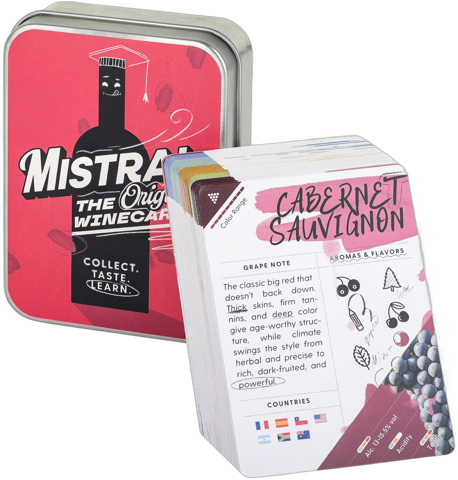
Mistral WineCards. Deck ONE: Global. 55 wine education cards covering grapes, regions, terroir, and winemaking. $35.
Get the DeckMaritime-climate wines share a recognizable sensory signature built on freshness and precision rather than weight. Pinot Noir from cool maritime zones shows bright red fruit, cranberry, raspberry, and cherry, with secondary notes of forest floor, dried herbs, and earthy mushroom as the wine develops. Chardonnay reveals green apple, citrus, hazelnut, and a linear, mineral-edged finish rather than tropical richness. Cabernet Sauvignon from Bordeaux's Atlantic-tempered left bank expresses blackcurrant, pencil shavings, and tobacco, with firm, age-worthy tannins. Across varieties, the defining quality is the interplay of fruit and structure: high natural acidity frames the palate, tannins are refined rather than extracted, and the finish is long and precise. These are wines that reward patience, evolving over years or decades as secondary complexity unfolds.
- Bordeaux = moderate maritime climate: around 45° latitude, an average of 950 mm of rainfall a year; the Landes pine forest shields the Left Bank from Atlantic weather systems, and the more open northern Médoc is cooler.
- Champagne = dual oceanic and continental climate: average annual temperature 11°C; Reims at 49°5 north and Épernay at 49°, close to the 50th parallel.
- Burgundy = confluence of continental, Mediterranean and oceanic influences: around 1,300 hours of sunshine between April and September and an average of 700mm of precipitation annually.
- Van Duzer Corridor AVA (effective January 14, 2019; approximately 59,871 acres within the Willamette Valley AVA): low elevations let cool Pacific breezes through the Coastal Ranges; high winds and low growing degree day accumulations.
- Noble rot: misty autumn mornings from nearby rivers followed by warm, sunny afternoons; without them, grey mold. In Sauternes the cooler Ciron meets the warmer Garonne, and thin-skinned Semillon is a prime target.
Put this into practice
Blind tastings, flashcards, and trivia in the Wine with Seth app.
Try the app free