Bernkasteler Doctor
How to Pronounce It
A 3.25-hectare Mosel site above Bernkastel whose wine King Edward VII drank as medicine.
Bernkasteler Doctor is a VDP.Grosse Lage above the old town of Bernkastel in the Mosel. It covers 3.25 hectares, 3.22 hectares of them classified, for Riesling, and is still largely planted with ungrafted vines. The VDP calls it one of the most famous and once most expensive vineyards in the world. Julius Wegeler bought a parcel in 1900 at 100 gold marks per vine, and Wegeler calls the Doctor still Germany's most expensive vineyard site. The Thanisch family's 1921 Doctor Trockenbeerenauslese was the first TBA produced in the Mosel, together with what Decanter calls a less prestigious example from the Bischöflichen Weingüter.
History and Legend
Legend gives the name its origin: in 1360 the Archbishop of Trier, Boemund II, was gravely ill and no medicine helped, until he was supposedly cured by drinking two bottles of Bernkastel wine, which then received the name Doctor. Wwe. Dr. H. Thanisch (Erben Thanisch) places the cure during a stay at Landshut Castle and has the archbishop calling the wine the "Real Doctor", while Decanter's Stephen Brook observes that the site and its reputation have certainly benefited from having a legend attached. It is documented that King Edward VII of Great Britain (1841-1910) drank the wine as medicine. In 1904 the wine fetched 10 gold marks a bottle in Berlin, roughly one twelfth of a chemical worker's monthly wage, and Kaiser Wilhelm II (1859-1941), US President Dwight D. Eisenhower (1890-1969) and Chancellor Konrad Adenauer (1876-1967) were among its admirers. In 1882 Dr. Hugo Thanisch bought a parcel of 6,000 square metres for 17 gold marks per vine, and Erben Thanisch cites wine auction results in Trier as proof of the increasing demand: between 1893 and 1908 a total of 159 barrels were auctioned at an average of 4,275 gold marks. Erben Müller-Burggraef dates the Thanisch family's acquisition of the Doctor to the early 19th century. Hugo Thanisch's widow Katharine ran the estate after his death, which is why it is still known as Witwe (Wwe) Dr Thanisch. In 1900 Julius Wegeler bought 4,300 square metres in the heart of the Doctor from the then mayor, Kunz, at 100 gold marks per vine, a price that also covered the historic Doctor cellar of 1650 and the wine stored in it; a further purchase in 1910 made the Wegeler estates the largest owner in the site. A bottle of the 1921 Doctor Trockenbeerenauslese sold at auction in 1986 for 11,100 Deutschmarks in Decanter's account, or 11,200 marks in Erben Müller-Burggraef's.
- Name legend: Archbishop Boemund II of Trier, 1360
- 1882: Dr. Hugo Thanisch bought 6,000 square metres at 17 gold marks per vine
- 1900: Julius Wegeler bought 4,300 square metres at 100 gold marks per vine, with a further purchase in 1910
- In 1986 the Thanisch estate was divided in two, expanding ownership of the Doctor from two to three estates. Erben Müller-Burggraef records a division of the estate under Napoleonic inheritance law between the widow's two daughters.
- Area: 3.25 hectares, of which 3.22 hectares are classified; Wegeler also gives 3.22 hectares and Wwe. Dr. H. Thanisch (Erben Thanisch) gives 3.21 hectares
- VDP.Grosse Lage; the VDP estates working in the site are Schloss Lieser (Thomas Haag), Wwe. Dr. H. Thanisch Erben Thanisch and Geheimrat J. Wegeler
- Slopes of up to 70 percent face the Mosel, turning from southwest to south, at 130 to 190 metres above sea level
- Soils: dark, stony weathered Devonian slate with a high fine-earth content; blue and grey slate
- Legend has it that Archbishop Boemund II of Trier, gravely ill in 1360, was supposedly cured by two bottles of Bernkastel wine, which then took the name Doctor
- Julius Wegeler bought 4,300 square metres in 1900 at 100 gold marks per vine, a price that also covered the historic Doctor cellar of 1650 and the wine stored in it
- The Thanisch family's 1921 Doctor TBA was the first Trockenbeerenauslese produced in the Mosel, together with what Decanter calls a less prestigious example from the Bischöflichen Weingüter
Location and Terroir
The Doctor lies above Bernkastel's old town, facing the Mosel with slopes of up to 70 percent; the site turns from southwest to south and, through its orientation and steepness, receives long, intense sunshine. It lies exposed to the wind at 130 to 190 metres above sea level; Erben Müller-Burggraef gives 125 to 200 metres and a south-southwest aspect, and Erben Thanisch gives a steepness of between 60 and 70 percent. Dark soils of stony weathered Devonian slate with a high fine-earth content act as a heat store and, through their water-holding capacity, secure the water supply; the soil type is recorded as blue and grey slate. Erben Müller-Burggraef characterises the soil as a stony, loamy weathered Devonian clay-slate and adds that the many slate roofs of Bernkastel below the vineyard radiate warmth up into the slope. In Erben Thanisch's account, the snow in the Doctor regularly melts first compared with the neighbouring sites. Decanter's Stephen Brook writes that it is hard to demonstrate that the Doctor's black slate soils and microclimate are significantly superior to those of immediate neighbours such as Graben and Alte Badstube.
- Aspect: turning from southwest to south, recorded as south-southwest in the site data; slopes of up to 70 percent
- Altitude: 130 to 190 metres; 125 to 200 metres in Erben Müller-Burggraef's figures
- Soils: weathered Devonian slate with a high fine-earth content; blue and grey slate
- Erben Müller-Burggraef counts the Doctor among the six sites of the Bernkasteler Badstube, with Alte Badstube am Doctorberg, Bratenhöfchen, Graben, Lay and Matheisbildchen
The glasses, tools, and cards I stand behind.
A short list. Nothing I would not recommend to a friend.
Browse the WineShopViticulture and Production
Riesling is the site's classified variety, and the Doctor is still largely planted with ungrafted vines; Erben Thanisch gives the average age of the predominantly ungrafted vines as more than 60 years, and some vines were planted more than a century ago. The Doctor is a 100 percent steep site. The Doctor was owned by two families; in 1986 the Thanisch estate was divided in two, expanding its ownership from two to three estates. The VDP estates working in the site are Schloss Lieser (Thomas Haag), Wwe. Dr. H. Thanisch Erben Thanisch and Geheimrat J. Wegeler, and Weingut Markus Molitor holds a parcel of 0.13 hectares. Erben Müller-Burggraef still makes most of its wines in the Doctor cellar, cut into the rock below the vineyard; it gives the cellar's age as over 350 years and its temperatures as between 8 and 9 degrees Celsius, while Wegeler dates the historic Doctor cellar to 1650. The Thanisch family's 1921 Doctor TBA, probably overseen by Hugo Thanisch's widow Katharine, was the first Trockenbeerenauslese produced in the Mosel, together with what Decanter calls a less prestigious example from the Bischöflichen Weingüter.
- Classified variety: Riesling, largely on ungrafted vines
- Estates working the site include Erben Thanisch, Erben Müller-Burggraef, Wegeler, Schloss Lieser and Markus Molitor (0.13 hectares)
- Doctor cellar: over 350 years old in Erben Müller-Burggraef's account; dated to 1650 by Wegeler
- 1921: first Mosel Trockenbeerenauslese, made by the Thanisch family
The map that explains this region.
The World Atlas of Wine, now in its 9th edition, is the book I open before any trip and after any bottle I could not place. Every region on this page has a map in it.$70.
See the AtlasWine Style
For Erben Thanisch, the Doctor's grey slate soil delivers Riesling wines that are "delicate, full bodied, spicy and minerally in character". Weingut Markus Molitor characterises the Doctor's wines as crystal-clear and radiant, with lively fruit that at times shows exotic nuances, a silky acid structure and very fine slate minerality. Doctor wines appear across dry and Prädikat styles in the estates' own lists: Erben Thanisch's current price list includes a Doctor Riesling GG trocken, Kabinett, Spätlese, Auslese and Auslese Selection, and Wegeler's online shop lists Doctor Riesling Kabinett, Spätlese, Auslese and GG. Erben Thanisch makes two GGs, the dry wines of a VDP.Grosse Lage, one of them from the Doctor, and ranks them as the flagships among its dry wines; in the estate's words its Kabinett wines have "a fascinating balance between sweetness and acidity".
- Delicate, full bodied, spicy and minerally, in Erben Thanisch's words
- Silky acid structure and very fine slate minerality, in Markus Molitor's characterisation
- Styles in the Erben Thanisch and Wegeler lists: GG trocken, Kabinett, Spätlese and Auslese
- 1921 TBA: 200 to 300 bottles produced; alcohol level not recorded, probably about 6%
Sources and last verified
Primary sources (VDP site profile and the growers' own sites): https://www.vdp.de/de/die-weine/weinbergonline/lage/4032-doctor, https://www.thanisch-vdp.de/en/berncasteler-doctor/, https://www.dr-thanisch.de/de/, https://www.wegeler.com/weingueter/gutshaus-mosel, https://markusmolitor.com/lagen, https://www.weingut-schloss-lieser.de/lagen/, https://www.thanisch-vdp.de/en/our-wines/, https://www.thanisch-vdp.de/wp-content/uploads/2026/09/Weinliste-4_26.pdf, https://shop.wegeler.com/search?search=doctor. Secondary source: https://www.decanter.com/learn/wine-legend-bernkasteler-doctor-riesling-trockenbeerenauslese-1921-369851/. Last verified 2026-10-05

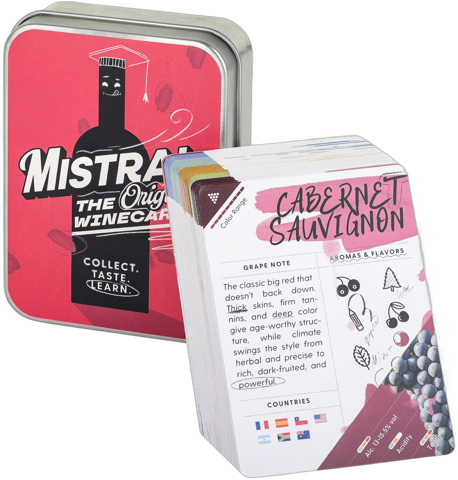
Every concept in this article fits on a card.
Mistral WineCards. Deck ONE: Global. 55 wine education cards covering grapes, regions, terroir, and winemaking. $35.
Get the DeckRiesling that Erben Thanisch calls delicate, full bodied, spicy and minerally, from the Doctor's grey slate. Markus Molitor credits the site's wines with lively fruit, at times showing exotic nuances, and a silky acid structure. Dry GG and Prädikat styles from Kabinett to Auslese appear in the estates' own lists.
- Wegeler Bernkastel Doctor Riesling SpätleseEUR 59 (2024 and 2025 vintages, Wegeler online shop, 2026)Julius Wegeler bought his Doctor parcel in 1900, and Wegeler's shop lists this Spätlese in the 2024 and 2025 vintages.
- Wwe. Dr. H. Thanisch Erben Thanisch Berncasteler Doctor Riesling KabinettEUR 42 (2024/25 vintages, estate price list, 2026)Dr. Hugo Thanisch bought his Doctor parcel in 1882, and Erben Thanisch describes its Kabinett wines as balancing sweetness and acidity.
Wine with Seth may earn a commission on Wine.com purchases at no cost to you. Wine links are for adults 21 and over.
- VDP.Grosse Lage above Bernkastel's old town: 3.25 ha (3.22 ha classified), Riesling, slopes up to 70 percent, 130 to 190 m
- Soils: weathered Devonian slate with a high fine-earth content; blue and grey slate
- Name legend: Archbishop Boemund II of Trier, 1360; Edward VII drinking it as medicine is documented
- 1900: Julius Wegeler bought 4,300 square metres at 100 gold marks per vine
- 1921: first Mosel Trockenbeerenauslese, made by the Thanisch family
Drinking your way through Bernkasteler Doctor?
Track every bottle in your Tasting Journal in the Wine with Seth app.
Start your Journal