AOC / AOP — Appellation d'Origine Contrôlée / Protégée
ah-peh-lah-SYOHN doh-ree-ZHEEN kohn-troh-LAY / proh-teh-ZHAY
France's appellation system: a protected name tied to one delimited area, with a cahier des charges that sets how the wine is grown and made.
AOC (appellation d'origine contrôlée) is the French national designation of origin, and AOP (appellation d'origine protégée) is its European equivalent. An AOP names a product whose every production step follows recognised know-how in one geographical area, and its rules are written in a cahier des charges defined by the professionals. The decree-law of 30 July 1935 created the AOC, and the first AOCs were recognised on 15 May 1936. AOC recognition is a mandatory national step before a name is registered as an AOP and protected across the EU, and only wine products keep the right to carry the AOC mention if they wish.
Start WineSchool Level 1. Free, in the app, under a minute a lesson.
Open WineSchoolDefinition and Origin
AOC (appellation d'origine contrôlée) and AOP (appellation d'origine protégée) describe the same protection at two levels: AOP is the European sign, and AOC is its French national equivalent. An AOP is a product whose every production step follows recognised know-how in one geographical area, which gives the product its characteristics. The law of 1 August 1905 created administrative appellations, and the law of 6 May 1919 created simple and judicial appellations. Faced with a persistent crisis, the decree-law of 30 July 1935 created the appellations d'origine contrôlées and the Comité national des appellations d'origine des vins et eaux de vie. That decree-law protects not only the name of the product, but also its distinctive features and its link with a specific terroir. On 14 May 1936, a report by the Minister of Agriculture on Châteauneuf-du-Pape paved the way for the first appellations, and on 15 May 1936 the first AOCs were recognised: Arbois, Cassis, Cognac, Châteauneuf-du-Pape, Monbazillac and Tavel.
- Joseph Capus (1867-1947) was the first president of the national committee, from 1935 to 1947
- On 16 July 1947 the committee became the Institut national des appellations d'origine des vins et eaux-de-vie, the INAO, chaired for 20 years by Baron Pierre Le Roy de Boiseaumarié (1890-1967)
- INAO became a public body in 1967; the law of 2 July 1990 extended its remit to agri-food products, and in 2006 it became the Institut national de l'origine et de la qualité, keeping the acronym INAO
- Clos de Vougeot: its AOC was first recognised by the decree of 31 July 1937
- The decree-law of 30 July 1935 created the appellations d'origine contrôlées and the national committee that became INAO in 1947; the first AOCs were recognised on 15 May 1936: Arbois, Cassis, Cognac, Châteauneuf-du-Pape, Monbazillac and Tavel
- AOP is the European sign and AOC its French national equivalent; AOC recognition is a mandatory national step before a name is registered as an AOP, and since 2012 products registered at European level carry the AOP mention, with French wines able to keep the historic AOC mention
- Each AOP has a cahier des charges defined by the professionals and homologated by the European Union, and its rules are checked by an independent body approved by INAO
- In 2023, France counted 366 wine AOP/AOC and 77 wine IGP
- Burgundy has 84 AOCs: 7 regional, 44 village and 33 Grand Cru; Premier Cru is an additional geographical denomination within certain village appellations
- The Alsace grand cru cahier des charges, amended by arrêté of 4 July 2025, sets a yield of 50 hl/ha for white wines and 40 hl/ha for red wines, with a maximum production yield of 77 hl/ha
- Under Regulation (EU) No 1308/2013, a PDO wine is produced from grapes which originate exclusively from its geographical area and is made in that area, while a PGI wine needs at least 85% of its grapes from its area
The Regulatory Framework
The rules for each AOP are written in a cahier des charges (specification) defined by the professionals and homologated by the European Union. Sancerre's cahier was homologated by decree no. 2011-1021 of 25 August 2011, and the Alsace grand cru cahier was amended by arrêté of 4 July 2025. AOC and AOP are regulated by the Code rural et de la pêche maritime (articles L.641-5 to L.641-10), and wine AOPs also depend on European law: Regulation (EU) No 1308/2013, Delegated Regulation (EU) 2019/33, Implementing Regulation (EU) 2019/34 and Regulation (EU) 2024/1143. Within INAO, a national committee of professionals for wine appellations proposes the recognition of a product, examines the content of the cahiers des charges, and defines the points to check and their methods of evaluation. The rules are checked by an independent body approved by INAO. Since the reform begun in 2006, INAO no longer carries out controls directly, but supervises independent, impartial third-party bodies.
- AOP: every production step follows recognised know-how in one geographical area
- AOC recognition is a mandatory national step before a name is registered as an AOP and protected at European level
- European registration of an AOP protects the product's name within the EU
- Only wine products keep the right to carry the AOC mention, if they wish
- In the Sancerre cahier, checks include an analytical and organoleptic examination, for both bulk and packaged wines
The glasses, tools, and cards I stand behind.
A short list. Nothing I would not recommend to a friend.
Browse the WineShopCore Regulatory Variables
Sancerre's cahier (the text homologated by decree 2011-1021) makes white wines from the single variety (cépage) Sauvignon and red and rosé wines from Pinot Noir alone, requires a minimum planting density of 6,100 vines per hectare, and sets a minimum natural alcoholic strength of 10.5% for white, red and rosé wines. It also fixes the maximum spacing between rows, the pruning rules and a threshold for the percentage of dead or missing vines. The Champagne cahier homologated by decree no. 2010-1441 reserves the appellation for white or rosé sparkling wines and lists seven varieties: Arbane, Chardonnay, Meunier, Petit Meslier, Pinot Blanc, Pinot Gris and Pinot Noir. The current Alsace grand cru cahier sets 50 hl/ha for white wines and 40 hl/ha for red wines, a rendement butoir of 60 and 48 hl/ha, and a maximum production yield of 77 hl/ha.
- Sancerre (France, cahier homologated by decree 2011-1021): white from Sauvignon alone; red and rosé from Pinot Noir alone; at least 6,100 vines per hectare at planting; minimum natural alcoholic strength 10.5%
- Alsace grand cru (France, cahier amended 4 July 2025): 50 hl/ha white and 40 hl/ha red; rendement butoir 60 and 48 hl/ha; with the mention sélection de grains nobles, 40 hl/ha and a rendement butoir of 48 hl/ha
- Alsace grand cru white wines come from a single variety among Gewürztraminer, Muscat (Muscat à petits grains blancs or roses, Muscat Ottonel), Pinot Gris and Riesling, or from a blend of the Muscats; red wines come from Pinot Noir; Zotzenberg has its own list (Gewürztraminer, Pinot Gris, Riesling and Sylvaner), and Altenberg de Bergheim and Kaefferkopf also allow blends
- Since the law of 5 July 1972, Alsace grand cru wines must be bottled within the Bas-Rhin and Haut-Rhin departments
Famous Examples and Classification Hierarchy
AOP/AOC wines follow a cahier des charges in one delimited area. IGP (indication géographique protégée) identifies a product whose quality, reputation or other characteristics are linked to its geographical origin; for wine, every operation from the grape harvest to the end of winemaking takes place in the area. Wines with neither an AOP nor an IGP belong to the VSIG category (vins sans indication géographique), which corresponds to the former vin de table category. Burgundy has exactly 84 appellations: 7 regional, 44 village and 33 Grand Cru, and Premier Cru wines carry an additional geographical denomination noted in the specification of certain village appellations. Alsace's 51 grand cru appellations are listed in one cahier des charges. According to Vins d'Alsace, 51 sites were progressively classified as Grands Crus from 1975 to 2007, the parcels varying from 3 to 80 hectares, the single Alsace Grand Cru AOC became 51 appellations in 2011, and the wines account for about 5% of production. Inter Rhône lists Côtes du Rhône AOC, Côtes du Rhône Villages AOC and Côtes du Rhône Cru AOCs such as Gigondas, Châteauneuf-du-Pape and Crozes-Hermitage.
- AOP/AOC: every production step in one geographical area, under a cahier des charges
- IGP: from the grape harvest to the end of winemaking in the area; under EU law, at least 85% of the grapes from the area
- VSIG: no AOP or IGP; 'Vin de France' must appear when the grapes are harvested and made into wine in France
- Burgundy: 7 regional, 44 village (including Premier Cru climats) and 33 Grand Cru AOCs
How to Read the Label
Since 2012, products registered at European level carry the AOP mention, with the option for French wines to continue using the historic AOC mention, so French wine labels may show either. In Burgundy, a Premier Cru label gives the name of the commune followed by the name of the plot where the grapes were grown, as in Chablis Premier Cru, Montée de Tonnerre. Alsace grand cru appellations are named for sites, such as Alsace grand cru Hengst; when the mentions vendanges tardives or sélection de grains nobles are used, the vintage must be stated. VSIG wines may state a grape variety and/or a vintage once the seller is approved and the volumes certified, but they may not use the same label mentions as AOP or IGP wines. When the grapes are harvested and made into wine in France, the label must show 'Vin de France'.
- AOP or AOC: on French wine, either mention may appear
- Burgundy Premier Cru: commune name plus plot name, as in Chablis Premier Cru, Montée de Tonnerre
- Alsace: 'Alsace grand cru' plus the site name; vintage mandatory with vendanges tardives or sélection de grains nobles
- 'Vin de France': grapes harvested and made into wine in France, without an AOP or IGP
One glass for everything, Champagne to Barolo.
The Gabriel-Glas StandArt is the one I name when someone asks which single stem to buy. Light, wide bowl, dishwasher safe, and it flatters this grape as much as any other.$67 a pair.
See the StandArtThe European Framework and Italy
European law defines a wine designation of origin in Article 93 of Regulation (EU) No 1308/2013. Its quality or characteristics are essentially or exclusively due to a particular geographical environment with its inherent natural and human factors; it originates in a specific place, region or, in exceptional cases, country; it is produced from grapes which originate exclusively from that geographical area; its production takes place in that area; and it is obtained from Vitis vinifera or a cross between Vitis vinifera and other species of the genus Vitis. A wine geographical indication needs at least 85% of the grapes used for its production from its area. Regulation (EU) 2024/1143 applies from 13 May 2024, except that Article 10(4) and (5), Article 39(1) and Article 45 apply from 1 January 2025. It covers geographical indications for wine, spirit drinks and agricultural products, amends Regulation (EU) No 1308/2013 and repeals Regulation (EU) No 1151/2012, and each wine geographical indication is identified in the Union register as a 'protected designation of origin' or a 'protected geographical indication'. The European Union created its quality systems in 1992 for agri-food products, the PDO being the equivalent of the national AOC. INAO's history pages date the extension of the PDO and PGI to the wine sector differently: 2008, through the Common Organisation of Agricultural Markets, on one page, and 2009 on another. Italy set out its own categories in DPR no. 930 of 12 July 1963, which distinguished 'semplice', 'controllata' and 'controllata e garantita' designations of origin; that decree was repealed by Legislative Decree no. 61 of 8 April 2010.
- PDO wine: grapes originate exclusively from the geographical area, and production takes place there (EU, Regulation (EU) No 1308/2013, Article 93)
- PGI wine: at least 85% of the grapes from the geographical area (same article)
- Regulation (EU) 2024/1143: applies from 13 May 2024 (certain articles from 1 January 2025); repeals Regulation (EU) No 1151/2012 and amends Regulation (EU) No 1308/2013
- Italy: DPR 930 of 12 July 1963 distinguished 'controllata' and 'controllata e garantita' designations of origin (repealed in 2010)
Sources and last verified
Primary sources (INAO; French Ministry of Agriculture BO-Agri cahiers des charges; EU eAmbrosia register; EUR-Lex; BIVB; FranceAgriMer; Normattiva): https://www.inao.gouv.fr/en/history-1935-1970, https://www.inao.gouv.fr/en/history-inao-key-dates, https://www.bourgogne-wines.com/wine-and-terroir/decoding-the-aocs/bourgogne-wines-decoding-the-aocs,2467,9263.html, https://www.inao.gouv.fr/aop-appellation-origine-protegee, https://www.inao.gouv.fr/en/history-1990-2000, https://www.inao.gouv.fr/en/history-2000-today, https://info.agriculture.gouv.fr/boagri/document_administratif-c5b06e73-5c8e-40fc-81cb-26d1b8a0135a/telechargement, https://info.agriculture.gouv.fr/boagri/document_administratif-9f9cedf1-9289-4ab8-aaf0-29c6aa255616/telechargement, https://webgate.ec.europa.eu/eambrosia-api/api/v1/attachments/8209, https://www.bourgogne-wines.com/press/gallery_files/site/289/78093.pdf, https://extranet.inao.gouv.fr/fichier/CDC-ClosdeVougeot-ou-ClosVougeot-250910-PNO.pdf, https://www.inao.gouv.fr/indication-geographique-protegee, https://www.inao.gouv.fr/en/economy, https://www.normattiva.it/uri-res/N2Ls?urn:nir:stato:decreto.del.presidente.della.repubblica:1963-07-12;930~art1@originale, https://www.franceagrimer.fr/les-vins-sans-indication-geographique-vsig, https://eur-lex.europa.eu/legal-content/EN/TXT/HTML/?uri=CELEX:02013R1308-20260818, https://eur-lex.europa.eu/legal-content/EN/TXT/HTML/?uri=CELEX:02024R1143-20260318. Secondary sources (Vins d'Alsace; Inter Rhône): https://www.vinsalsace.com/en/grands-crus/, https://www.vins-rhone.com/en/rhone-valley-vineyards/appellations. Last verified 2026-11-09

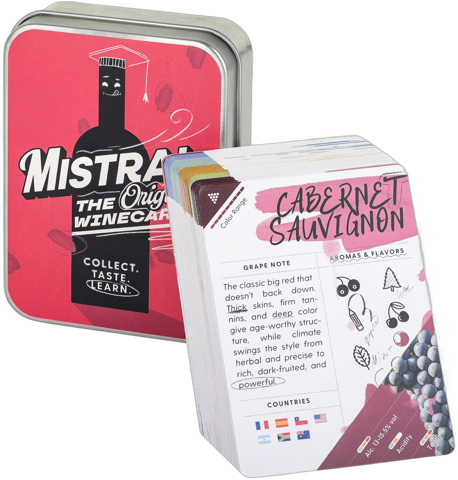
Every concept in this article fits on a card.
Mistral WineCards. Deck ONE: Global. 55 wine education cards covering grapes, regions, terroir, and winemaking. $35.
Get the Deck- The decree-law of 30 July 1935 created the AOC; the first AOCs were recognised on 15 May 1936: Arbois, Cassis, Cognac, Châteauneuf-du-Pape, Monbazillac and Tavel.
- AOP is the European sign and AOC its French national equivalent; AOC recognition is a mandatory national step before AOP registration, and since 2012 products registered at European level carry the AOP mention, with French wines able to keep the historic AOC mention.
- Each AOP has a cahier des charges defined by the professionals and homologated by the European Union; the rules are checked by an independent body approved by INAO.
- EU law (Regulation (EU) No 1308/2013, Article 93): a PDO wine is produced from grapes which originate exclusively from its area; a PGI wine needs at least 85% of its grapes from its area.
- Burgundy has 84 AOCs (7 regional, 44 village, 33 Grand Cru); Alsace has 51 grand cru appellations, with white wines from Gewürztraminer, Muscat, Pinot Gris or Riesling, red wines from Pinot Noir, and site exceptions such as Sylvaner in Zotzenberg.