5 Premiers Crus Classés (1855): Lafite Rothschild, Mouton Rothschild, Latour, Margaux, Haut-Brion
pray-MYAY kroo klah-SAY
The five First Growths of Bordeaux's 1855 Classification: Lafite Rothschild, Latour, Margaux and Haut-Brion, classified at the top in 1855, and Mouton Rothschild, which achieved First Growth status in 1973.
The 1855 Classification was made at the request of Napoleon III for the 1855 Paris Universal Exhibition and was established on April 18, 1855, with the reputation of each estate and the market prices fetched by its most recent vintages as the criteria. Four châteaux were classified as First Growths in 1855: Lafite Rothschild, Latour, Margaux and Haut-Brion. Château Mouton Rothschild, a Second Growth on the 1855 list, was reclassified as a First Growth in 1973, and the Conseil des Grands Crus Classés en 1855 lists five Premiers Crus today. Three are in Pauillac (Lafite Rothschild, Latour and Mouton Rothschild), one is in Margaux, and Haut-Brion, in Pessac, is the only classified red wine outside the Médoc.
Start WineSchool Level 1. Free, in the app, under a minute a lesson.
Open WineSchoolHistory and Heritage
The 1855 Classification was established in preparation for a presentation of the wines of the Gironde at the Paris Universal Exhibition, at the request of Napoleon III. On April 5, 1855, the Bordeaux Chamber of Commerce asked the wine brokers' syndicate to rate and rank the region's finest wines, and the classification was established on April 18, 1855. The criteria were the reputation of each estate and the market prices fetched by its most recent vintages. Four châteaux were classified as First Growths: Lafite, Latour, Margaux and Haut-Brion. Château Mouton Rothschild, a Second Growth in 1855, achieved First Growth status in 1973. Each estate's own history reaches further back. Latour's oldest document, from 1331, authorises the building of a fortified tower in the parish of Saint Maubert. Lafite was first noted as a wine producer in 1234. The earliest written mention of a wine from Haut-Brion's soils dates from 1521. Between 1572 and 1582, Pierre de Lestonnac restructured the property and vineyards of Château Margaux.
- In 1853 Baron Nathaniel de Rothschild bought Château Brane-Mouton at auction, and the estate took the name Château Mouton Rothschild
- Jane Anson writes in Decanter that Château Cantemerle was added to the list as a fifth growth, in different handwriting from the rest of the original document
- Benjamin Lewin MW writes in Decanter that when INAO attempted an official reclassification in 1961, dropping 17 châteaux and including 13 new ones, a leak to the press killed the proposal
- Four châteaux were classified as First Growths in 1855: Lafite Rothschild, Latour, Margaux and Haut-Brion
- Château Mouton Rothschild was reclassified from Second Growth to First Growth in 1973, after Baron Philippe de Rothschild fought for twenty years to secure its elevation; Mouton's own history records a decree signed by Jacques Chirac, then Minister of Agriculture
- The Conseil des Grands Crus Classés en 1855 lists 5 First, 14 Second, 14 Third, 10 Fourth and 18 Fifth Growths among the red wines, and the classification counts 88 classified growths in all
- Château Lafite Rothschild's vineyard covers 112 hectares, including a 4.5-hectare lot in the neighbouring township of Saint-Estèphe; Baron James de Rothschild acquired Lafite in 1868
- Château Latour's vineyard covers 96.5 hectares, including the 47-hectare Enclos around the château, the source of the Grand Vin; the entire vineyard has been managed organically since August 2015
- Château Margaux covers 265 hectares, with around 87 hectares of red vines and 12 hectares of white vines in production, and has been under the guidance of the Mentzelopoulos family since 1977
- Château Haut-Brion, in Pessac a few miles southwest of Bordeaux's city centre, has a 51-hectare vineyard, 48 hectares of red varieties and about 3 hectares of white; New York banker Clarence Dillon's purchase was finalised on May 13, 1935
Geography and Terroir
Three of the five Premiers Crus Classés, Lafite, Latour and Mouton, lie in the Pauillac appellation. Château Margaux is in the Margaux appellation, and Haut-Brion is in the commune of Pessac, in the Pessac-Léognan appellation to the north of the Graves wine-growing region. The soils differ from estate to estate. At Lafite the soil is fine, deep gravel mixed with windblown sand on a well-drained tertiary limestone subsoil. At Mouton, thin and poor gravelly soil extends down several metres over a clay-limestone base. Most of Latour's vines are planted on gravelly hilltops 12 to 16 metres above the Gironde estuary, with layers of gravel on the surface and a clay subsoil. Château Margaux's mosaic of soils is dominated by deep gravel, particularly on the so-called Type 4 terrace. Haut-Brion's gravel of small quartz pebbles lies on a subsoil of clay, sand, limestone and shelly sand.
- Château Latour lies just 300 metres from the estuary, which tempers extreme weather; lower layers of marly clay capture water in the subsoil and give the vines a minimum of water
- Château Margaux sits between the Atlantic Ocean and the Gironde estuary and has a temperate oceanic climate
- Lafite's vineyard comprises the slopes around the château, the Carruades plateau to the west, acquired at the end of the 19th century, and a 4.5-hectare lot in Saint-Estèphe
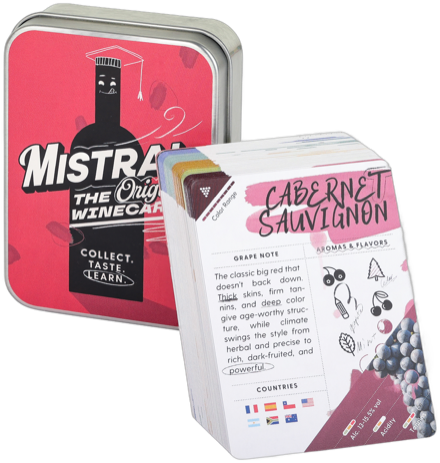
Every concept in this article fits on a card.
Mistral WineCards. Deck ONE: Global. 55 wine education cards covering grapes, regions, terroir, and winemaking. $35.
Get the DeckKey Grapes and Wine Styles
Mouton Rothschild's vineyard is planted with Cabernet Sauvignon (81%), Merlot (15%), Cabernet Franc (3%) and Petit Verdot (1%); the blend varies with each vintage, but Cabernet Sauvignon always predominates. Latour is planted with about 76% Cabernet Sauvignon, 22% Merlot and 2% Petit Verdot, and its Grand Vin, made exclusively from old vines in the Enclos averaging 60 years of age, is more than 90% Cabernet Sauvignon. Lafite grows Cabernet Sauvignon, Merlot, Cabernet Franc and Petit Verdot, and its wine usually has a large proportion of Cabernet Sauvignon, then Merlot, with a small contribution of Petit Verdot. At Château Margaux, Cabernet Sauvignon predominates with 72 of the estate's 126 plots. Haut-Brion's 48 hectares of red vines are planted with Merlot, Cabernet Sauvignon, Cabernet Franc and Petit Verdot.
- Barrel ageing differs by estate: 18 to 20 months in barrel at Haut-Brion, 15 months in new oak after blending at Lafite, an average of twenty-one months in new French oak for the Château Margaux Grand Vin, French oak barrels renewed every year for the Latour Grand Vin, and new oak barrels at Mouton
- Pavillon Blanc du Château Margaux comes from a 12-hectare vineyard planted exclusively with Sauvignon Blanc
- Château Margaux's red vines average 35 years old and its Sauvignon Blanc vines 50 years; Château Latour's vineyard is made up of 900,000 vines
Ownership and Winemaking Philosophy
Baron James de Rothschild acquired Lafite in 1868, and the same family has taken turns at the estate for over one hundred and fifty years; Saskia de Rothschild is part of the sixth generation. At Mouton Rothschild, Baron Philippe de Rothschild (1902-1988) took the estate in hand in 1922, barely 20 years old. Baroness Philippine de Rothschild (1933-2014) inherited in 1988, and her three children, Camille Sereys de Rothschild, Philippe Sereys de Rothschild and Julien de Beaumarchais de Rothschild, are co-owners of the château. In June 1993 François Pinault bought the Allied Lyons stake in Château Latour through his holding company Artémis. Château Margaux has been under the guidance of the Mentzelopoulos family since 1977, when the sale of the estate was completed. The purchase of Haut-Brion by the New York banker Clarence Dillon was finalised on May 13, 1935; Prince Robert of Luxembourg, Chairman and CEO since 2008, represents the fourth generation of the family.
- From 1945, each Mouton Rothschild vintage label has been illustrated with an original artwork created for Mouton by a contemporary artist; the 1973 label is by Pablo Picasso
- Haut-Brion systematically bottled its wine at the estate from 1923, Baron Philippe insisted in 1924 that all of Mouton's wine be bottled at the château, and Château Margaux adopted the requirement of bottling at the château in 1925
- Since August 2015 the entire Château Latour vineyard has been managed organically, with certification issued in August 2018, and biodynamic preparations are applied to the entire Enclos and some outside plots; Latour no longer sells its wines en primeur, and in 2012 it enlarged its workspace and created a new ageing cellar following that decision
- Jean-Philippe Delmas is the third generation of his family in charge of producing the Château Haut-Brion wines
Wine Laws and Classification Status
The 1855 Classification has five levels for red wines: Premier Cru, Second Cru, Troisième Cru, Quatrième Cru and Cinquième Cru. The Conseil des Grands Crus Classés en 1855 lists 5 First, 14 Second, 14 Third, 10 Fourth and 18 Fifth Growths, spread over the five Médoc appellations of Saint-Estèphe, Pauillac, Saint-Julien, Margaux and Haut-Médoc, plus one château in the Graves. Its Premiers Crus are Lafite-Rothschild, Latour and Mouton Rothschild in Pauillac, Margaux in Margaux, and Haut-Brion in Pessac. The classification counts 88 classified growths in all. Mouton's own history records that it officially joined the First Growths in 1973 following a decree signed by Jacques Chirac, then Minister of Agriculture.
- Premier Cru (First Growth): Lafite Rothschild, Latour, Margaux and Haut-Brion since 1855, and Mouton Rothschild since 1973
- Château Haut-Brion is the only Cru Classé of the 1855 classification in the Graves
- Haut-Brion describes itself as the only wine to be both a First Growth from the 1855 classification and a Classified Growth of the Graves
The glass I drink from every night.
The Zalto Denk'Art Universal has been my daily glass for ten years. Mouth-blown and absurdly thin, and mine go through the dishwasher on the lower rack every night.$156 a pair.
See the ZaltoVisiting and Cultural Significance
Château Mouton Rothschild inaugurated its Museum of Wine in Art in 1962. At Château Margaux, Bertrand Douat, Marquis de La Colonilla, acquired the estate in 1801, and works on the present château, designed by the Bordeaux architect Louis Combes, began in 1810; the winery designed by British architect Lord Norman Foster was inaugurated in 2015. Haut-Brion's history quotes the English diarist Samuel Pepys, who wrote in his journal in 1663 of drinking "a sort of French wine called Ho Bryan", and it lists an entry for Haut-Brion wine in King Charles II's cellar book in 1660-1661.
- Château Margaux offers cellar visits by appointment only, Monday to Friday, with tasting only for professionals; Château Lafite Rothschild is closed to visitors until January 2028 for renovations
- Three bottles of 1869 Lafite Rothschild sold at a Sotheby's auction in Hong Kong in October 2010; Jancis Robinson gives the price as HK$1,815,000 each, and Decanter called them the world's most expensive wine sold at auction
Sources and last verified
Primary sources (the Conseil des Grands Crus Classés en 1855 for the list, tiers and counts; bordeaux.com; and the five estates' own websites, for their own facts): https://gcc-1855.fr/en/, https://gcc-1855.fr/the-1855-grand-cru-classification/, https://www.bordeaux.com/en/classifications/classifications-1855/, https://www.chateau-latour.com/en/in-the-beginning/since-1331, https://www.chateau-latour.com/en/in-the-beginning/the-land-of-pauillac, https://www.chateau-latour.com/en/in-the-beginning/from-generation-to-generation, https://www.chateau-latour.com/en/a-time-for-sharing/le-grand-vin-de-chateau-latour, https://chateau-margaux.com/en/le-domaine/histoire, https://chateau-margaux.com/en/le-domaine/le-terroir, https://chateau-margaux.com/en/le-domaine/notre-patrimoine, https://chateau-margaux.com/en/vins/grand-vin-du-chateau-margaux, https://chateau-margaux.com/en/vins/pavillon-blanc-du-chateau-margaux, https://chateau-margaux.com/en/nos-experiences/visite-contact, https://chateau-margaux.com/en, https://www.haut-brion.com/en/history/, https://www.haut-brion.com/en/terroir/, https://www.haut-brion.com/en/savoir-faire/, https://www.chateau-mouton-rothschild.com/the-vineyard/the-terroir, https://www.chateau-mouton-rothschild.com/the-vineyard/from-vine-to-wine, https://www.chateau-mouton-rothschild.com/the-history/key-dates/key-date-1853, https://www.chateau-mouton-rothschild.com/the-history/key-dates/key-date-1924, https://www.chateau-mouton-rothschild.com/the-vineyard/the-skills, https://www.chateau-mouton-rothschild.com/label-art/discover-the-artwork/pablo-picasso, https://www.chateau-mouton-rothschild.com/the-history/the-history-of-mouton/from-marquis-to-barons, https://www.chateau-mouton-rothschild.com/the-history/key-dates/key-date-1973, https://www.chateau-mouton-rothschild.com/the-history/the-history-of-mouton/from-baron-philippe, https://www.chateau-mouton-rothschild.com/the-history/key-dates/key-date-2014, https://www.chateau-mouton-rothschild.com/the-history/key-dates/key-date-1988, https://www.lafite.com/domaines/chateau-lafite-rothschild/read/, https://www.lafite.com/history/. Secondary sources: https://www.decanter.com/features/the-1855-classification-on-the-mark-or-marketing-ploy-246574/, https://www.decanter.com/wine-news/opinion/news-blogs-anson/bordeaux-women-wine-history-382581/, https://www.decanter.com/wine-news/the-1855-classification-77200/, https://www.decanter.com/wine-news/lafite-prices-spiral-at-record-sotheby-s-hong-kong-auction-46849/, https://www.jancisrobinson.com/articles/that-lafite-sale-in-honkers. Last verified 2026-11-09
One glass for everything
The Gabriel-Glas StandArt is the stem I reach for from Champagne to Barolo.
See the glass- The 1855 Classification, made at the request of Napoleon III for the Paris Universal Exhibition and established on April 18, 1855, classified four First Growths: Lafite Rothschild, Latour, Margaux and Haut-Brion.
- Château Mouton Rothschild, a Second Growth in 1855, was reclassified as a First Growth in 1973, giving the five Premiers Crus listed today; Château Cantemerle was added as a Fifth Growth.
- Three First Growths are in Pauillac (Lafite Rothschild, Latour, Mouton Rothschild) and one in Margaux; Haut-Brion, in Pessac in the Pessac-Léognan appellation, is the only Graves estate in the classification.
- Plantings: Mouton Rothschild 81% Cabernet Sauvignon, 15% Merlot, 3% Cabernet Franc, 1% Petit Verdot; Latour about 76% Cabernet Sauvignon, 22% Merlot, 2% Petit Verdot, with a Grand Vin of more than 90% Cabernet Sauvignon from the 47-hectare Enclos.
- Owners: Baron James de Rothschild acquired Lafite in 1868; Clarence Dillon's purchase of Haut-Brion was finalised in 1935; the Mentzelopoulos family has guided Château Margaux since 1977; François Pinault bought the Allied Lyons stake in Latour through Artémis in 1993.