Terraced Vineyards: History and Function (Douro, Priorat, Mosel, Cinque Terre)
Stepped platforms held up by stone walls or earth banks let growers plant vines on slopes too steep to farm otherwise, from the Douro and Priorat to the Mosel and Cinque Terre.
Terraced vineyards turn steep hillsides into steps that vines can be planted and worked on, retained by dry-stone walls or, in modern Douro builds, by earth banks. Terraces and stone terraces are among the specific cultural practices that mountain and steep-slope viticulture requires, and this kind of farming has always been more burdensome than farming flat terrain. In the Douro, Priorat, the Mosel and Cinque Terre, terraces were built to plant vines on the steepest ground, and much of the work on them is still done by hand.
Take Terraced Vineyards: History and Function (Douro, Priorat, Mosel, Cinque Terre) into the app. Flashcards, trivia and label lookup.
Open the appDefinition and Physical Structure
Terraces and stone terraces are among the specific cultural practices that mountain and steep-slope viticulture requires, alongside adapted equipment such as narrow-gauge tractors and caterpillar traction. Construction differs by place. In the Douro, the traditional socalcos were cut into the slopes from the bottom up, with walls built from the stones taken out of the ground and wall height depending on the slope of the plot. In Priorat, many vineyards are worked as costers, the Catalan word for steep slope, and some are so steep that terraces have been built. On the Bremmer Calmont in the Mosel, walls of slate rock built horizontally across the slope stop the soft clay-slate soil from sliding down.
- Douro slope systems fall into two groups: traditional, unmechanised ones (pre-phylloxera calços, plus geias and terraces with dry-stone retaining walls built from the phylloxera crisis until about the 1970s) and mechanised ones (earth-banked patamares and vinha ao alto) introduced from then on
- Pre-phylloxera Douro terraces had drains in the walls, known locally as pilheiros
- Vinha ao alto, planted along the slope's line of maximum gradient, is a more recent alternative to patamares, at about 4,500 to 5,000 plants per hectare, and can be mechanised with winches or, up to slopes of around 40%, with tracked tractors
- In Winningen on the lower Mosel, the dry-stone walls are built without mortar or concrete, a craft that very few craftsmen still master
- The OIV's Resolution OIV-VITI 716-2024 (certified 18 October 2024) defines mountain and steep-slope viticulture and recommends research to support it, naming terraces and stone terraces as specific cultural practices and narrow-gauge tractors and caterpillar traction as adapted equipment
- The Douro's pre-phylloxera plantings sat on small irregular terraces (geios) holding 1 to 2 rows of vines behind stone walls; phylloxera first appeared in the region in 1862, and the patamares, horizontal terraces with earth banks, date to the late 1960s and early 1970s
- In 1756 a royal decree of the Marquis of Pombal created the Companhia Geral da Agricultura das Vinhas do Alto Douro, which the Douro's own wine institute counts as the oldest wine demarcation and regulation for a controlled designation of origin; in December 2001 part of the Douro region was classified by UNESCO as World Heritage
- Priorat's vineyards mostly sit on slopes steeper than 15%, some reaching 60%, and some terraces are so narrow they hold only two rows of vines and cannot be worked with farm machinery
- As of 2025 the Mosel covers 8,287 hectares, with half of its vineyards on steep and terraced sites with a slope of over 30 degrees; the Burg Cochem area of the lower Mosel is often called the terraced Mosel
- The Bremmer Calmont, with a gradient of up to 60%, is billed as the steepest sloped vineyard in Europe; in Winningen, 29 terraces in the Koberner and Winninger Uhlen are supported by around 17.4 kilometres of dry-stone walls
- In 2015 the 3,860-ha Cinque Terre zone held around 1,400 ha of terraces, of which 500 ha were cultivated before road access arrived, against just 80 ha of vineyard left at that time
Historical Context: Ancient Walls to UNESCO Recognition
Traces in several places attest to vine growing in the Douro during the Roman occupation. In 1756 a royal decree of the Marquis of Pombal created the Companhia Geral da Agricultura das Vinhas do Alto Douro, which the Douro's own wine institute counts as the oldest wine demarcation and regulation for a controlled designation of origin. Before phylloxera, which first appeared in the region in 1862, Douro plantings sat on small irregular terraces with 1 to 2 rows of vines; these were later abandoned and are now called mortórios, and after phylloxera growers built new, wider and more sloping terraces, with or without retaining walls, at higher planting densities. In December 2001 part of the Douro region was classified by UNESCO as World Heritage as a living, evolving and humanised landscape. In Priorat, Carthusian monks brought wine-growing knowledge and techniques from Provence in the 12th century and were established at Scala Dei in 1194. On the Mosel, the Romans brought viticulture on a grand scale, and the poem De navigo suo, written around 588 by Venantius Fortunatus, is the oldest known record of vines on the Calmont. The Cinque Terre terraces were made between 900 and 1,000 years ago.
- Douro: pre-phylloxera calços used relatively low stone walls with a rounded profile following the natural contour of the ground, each terrace holding one row of vines, sometimes two
- Douro: after phylloxera, vines went mainly onto wider terraces, set at some incline relative to the slope and separated by retaining walls that were generally tall
- Priorat: phylloxera was a disaster for the region, as Catalonia's textile boom drew the workforce to the city and vines were not replanted except on a small scale; a new cycle of prosperity began at the end of the 1980s
- Mosel: in Winningen, the dry-stone walls were built as early as the Middle Ages, with parts most probably dating to the 13th to 15th centuries
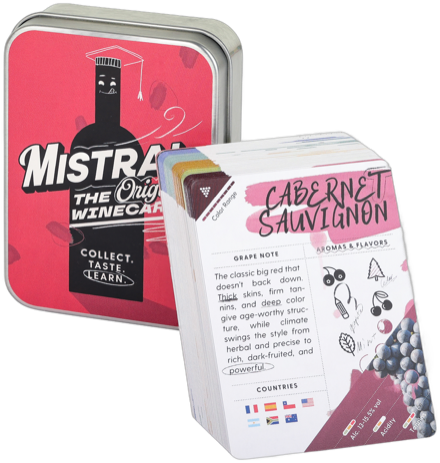
Every concept in this article fits on a card.
Mistral WineCards. Deck ONE: Global. 55 wine education cards covering grapes, regions, terroir, and winemaking. $35.
Get the DeckThe Science: Thermal, Hydrological, and Agronomic Functions
Mountains are susceptible to accelerated soil erosion and landslides, and the presence of viticulture in the mountains is essential to reduce erosion, landslides and the effects of flooding in flat areas. Improved insolation in spring and autumn, from slopes inclined toward the sun, might be a key requirement for ripening grapes in some higher-altitude wine zones. The same holds in German vineyards: slopes facing south or south-west in protected valleys get much more intense sunshine than the plain and a longer sunshine duration overall. On the Mosel, the steep slate slopes store the sun's heat during the day and release it at night, and on the Calmont the steep slope gives an angle of sun radiation well suited to growing Riesling. In Priorat, vines tend to suffer in the local soil and climate, with yields below 1 kg per plant on average.
- Water: the OIV recommends research into surface and sub-surface water flows to establish adequate drainage on the slope, minimising landslide risk while conserving water for vineyards and the surrounding ecosystem
- Erosion: in post-phylloxera Douro plots laid out close to the natural slope, lower retaining walls served both to reduce erosion and to store stones removed during deep ploughing
- Runoff: uncontrolled surface runoff can gully the earth banks of patamares and vinha ao alto plots, and erosion repairs are often very costly
- Roots: on the Mosel, the vines' roots penetrate deep into the ground to seek water and minerals
Effect on Wine: How Terraces Shape Flavour and Structure
In Priorat, yields below 1 kg per plant on average are linked with wines of "a very unique personality", in the words of the region's regulatory council. On the Mosel, the heat-storing slate slopes and deep-rooting vines are associated with fine, fruity wines with enormous depth of flavour and relatively low alcohol. In the Douro, per-vine yields on traditional walled terraces are low, and the legal maximum of 7.5 tonnes per hectare for DO wines is rarely reached in these systems. In Cinque Terre, the dry Cinque Terre DOC (minimum 40% Bosco) tends to show herbal freshness and pleasant sapidity, and Andrew Jefford found the cooperative's wines "delicate, poised, refreshing and seemingly saline".
- Priorat: Carinyena (Carignan) and Garnatxa (Grenache) are the most important native varieties
- Mosel: the region grows 5,156 hectares of Riesling
- Douro: traditional walled terraces carry many grape varieties planted at random through the vineyard, while patamares carry a much smaller selection in separate blocks
- Cinque Terre: Sciacchetrà DOC (minimum 85% Bosco) is an amber passito from grapes dried on racks, with notes of honey, citrus and butterscotch
Regional Profiles: Four Canonical Terraced Wine Regions
Douro: the demarcated region covers 250,000 hectares, with vines on only 40,000 hectares in the valleys of the Douro and its tributaries, and planting densities run from 3,000 vines per hectare on patamares to more than 6,000 in traditional vineyards. Priorat: the DOQ covers 17,629 hectares, of which 2,196.8 are planted with vines and cultivated by 511 growers, with vines from 100 metres above sea level in Bellmunt del Priorat and el Molar up to 750 metres in La Morera de Montsant and Porrera. Mosel: as of 2025, around 5,000 winegrowers work 8,287 hectares across 125 wine towns, with clayish slate and greywacke in the lower Mosel and Devonian slate in the steep sites of the middle Mosel. Cinque Terre: Bosco, Albarola and Vermentino are among the main white grapes, and in 2015 the zone's 80 hectares of vineyard were shared by around 120 growers, 100 of whom delivered to the cooperative.
- Douro: traditional walled systems still represent about 50% of the total vineyard area, and their conversion is governed by the PIOT land-use rules for the UNESCO-listed Alto Douro Vinhateiro, since extended to the whole demarcated region
- Priorat: the DOQ was admitted at the beginning of 2013 to CERVIM, an international institute for mountain viticulture formed in 1987 under the leadership of the OIV
- Mosel: the Uhlen in Winningen, about 19 ha with 14.6 ha of vineyard, is Germany's largest contiguous terraced site
- Cinque Terre: the three crus, Costa de Posa, Costa de Campu and Costa de Sèra, lie at Riomaggiore, at the steeper eastern end of the Cinque Terre
The map that explains this region.
The World Atlas of Wine, now in its 9th edition, is the book I open before any trip and after any bottle I could not place. Every region on this page has a map in it.$70.
See the AtlasModern Challenges: Labour Economics, Abandonment, and Climate Change
Mountain and steep-slope viticulture faces threats on two fronts, cost and climate. On cost, this viticulture has always been more burdensome than on flat terrain, a disadvantage that increased sharply with the growing mechanisation of flat vineyards. On climate, in some regions climate change may turn the former climatic advantage of steep slopes into a disadvantage: in warmer regions, intensified solar radiation often leads to problematic conditions on steep slopes, reduced water retention and high evapotranspiration often induce water stress and lower yields, changing rainfall patterns and extreme rainfall intensify erosion and can lead to landslides, and sun-exposed slopes may start growth earlier and face a high risk of late-frost losses. Mechanisation is impossible on post-phylloxera Douro terraces and on vines planted on the natural slope, and the resulting high labour costs have led to the gradual abandonment of this type of vineyard. On the Calmont, only 13 of the 22 hectares of vineyard space are still planted, because the work on the steep slopes remains strenuous. In Cinque Terre, the cooperative's director, Matteo Bonanini, put the blame on road access: "The road caused the abandonment of the vineyards, because it has brought tourists here, which meant a much easier living than working the terraces."
- Mosel: on the steep inclines nearly all grapes are picked by hand, each vine is tied to its own eight-foot wooden stake, and slate soil washed down by winter rains has to be carried back up
- Calmont: a monorack train has eased some of the work since the 1990s, but it still takes up to 1,800 hours of manual work per hectare
- Douro: labour shortages and rising farm wages drove the move to mechanisable terracing from the 1970s, through the pioneering work of the Brigada de Mecanização e Reconversão do Douro
- Cinque Terre: everything is still done by hand, though some wineries benefit from monorails provided by the cooperative
Sources and last verified
Primary sources: https://www.oiv.int/node/3805/download/pdf, https://www.ivdp.pt/pt/vinha/cultura-da-vinha/, https://www.ivdp.pt/pt/docs/douro_pt.pdf, https://www.ivdp.pt/pt/docs/SUVIDUR/MBP_(vs_integral).pdf, https://www.doqpriorat.org/en/varietals/, https://www.doqpriorat.org/en/territory/, https://www.doqpriorat.org/en/doq-priorat/, https://doqpriorat.org/en/contingut/history, https://www.winesofgermany.com/our-regions/growing-area/72/mosel, https://www.winesofgermany.com/our-regions/highlight-of-wine-culture/159/the-bremmer-calmont-vineyard, https://www.winesofgermany.com/our-regions/highlight-of-wine-culture/403/winninger-vineyard-terraces, https://www.winesofgermany.com/our-wine/viticulture/viticulture/178/soil-sites. Secondary sources: https://www.decanter.com/wine-travel/italy/decanter-travel-guide-cinque-terre-italy-300271/, https://www.decanter.com/wine-news/opinion/jefford-on-monday/jefford-on-monday-angela-s-lemon-1270/. Last verified 2026-10-04
Terraced-site wines are best described region by region. Mosel wines from the steep slate slopes are linked with fine, fruity styles with enormous depth of flavour and relatively low alcohol. Douro reds for laying down tend to be intense purple when young, with aromas of black fruit, chocolate and violet, becoming complex and delicate at their peak. Dry Cinque Terre DOC tends to show herbal freshness and pleasant sapidity, and Sciacchetrà shows honey, citrus and butterscotch.
- OIV Resolution OIV-VITI 716-2024 defines mountain and steep-slope viticulture, names terraces and stone terraces as specific cultural practices, and identifies threats to this viticulture on two fronts: cost and climate.
- Douro: pre-phylloxera geios held 1 to 2 rows of vines behind stone walls; phylloxera first appeared in the region in 1862; earth-banked patamares arrived in the late 1960s and early 1970s; vinha ao alto is planted along the slope's line of maximum gradient; the 1756 Pombal decree created what the Douro's wine institute counts as the oldest wine demarcation; part of the region became UNESCO World Heritage in December 2001.
- Priorat: costers is the Catalan word for steep slope; slopes are mostly over 15%, some reaching 60%; some terraces hold only two rows of vines; 2,196.8 ha planted within a 17,629 ha DOQ; Carthusians established at Scala Dei in 1194.
- Mosel (2025 figures): 8,287 ha; half of the vineyards on steep and terraced sites over 30 degrees; Burg Cochem is often called the terraced Mosel; the Bremmer Calmont reaches a gradient of up to 60%; Winningen's Uhlen is Germany's largest contiguous terraced site.
- Cinque Terre: Cinque Terre DOC is a dry white with minimum 40% Bosco; Sciacchetrà DOC is an amber passito with minimum 85% Bosco; in 2015 the zone had 80 ha of vineyard left, against 500 ha cultivated before road access arrived.
Put this into practice
Blind tastings, flashcards, and trivia in the Wine with Seth app.
Try the app free