Sandy Soils: Sand, Phylloxera, and Ungrafted Vines (Colares & Sable de Camargue)
Colares vines are planted ungrafted on their own roots, deep in the sand.
Most observations of how soil affects phylloxera, an aphid that feeds on plant roots and devastated vineyards at the end of the 19th century, are largely anecdotal and focus on the ratio of sand to clay. Phylloxera does not cause economic damage in soils with a medium to fine sand content of more than 65 percent. In Colares, near Lisbon between the Serra de Sintra and the Atlantic, vines are planted ungrafted on their own roots deep into the sand, while the vineyard soils of the Sable de Camargue AOP on the Rhône delta are made up of at least 80% sand.
Take Sandy Soils: Sand, Phylloxera, and Ungrafted Vines (Colares & Sable de Camargue) into the app. Flashcards, trivia and label lookup.
Open the appWhat It Is: Sandy Soil Composition and Characteristics
Observations of soil and phylloxera are largely anecdotal and focus mostly on texture, particularly the ratio of sand to clay. Sable de Camargue vineyard soils are very homogeneous, practically free of clay and loam, and made up of at least 80% sand. These sandy soils have a high mineralisation rate and a high degree of leaching, and they are susceptible to wind erosion. In Colares, golden beach sand with poor water-holding capacity, devoid of humus, worms, and other living organisms, lies over clay and limestone soils where the vines root and absorb nutrients.
- Sable de Camargue: soils practically free of clay and loam and made up of at least 80% sand
- Sable de Camargue: given the high mineralisation rate and high leaching of the sandy soils, organic fertilisation is required, at least by digging in the residues of cover vegetation
- Colares: the sand has poor water-holding capacity and is devoid of humus, worms, and other living organisms
- Colares: vineyards may sit on sandy 'chão de areia' soils and/or on brown calcareous 'chão rijo' soils of marls or similar materials
- Phylloxera does not cause economic damage in soils with a medium to fine sand content of more than 65 percent, while fine-texture soils such as clay are generally more favorable to it
- Washington State's phylloxera risk map rates sand content above 80% as low risk, 65 to 80% as moderate risk, and below 65% as high risk
- Deep clay soils covered by sand spared Colares vineyards from the phylloxera that devastated vineyards at the end of the 19th century
- Colares vines on sand are planted by the traditional practice of setting an own-rooted cane into the layer beneath the sand; growers dig away 1 to 4 meters of sand to reach clay-limestone soil
- Colares vineyards may sit on sandy 'chão de areia' soils and/or on 'chão rijo', brown calcareous soils of marls or similar materials
- Sable de Camargue was first an IGP and has been an AOP for still gris and gris de gris wines since October 2023
- Sable de Camargue vines grow only on sandy and limestone soils of the Rhône delta that are practically free of clay and loam and made up of at least 80% sand, at an average of 1 m above sea level
How Sandy Terroirs Form: Geology and Maritime Influence
The Colares DOC lies near Lisbon, between the Serra de Sintra and the Atlantic Ocean, in a climate of marked Atlantic maritime influence. Its delimited area covers the parishes of Colares, São Martinho, and São João das Lampas in the municipality of Sintra. The appellation rules tie the particular character of its vineyards to the nearness of the sea, the influence of maritime winds, and deep clay soils covered by sand. Sable de Camargue soils formed from sediments carried by the river, the sea, and the wind, on the Rhône delta and its associated coastal belt. Its vineyards sit at an average of 1 m above sea level among coastal lagoons and salt marshes, supplied with fresh water by a groundwater layer a few centimetres thick that is kept in hydrostatic balance with the sea, the lagoons, and a network of channels called roubines.
- Colares: the appellation rules attribute the unique characteristics of Colares wine to its grape varieties, its soils, and a temperate climate that is humid in summer
- Colares has an extreme maritime climate, with average humidity never below 78% and an average of 86% in August
- Sable de Camargue: the roubines let growers manage both the level and the salinity of the groundwater layer
- Sable de Camargue rules prohibit substantial changes to the water circulation system, because protecting the vineyard from the surrounding salinity is essential for its survival
The glasses, tools, and cards I stand behind.
A short list. Nothing I would not recommend to a friend.
Browse the WineShopEffect on Wine: Aromatics, Acidity, and Mineral Character
The appellation texts link specific wine traits to sand and sea. For Sable de Camargue, the rules tie the sandy and limestone soils to grapes with a slightly pink, bluish-grey colour and low anthocyanin potential, and link maritime conditions during ripening with high levels of malic and lactic acid in the grapes. The wines show a pale salmon colour, softness, roundness, freshness, and notes of iodine that the rules attribute to the maritime influence, with mineral notes emerging in the finish. Colares Ramisco reds are ruby and astringent, softening with age as they take on a brownish tone, and Colares Malvasia whites are citrine and quite fruity. Ramisco wines have hard tannins and high acidity and, if well made, can age for a long time in bottle. Colares wines often hover around 12% ABV, and salt (NaCl) in Colares white wines surpasses 100 milligrams per liter.
- Sable de Camargue gris de gris wines are made solely from Grenache Gris and are paler, with subtler, more delicate aromas
- Sable de Camargue: after fermentation, the relatively high level of lactic acid gives the wines freshness and roundness
- Ramisco (Colares): its structure has been compared to Barolo, with high acidity and high tannin but lower alcohol
- Malvasia de Colares: high acidity, low alcohol, citrus flavors, and briny, saline notes
Where You'll Find It: Colares and Sable de Camargue
Colares is one of nine denominations of origin in Portugal's Lisboa wine region, planted with Ramisco by the sea on very loose sandy soils. Colares covered 1,800 planted hectares at its 1930s peak, fell to 12 hectares by 1999, and has since expanded to 18 hectares; the Adega Regional de Colares cooperative was established in 1931. Wines of Portugal puts the shrinking vineyard land down to the fact that far more money is to be made near Lisbon from building villas than from growing vines. Sable de Camargue is a French AOP whose area covers 14 coastal municipalities in the Hérault, Gard, and Bouches-du-Rhône departments. Benedictine monks of the Abbaye de Psalmody, near Aigues-Mortes, were already producing wine from vines grown on the region's sand in the 7th century.
- Colares DOC area: the parishes of Colares, São Martinho, and São João das Lampas, in the municipality of Sintra
- Colares maximum yields: 55 hl/ha for reds and 70 hl/ha for whites
- Sable de Camargue AOP: 14 coastal municipalities across Hérault, Gard, and Bouches-du-Rhône; maximum yield 90 hl/ha
- Sable de Camargue: herbicides are banned across the whole soil surface, and 95% of the vineyard is organic, in organic conversion, or certified High Environmental Value (HVE)
The Science Behind Phylloxera Resistance in Sandy Soils
Vineyard surveys in South Africa found phylloxera predominating in soils with less than 65% sand content, and in Canadian and Californian vineyards the insect is reportedly more common on clay soils than on loam and sandy-loam soils. Heavier soils contract and crack when drying, and these openings allow the insect to crawl to and infest root systems. Washington State's risk map treats sand content as the most important risk factor for phylloxera survival, moderated by soil temperature. Other soil properties also play a part: in Austrian vineyards, soil pH, carbonate content, organic carbon, and texture act in combination on phylloxera abundance, and the Washington map still rates sand contents between 65 and 80% as moderate risk.
- South Africa: vineyard surveys found phylloxera predominating in soils with less than 65% sand content
- In California, France, and South Africa, susceptibility to phylloxera damage decreases as the proportion of fine and medium sand in the soil increases
- One study suggests the amount of silicon in sandy soil may be an important factor in reducing phylloxera abundance
- On the Washington map, average soil temperatures below 65 or above 84 degrees F rate as low risk, and 65 to 84 degrees F as high risk
The map that explains this region.
The World Atlas of Wine, now in its 9th edition, is the book I open before any trip and after any bottle I could not place. Every region on this page has a map in it.$70.
See the AtlasProduction Rules: Colares and Sable de Camargue
Colares vineyards on chão de areia must follow the traditional practice of setting the own-rooted cane into the layer beneath the sand, and vines are trained low, with the lowest wire no higher than 30 cm where wires are used. In practice, growers dig away 1 to 4 meters of sand to reach the clay-limestone soil, plant own-rooted vines there, and gradually put the sand back as the vines grow. Colares reds may be sold only after at least 18 months in vessel followed by 6 months in bottle, and whites after 6 months in vessel followed by 3 months in bottle. In the Camargue, the rules require managed plant cover between at least every other row, at least during vine dormancy, to combat wind erosion, and the vines are trained in Gobelet or Cordon de Royat at a minimum density of 4,000 vines per hectare.
- Colares: musts need a minimum natural potential alcohol of 9.5% vol, and the wines a minimum alcohol of 10% vol
- Colares: Ramisco and Malvasia de Colares must represent 80% of the blend of DOC wines
- Colares: most producers release Ramisco reds after four to seven years
- Sable de Camargue: gris wines come from Grenache Gris, Grenache, or a blend of listed varieties; gris de gris wines come solely from Grenache Gris
Sources and last verified
Primary sources: https://www.ivv.gov.pt/wp-content/uploads/2026/02/DO_Colares.pdf, https://www.ivv.gov.pt/regioes-vitivinicolas/mapa-das-regioes/lisboa/, https://winesofportugal.com/en/portuguese-wines/grape-varieties/ramisco/, https://winesofportugal.com/en/discover/wine-regions/lisboa/, https://www.inao.gouv.fr/produit/sable-de-camargue-gris-de-gris-17935, https://eur-lex.europa.eu/legal-content/EN/TXT/HTML/?uri=CELEX:52023XC0525(02), https://wine.wsu.edu/extension/pest-management/phylloxera/, https://extension.oregonstate.edu/sites/extd8/files/documents/ec1463.pdf, https://www.wineaustralia.com/getmedia/d0278bb1-a3dc-415a-9bd4-53fbe9fc47ef/20180115-DEP1301-A-Scientific-Basis-for-Risk-Analysis-of-Grape-phylloxera. Last verified 2026-10-04

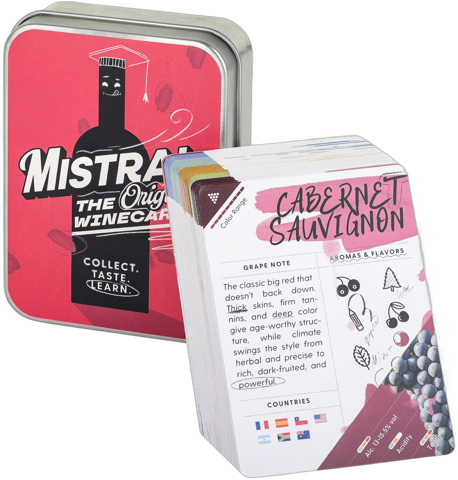
Every concept in this article fits on a card.
Mistral WineCards. Deck ONE: Global. 55 wine education cards covering grapes, regions, terroir, and winemaking. $35.
Get the DeckColares Ramisco reds are ruby and astringent in youth, with hard tannins and high acidity, softening with age as they take on a brownish tone. Colares Malvasia whites are citrine and fruity, with high acidity, citrus, and briny, saline notes. Sable de Camargue gris and gris de gris wines are pale salmon, soft, round, and fresh, with white fruit, citrus, exotic fruit, or red fruit, notes of iodine, and mineral notes in the finish.
- Phylloxera does not cause economic damage in soils with a medium to fine sand content of more than 65 percent; fine-texture soils such as clay are generally more favorable to it, and heavier soils crack when drying, letting the insect reach roots.
- Colares DOC (Lisboa, Portugal) lies between the Serra de Sintra and the Atlantic; deep clay soils covered by sand spared its vineyards from late-19th-century phylloxera, and vines on sand are planted from own-rooted canes.
- Colares ageing minimums: reds 18 months in vessel followed by 6 months in bottle; whites 6 months in vessel followed by 3 months in bottle.
- Sable de Camargue AOP (since October 2023, previously IGP): still gris and gris de gris wines only; gris de gris is made solely from Grenache Gris; 14 coastal municipalities in Hérault, Gard, and Bouches-du-Rhône.
- Sable de Camargue soils are at least 80% sand and practically free of clay and loam, at an average of 1 m above sea level; channels called roubines manage the level and salinity of a thin freshwater groundwater layer.
Put this into practice
Blind tastings, flashcards, and trivia in the Wine with Seth app.
Try the app free