Avignonesi
ah-vee-nyoh-NAY-zee
A Montepulciano estate owned by the Saverys family, farming its vineyards between Montepulciano and Cortona organically and biodynamically and making Vino Nobile di Montepulciano and Vin Santo.
Avignonesi was founded in Montepulciano in the 1970s and takes its name from a noble family of the 16th century. The Falvo family, its founders, sold a majority share to Virginie Saverys, who had held a minority stake since 2007; in 2009 she began the transition to biodynamic farming and expanded the estate. In 2024 the estate passed from Virginie Saverys to her children, Basile and Eline Aloy, and it is owned by the Saverys family. The estate extends over more than 300 hectares between Montepulciano and Cortona; Avignonesi cultivates 177 hectares, farmed organically and biodynamically, and vinifies only what it grows. It is a Benefit Corporation and a B Corp.
Take Avignonesi into the app. Flashcards, trivia and label lookup.
Open the appHistory and Ownership
Avignonesi takes its name from a noble family of the 16th century, and the modern estate was established in Montepulciano in the 1970s by the Falvo family. In 2007 Virginie Saverys bought a 30 percent stake from Ettore Falvo, who left the company that year. The Falvo family then sold a majority share to Saverys, a director of the Belgian shipping company Compagnie Maritime Belge; under the terms of the sale the Falvo family kept a 10 percent share and would continue to manage the company for the next five years, with Alberto Falvo staying on as president and managing director. The sale included Classica, an international distribution company owned by Avignonesi, while Li Veli, an estate in Puglia, remained with the Falvo family. In 2009 Saverys began the transition to biodynamic farming and expanded the estate; by 2018 production had increased to more than 42,000 cases a year. In 2024 the estate passed from Virginie Saverys to her children, Basile and Eline Aloy, and it is owned by the Saverys family.
- 1970s: the modern estate was established in Montepulciano; the name comes from a noble family of the 16th century.
- 2007: Virginie Saverys bought a 30 percent stake from Ettore Falvo; the Falvo family later sold her a majority share and kept 10 percent.
- 2009: Saverys began the transition to biodynamic farming and expanded the estate.
- 2024: the estate passed from Virginie Saverys to her children, Basile and Eline Aloy.
- Founded in Montepulciano in the 1970s by the Falvo family; Virginie Saverys took a 30 percent stake in 2007 and later bought a majority share.
- Owned by the Saverys family; in 2024 the estate passed from Virginie Saverys to her children, Basile and Eline Aloy.
- More than 300 hectares between Montepulciano and Cortona, with 177 hectares cultivated; only estate-grown grapes are vinified.
- Over 100 hectares of Sangiovese in Montepulciano are harvested as more than 60 distinct micro-parcels, each vinified separately.
- Practices certified organic and biodynamic; Avignonesi is a Benefit Corporation and a B Corp.
- Vin Santo ages for over ten years in small caratelli in the vinsantaia; Occhio di Pernice, made from Sangiovese, is its rarest expression.
People and Roles
Basile Aloy is President and Eline Aloy is a Board Member, representing the Saverys family together with Carmen Christiaansen, Le Capezzine Sr Advisor. The Executive Committee comprises Matteo Giustiniani (CEO), Alessio Gorini (COO), Claudio Benvenuti (CFO), Gaetano D’Afflitto (Commercial Director), Daniele Carlini (CMO) and Suzie Alexander (Hospitality Director). Giustiniani was recruited as winemaker and was CEO by 2018; Gorini, an agronomist, came to Avignonesi from Burgundy's Domaine Leflaive. Max de Zarobe, the husband of Virginie Saverys, had led the creation of "The Alliance" of six Nobile producers by 2018.
- Saverys family: Basile Aloy, President; Eline Aloy, Board Member; Carmen Christiaansen, Le Capezzine Sr Advisor.
- Executive Committee: Matteo Giustiniani (CEO), Alessio Gorini (COO), Claudio Benvenuti (CFO), Gaetano D’Afflitto (Commercial Director), Daniele Carlini (CMO), Suzie Alexander (Hospitality Director).
- Matteo Giustiniani joined as winemaker and was CEO by 2018; agronomist Alessio Gorini came from Domaine Leflaive.
Vineyards and Estate
Avignonesi is a 310-hectare ecosystem between Montepulciano and Cortona, where vineyards, woods and olive groves share the same seasonal rhythm. The estate cultivates 177 hectares and vinifies only what it grows. In Montepulciano, over 100 hectares of Sangiovese are harvested as more than 60 distinct micro-parcels, each vinified separately, a parcel-by-parcel approach followed since 2010. The new La Stella vineyard is grafted with several local Sangiovese selections; 5% of its vines have been replaced with resilient shrub hedges, "married" vines are present, and fruit varieties such as pomegranates, almonds, peaches and pears are integrated. La Tonda was planted in 1990 as an experiment to study the effects of vine training methods and planting density. Le Capezzine, founded in the 19th century as a model farm by the philanthropist and scientist Angelo Vegni, is home to the vinsantaia, the restaurant and the spaces for guests. Avignonesi also has 2,270 olive trees for its certified organic extra virgin olive oil, all processed in its own mill.
- More than 300 hectares between Montepulciano and Cortona; 177 hectares cultivated.
- Over 100 hectares of Sangiovese in Montepulciano, harvested as more than 60 micro-parcels and vinified separately since 2010.
- La Stella: several local Sangiovese selections, shrub hedges in place of 5% of the vines, and fruit trees among the rows.
- La Tonda: planted in 1990 to study vine training methods and planting density.
Farming and Certification
Avignonesi farms organically and biodynamically, observing each parcel as a living system; it sows cover crops, works the soil with care and measures biodiversity. Its practices are certified organic and biodynamic. Avignonesi is a Benefit Corporation and a B Corp, and it publishes impact reports, listed for 2021 to 2025, together with a JEDI (Justice, Equity, Diversity & Inclusion) declaration and action plan for 2026 to 2030.
- Organic and biodynamic farming, with cover crops and biodiversity measurement.
- Practices certified organic and biodynamic.
- Benefit Corporation and B Corp; impact reports listed for 2021 to 2025.
Winemaking
Since 2013, Lodola, a few kilometres from Le Capezzine, has been Avignonesi's centre for vinification and ageing. Each parcel is vinified separately, and only estate-grown grapes are vinified. Amphorae, stainless steel tanks, concrete eggs, barriques, large casks and caratelli are all used. The Vin Santo and Occhio di Pernice are made using the "madre", a natural yeast starter passed down through generations, and Vin Santo ages for over ten years in small caratelli in the vinsantaia, during which more than half of the liquid evaporates.
- Lodola: centre for vinification and ageing since 2013.
- Vessels: amphorae, stainless steel tanks, concrete eggs, barriques, large casks and caratelli.
- Vin Santo: made with a "madre" yeast starter and aged for over ten years in caratelli.
Wines
The range is organised in five families. The Sangiovese Tales include the Vino Nobile di Montepulciano DOCG, made from 100% Sangiovese; Poggetto di Sopra, a single-vineyard Vino Nobile di Montepulciano from 100% Sangiovese; In Grandi Annate, a Toscana IGT Sangiovese produced only in the best vintages; a Vino Nobile di Montepulciano Vintage Release; Rosso di Montepulciano DOC; and QX, a Toscana IGT Rosato named for the holm oak (Quercus Ilex) and dedicated to Fattoria Capezzine. Wines Steeped in Vision and History include Desiderio, a Toscana IGT Merlot named after a bull that lived on the Capezzine farm more than one hundred years ago and helped define the Chianina breed of cattle; Grifi, a Toscana IGT of Cabernet Sauvignon and Sangiovese; and Il Marzocco, a Toscana IGT Chardonnay named after a stone lion in front of Palazzo Avignonesi in Montepulciano. 50&50, first made in 1988, is an even blend of 50% Sangiovese and 50% Merlot born of the friendship between the owners of Avignonesi in Montepulciano and Capannelle in Chianti Classico. The Vin Santo family comprises Vin Santo di Montepulciano DOC, from Trebbiano and Malvasia, and Occhio di Pernice Vin Santo di Montepulciano DOC, from 100% Sangiovese. The Da•Di wines, a Toscana IGT Bianco and Rosso, are fermented and aged in amphora, and the estate calls Cantaloro Rosso Toscana IGT its ideal everyday wine. At Le Capezzine, guests have access to single-vineyard wines produced in small quantities, among them the Vino Nobile di Montepulciano wines El Grasso, La Banditella, La Stella, Le Badelle and Oceano, and La Tonda Toscana IGT Sangiovese.
- Vino Nobile di Montepulciano DOCG: 100% Sangiovese; 233,306 bottles of the 2022 vintage.
- Poggetto di Sopra Vino Nobile di Montepulciano DOCG: single vineyard, 100% Sangiovese; 13,921 bottles of the 2022 vintage.
- Grifi Toscana IGT 2022: 61.77% Cabernet Sauvignon and 38.23% Sangiovese.
- Occhio di Pernice: 100% Sangiovese; Vin Santo di Montepulciano DOC: Trebbiano and Malvasia.
Open one bottle, taste it for weeks.
The Coravin Pivot+ is the simpler Coravin, for wines you will finish inside a few weeks, which is how I taste a producer across vintages without finishing every bottle. It takes five seconds to use.$199.
See the Pivot+Vino Nobile and The Alliance
The Vino Nobile di Montepulciano DOCG requires only 70 percent Sangiovese. By 2018 Max de Zarobe had led the creation of "The Alliance" of six Nobile producers: Avignonesi, La Braccesca, Boscarelli, Dei, Poliziano and Salcheto. Starting with the 2015 vintage, each Alliance member committed to producing a single-vineyard cuvée from 100 percent Sangiovese bearing the group's logo; Avignonesi's version, Poggetto di Sopra, was to fill 250 cases.
- Vino Nobile di Montepulciano DOCG minimum: 70 percent Sangiovese.
- The Alliance: Avignonesi, La Braccesca, Boscarelli, Dei, Poliziano and Salcheto; single-vineyard 100 percent Sangiovese cuvées from the 2015 vintage.
- Poggetto di Sopra was Avignonesi's Alliance wine, at 250 cases.
Critical Recognition
The 1997 Vino Nobile di Montepulciano Grandi Annate Riserva scored 96 points on release and was ranked fourth on Wine Spectator's Top 100 list of 2001. Wine Spectator called the Vin Santo 'one of the most famous wines in Italy,' with the 1990 vintage achieving a perfect 100-point score on release in 2000.
- 1997 Grandi Annate Riserva: 96 points on release and fourth on Wine Spectator's Top 100 of 2001.
- 1990 Vin Santo: a perfect 100-point score on release in 2000.
House Style
In Avignonesi's own words, its Vino Nobile di Montepulciano shows 'a sleek medium body, seamless tannins and a distinctive tasting profile.' Of Poggetto di Sopra, the estate writes: 'We do not impose a style on Poggetto di Sopra, nor do we favour one trait over another: we simply allow the character of the site to emerge.' CEO Matteo Giustiniani puts the estate's approach this way: 'At Avignonesi, we are merely custodians of the land.'
Sources and last verified
Primary sources (producer's own site): https://www.avignonesi.it/en/about-us/, https://www.avignonesi.it/en/philosophy/, https://www.avignonesi.it/en/vino/, https://www.avignonesi.it/en/vino/vino-nobile-di-montepulciano-docg/, https://www.avignonesi.it/en/vino/poggetto-di-sopra-vino-nobile-di-montepulciano-docg/, https://www.avignonesi.it/en/vino/occhio-di-pernice-vin-santo-di-montepulciano-doc/, https://www.avignonesi.it/en/vino/vin-santo-di-montepulciano-doc/, https://www.avignonesi.it/en/vino/desiderio-toscana-igt-merlot/, https://www.avignonesi.it/en/vino/grifi-toscana-igt/, https://www.avignonesi.it/en/vino/il-marzocco-toscana-igt/, https://www.avignonesi.it/en/vino/rosso-di-montepulciano-doc/, https://www.avignonesi.it/en/vino/5050-toscana-igt/, https://www.avignonesi.it/en/vino/in-grandi-annate-toscana-igt/, https://www.avignonesi.it/en/experiences/, https://www.avignonesi.it/en/300sangiovese/. Secondary sources: Decanter (Kerin O'Keefe, last updated 28 May 2015, https://www.decanter.com/wine-news/avignonesi-sold-to-belgian-businesswoman-78965/) and Wine Spectator (5 August 2008, https://www.winespectator.com/articles/one-of-montepulcianos-best-estates-changes-hands-4268; Robert Camuto, 7 May 2018, https://www.winespectator.com/articles/facelift-for-vino-nobile-di-montepulciano-camuto). Last verified 2026-10-20. Where the producer's site and a secondary source disagree, the producer's site governs.
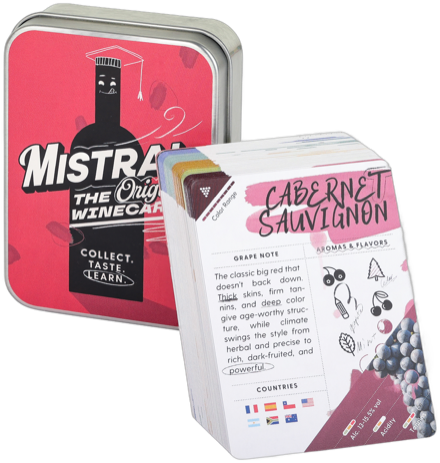
Every concept in this article fits on a card.
Mistral WineCards. Deck ONE: Global. 55 wine education cards covering grapes, regions, terroir, and winemaking. $35.
Get the DeckIn the estate's tasting note on the 2022 Vino Nobile di Montepulciano, the nose opens with small red berries and pomegranate juice and the violet note typical of quality Sangiovese, and the palate shows ripe cherry, plum jam and liquorice, with well-defined tannins and a fresh streak of acidity. The estate's note on Occhio di Pernice cites dried plums and dates, propolis, spiced gingerbread, malaga and tobacco, expanding on the palate into dried apricot and smoked hazelnut.
- Avignonesi Rosso di Montepulciano DOCThe 2024 is 98.3% Sangiovese and 1.7% Colorino, with 80,000 bottles made.
- Avignonesi Vino Nobile di Montepulciano DOCGMade from 100% Sangiovese; 233,306 bottles of the 2022 vintage.
- Avignonesi Desiderio Toscana IGT Merlot100% Merlot, named after a bull that lived on the Capezzine farm more than one hundred years ago.
- Avignonesi Poggetto di Sopra Vino Nobile di Montepulciano DOCGSingle-vineyard Vino Nobile from 100% Sangiovese; 13,921 bottles of the 2022 vintage.
- Avignonesi Occhio di Pernice Vin Santo di Montepulciano DOC100% Sangiovese, made with the "madre" yeast starter; more than half of the liquid evaporates during its long ageing.
New to Wine.com? $25 off $350+ with codeJOVIAL25
Wine with Seth may earn a commission on Wine.com purchases at no cost to you. Wine links are for adults 21 and over.
- Montepulciano estate established in the 1970s by the Falvo family; Virginie Saverys took a 30 percent stake in 2007, later bought a majority share, and in 2024 the estate passed to her children, Basile and Eline Aloy.
- More than 300 hectares between Montepulciano and Cortona; 177 hectares cultivated, organic and biodynamic certified; Benefit Corporation and B Corp.
- Over 100 hectares of Sangiovese harvested as more than 60 separately vinified micro-parcels, an approach followed since 2010; vinification and ageing at Lodola since 2013.
- Vino Nobile di Montepulciano DOCG requires only 70 percent Sangiovese; Avignonesi's Vino Nobile and Poggetto di Sopra are 100% Sangiovese.
- Vin Santo di Montepulciano DOC from Trebbiano and Malvasia; Occhio di Pernice from 100% Sangiovese; both made with the "madre" yeast starter, and Vin Santo ages for over ten years in caratelli.
Tasted a Avignonesi wine?
Log it in your Tasting Journal and build your palate over time.
Start your Journal