Preston Farm and Winery
PRES-ton Farm and Winery
A family-operated, organic 125-acre farm and winery in Dry Creek Valley, where estate-grown Zinfandel, Carignane, and Rhône varieties share the land with olives, grain, vegetables, and pastured livestock.
Preston Farm and Winery is a family-operated, organic property of 125 acres in Healdsburg's Dry Creek Valley. Its history begins with the 1973 purchase of the Hartsock Ranch, a prune and pear ranch with a few acres of grapes, and the first winery went into the ranch's historic prune dehydrator in 1975. After production peaked at 30,000 cases in 1988, Preston was re-envisioned in 2001 as Preston of Dry Creek and downsized to 8,000 cases. It received its first CCOF organic certification in 2002 and began farming biodynamically in 2010 under the guidance of Philippe Cordery. Grayson Hartley has been winemaker since 2018, and all of the wines are made from grapes grown on the farm.
Take Preston Farm and Winery into the app. Flashcards, trivia and label lookup.
Open the appFrom Hartsock Ranch to Winery
Preston Farm and Winery sits at 9282 West Dry Creek Road in Healdsburg. In 1895 the Guadagni family made an early planting of Zinfandel on the land. In 1973 came the purchase of the first Dry Creek parcel, the Hartsock Ranch, a prune and pear ranch with a few acres of grapes. Planting of new vineyards began in 1974, with Sauvignon Blanc the first new grape, inspired by Lou Preston's friend Dave Stare of Dry Creek Vineyards. In 1975 the first winery was established in the historic prune dehydrator on the Hartsock Ranch, and in 1978 a confusion between Petite Sirah and Syrah led to the first planting of a Rhône variety, Syrah. A new winery with a capacity of 12,000 cases, designed by architect John Picchi, followed in 1981, and production peaked at 30,000 cases in 1988.
- 1895: early planting of Zinfandel on the land by the Guadagni family
- 1973: purchase of the Hartsock Ranch, the first Dry Creek parcel
- 1975: first winery established in the historic prune dehydrator
- 1988: wine production peaks at 30,000 cases
- 1973: purchase of the Hartsock Ranch, the first Dry Creek parcel; first winery set up in its historic prune dehydrator in 1975
- Family-operated, organic 125-acre property at 9282 West Dry Creek Road, Healdsburg
- Production peaked at 30,000 cases in 1988; re-envisioned as Preston of Dry Creek and downsized to 8,000 cases in 2001
- First CCOF organic certification in 2002; biodynamic farming since 2010 under the guidance of Philippe Cordery
- 13 grape varieties on the estate; all wines made from grapes grown on the farm
- Winemakers: Matt Norelli from 2001 to his 2017 retirement; Grayson Hartley hired in 2018
Founding and Ownership
Preston Farm and Winery is a family-operated, organic property in Healdsburg's Dry Creek Valley. Lou and Susan Preston began an organic farm and winery on the land, and Lou learned to grow grapes and make wine at UC Davis in the early 70s. Lou Preston is the owner of the property. In 2001 Preston Vineyards was re-envisioned as Preston of Dry Creek and downsized to 8,000 cases, taking the business from a 30,000-case brand distributed in 40 states to one that sold most of its wine from its onsite tasting room. Lou made a commitment to organic farming in 2000 after meeting Amigo Bob Cantisano; the first organic certification by CCOF followed in 2002, and biodynamic farming began in 2010 under the guidance of Philippe Cordery.
- Family-operated, organic property in Healdsburg's Dry Creek Valley
- 2001: re-envisioned as Preston of Dry Creek and downsized to 8,000 cases
- 2002: first organic certification by CCOF
- 2010: biodynamic farming begins under the guidance of Philippe Cordery
People and Roles
Matt Norelli became winemaker in 2001 and retired in 2017 after over 20 years of work in the cellar. Preston hired Grayson Hartley in 2018 as its first new winemaker in over 20 years, and he serves as winemaker and viticulturist. Lou Preston personally fills customers' jugs from a barrel on the first Sunday of each month. Adriahna was the farm's farmer for the 2025 CSA season. Susan Preston describes herself as an artist and the aesthetic and culinary mother of the farm; her book In Ghost Time collects her art and stories.
- Grayson Hartley: winemaker and viticulturist, hired 2018
- Matt Norelli: winemaker from 2001 until his 2017 retirement
- Lou Preston: owner
- Susan Preston: artist, and in her words the aesthetic and culinary mother of the farm
The Estate: Vineyards, Orchards, and Pasture
All of the wines are made from grapes grown on the farm. The land in upper Dry Creek Valley is hot, with well-drained, even gravelly soils. The original property purchase included 100-year-old blocks of Zinfandel and Carignane, and added grapes typical of the Rhône Valley and Piedmont brought the varietal count to 13. After the first trial block of Syrah came plantings of Mourvèdre, Cinsault, Grenache, Viognier, Marsanne, Roussanne, and Grenache Blanc, alongside Petite Sirah and Sauvignon Blanc. The current Sauvignon Blanc blocks were planted in 1990 on ancient creek beds, the 2022 Carignane came from eighty-year-old vines, and the 2022 Syrah came from vines planted in 1989 on an alluvial bench across Pena Creek from the winery. Beyond grapes, the farm has 25 varieties of heirloom apples, 3 acres of annual row crops, 15 acres of pasture, and 1,500 olive trees of 10 varieties, all farmed organically. The olive project began with nursery trees Lou brought back from a visit in the late 1980s to a wine and oil exhibition in Modena, Italy: Leccino, Pendolino, Casaliva, and Grignano. In 2008, serious crop diversification began, replacing some vineyard blocks damaged by winter freeze, and a first flock of Katahdin sheep arrived, followed by chickens and pigs. A commercial bakery with a brick oven by Alan Scott was built in 1997, and grain for estate loaves was first planted in 2007.
- 125 acres in upper Dry Creek Valley; hot site with well-drained, even gravelly soils
- 13 grape varieties; the original purchase included 100-year-old Zinfandel and Carignane blocks
- Sauvignon Blanc blocks planted in 1990; Syrah vines on an alluvial bench planted in 1989
- 1,500 olive trees of 10 varieties, 25 heirloom apple varieties, and 15 acres of pasture
The Wines
The current red lineup covers Barbera, Carignane, Cinsaut, Grenache, Mourvedre, Petite Sirah, Syrah, and Zinfandel alongside the L. Preston blend; the white and rosé wines are Sauvignon Blanc, Vermentino, and Viognier, plus a Vin Gris and a White Wine. L. Preston and Madam Preston were introduced as signature blends in 2001. L. Preston is an homage to the blended reds of the Southern Rhône; the 2022 is 32% Syrah, 32% Mourvedre, 30% Grenache, and 6% Cinsaut from vines averaging over 40 years in age. Madam Preston is the white counterpart, a blend of Roussanne, Viognier, Marsanne, and Grenache Blanc. The 2023 Zinfandel is 97% Zinfandel and 3% Mataro, with 723 cases produced. The Vin Gris is a Provençal-inspired dry rosé historically made from Mourvedre, Cinsaut, and Grenache, and the White Wine project began as an experiment in 2019 around skin-fermented Sauvignon Blanc; the 2023 is 40% Sauvignon Blanc, 30% Ribolla Gialla, and 30% Tocai Friulano. Other timeline milestones include the first sulfite-free Organic Syrah in 2011 and the first hard apple cider from estate apples in 2015. In 2002 Preston introduced a jug wine honoring local old-timer Jim Guadagni. The Zinfandel-based blend was first called Guadagni Red and was later renamed Jim's Jug so as not to create confusion with the Guadagni family's own winery. Jug day falls on the first Sunday of every month.
- L. Preston: red blend in homage to the Southern Rhône (2022: Syrah, Mourvedre, Grenache, Cinsaut)
- Madam Preston: white blend of Roussanne, Viognier, Marsanne, and Grenache Blanc
- White Wine: experimental project begun in 2019 around skin-fermented Sauvignon Blanc
- Jim's Jug: Zinfandel-based jug wine sold since 2002, first called Guadagni Red
Open one bottle, taste it for weeks.
The Coravin Pivot+ is the simpler Coravin, for wines you will finish inside a few weeks, which is how I taste a producer across vintages without finishing every bottle. It takes five seconds to use.$199.
See the Pivot+Farming and House Style
Preston describes its winemaking as based on minimal intervention: grapes are gently harvested by hand, fermentations proceed naturally without the addition of commercial yeasts or bacterial inoculation, and the addition of sulfites is minimal. In the producer's words, "We strive for balanced wines with emphasis on nuance rather than power," with alcohol levels, tannin presence, and oak finish all moderate and balanced. Preston has long been influenced by the blending traditions of Rhône Valley producers. In the vineyards, cover crops and compost replace chemical fertilizers and mechanical cultivation replaces herbicide weed control, and in 2003 Lou began converting tractors and personal vehicles to run on waste vegetable oil. Reviewing the jug wine in February 2026, the San Francisco Chronicle's Esther Mobley called it "Boldly fruity yet somehow still in balance."
- Hand harvesting and spontaneous fermentation without commercial yeast or malolactic bacteria
- Alcohol, tannin, and oak described by the producer as moderate and balanced
- Cover crops and compost in place of chemical fertilizers
- Grapes certified organic by CCOF; farming practices described as Biodynamic
Sources and last verified
Primary sources (producer's own site and its linked store): https://www.prestonfarmandwinery.com/about-us, https://www.prestonfarmandwinery.com/about-us/history, https://www.prestonfarmandwinery.com/vineyards-and-winery, https://www.prestonfarmandwinery.com/food-and-farm, https://www.prestonfarmandwinery.com/visit, https://www.prestonfarmandwinery.com/in-ghost-time, https://store.prestonvineyards.com/SHOP.AMS?LEVEL=MID&CAT=RED_WINES, https://store.prestonvineyards.com/SHOP.AMS?LEVEL=MID&CAT=WHITE_WINE, https://store.prestonvineyards.com/SHOP.AMS?LEVEL=BOT&PART=ZN232, https://store.prestonvineyards.com/SHOP.AMS?LEVEL=BOT&PART=LP222, https://store.prestonvineyards.com/SHOP.AMS?LEVEL=BOT&PART=SY222, https://store.prestonvineyards.com/SHOP.AMS?LEVEL=BOT&PART=CG222, https://store.prestonvineyards.com/SHOP.AMS?LEVEL=BOT&PART=WW232, https://store.prestonvineyards.com/SHOP.AMS?LEVEL=BOT&PART=SB252, https://store.prestonvineyards.com/SHOP.AMS?LEVEL=BOT&PART=VG252. Secondary sources: https://www.sfchronicle.com/food/wine/article/preston-farm-jug-wine-21290843.php, https://www.pressdemocrat.com/2010/08/26/winemaker-farmer-rancher-through-almost-four-decades-the-dry-creek-valley-pioneer-who-describes-himself-as-a-dreamer-and-discoverer-has-helped-define-sonoma-countys-food-and-wine-identity/. Where the producer's site and a secondary source disagree, the producer's site governs. Last verified 2026-10-12

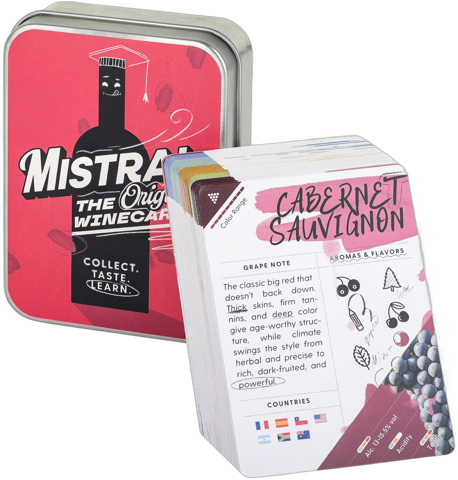
Every concept in this article fits on a card.
Mistral WineCards. Deck ONE: Global. 55 wine education cards covering grapes, regions, terroir, and winemaking. $35.
Get the Deck- Preston Zinfandel$45The 2023 is 97% Zinfandel and 3% Mataro from certified organic estate grapes, with 723 cases produced.
- Preston L. Preston$48Signature red blend introduced in 2001 in homage to the Southern Rhône; the 2022 is 32% Syrah, 32% Mourvedre, 30% Grenache, and 6% Cinsaut.
- Preston Carignane$45From eighty-year-old vines; whole bunches are crushed by foot in an open-top fermenter and aged in neutral barrels.
- Preston Sauvignon Blanc$36From blocks planted in 1990; the 2025 was fermented in 85% stainless steel and 15% used French and Austrian oak.
- Preston Vin Gris$36Provençal-inspired dry rosé; the 2025 is 40% Mourvedre, 40% Cinsaut, and 20% Grenache.
New to Wine.com? $25 off $350+ with codeJOVIAL25
Wine with Seth may earn a commission on Wine.com purchases at no cost to you. Wine links are for adults 21 and over.
- Preston's first Dry Creek parcel, the Hartsock Ranch, was purchased in 1973; the first winery (1975) was set up in its historic prune dehydrator
- Sauvignon Blanc was the first new grape planted (1974); Syrah followed in 1978 as the first Rhône variety
- Signature blends L. Preston (red) and Madam Preston (white) were introduced in 2001, reflecting Rhône Valley blending traditions
- First CCOF organic certification came in 2002; biodynamic farming began in 2010 under the guidance of Philippe Cordery
- Fermentations are initiated spontaneously, without commercial yeast or malolactic bacteria
Tasted a Preston Farm and Winery wine?
Log it in your Tasting Journal and build your palate over time.
Start your Journal