Palate Assessment — Sweetness, Acidity, Tannin, Alcohol, Body, Flavor Intensity, Finish
What to feel for once the wine is in your mouth, using a common framework and a common language for sweetness, acidity, tannin, alcohol, body, flavor and finish.
Palate assessment is the part of tasting that happens once the wine is in your mouth. Take a sip and move the wine around your mouth so some of it reaches your gums. The palate part of the WSET Systematic Approach to Tasting (SAT) covers sweetness, acidity, tannin, alcohol and body, then flavor intensity, flavor characteristics and finish. The finish is how long the pleasant sensations stay after you swallow or spit. The palate also checks the nose: it confirms what you smelled, or shows that the fruit, earth or other qualities have changed from nose to palate.
How to Taste: Palate
WineSchool Level 1 · free in the app
Take Palate Assessment - Sweetness, Acidity, Tannin, Alcohol, Body, Flavor Intensity, Finish into the app. Flashcards, trivia and label lookup.
Open the appDefinition and Origin
Palate assessment is the part of tasting that happens once the wine is in your mouth. The WSET Systematic Approach to Tasting (SAT) gives tasters a common framework and a common language, and it covers appearance, nose, palate and conclusions. The SAT exists at Level 2, Level 3 and Level 4 (the Diploma). Its palate section covers sweetness, acidity, tannin, alcohol, body, flavor intensity, flavor characteristics and finish. What you find on the palate feeds the conclusions: an assessment of quality is based on the sum of a wine's structural components (acidity, tannin, alcohol and so on) and its flavor and aroma characteristics. At Level 4, an explanation supporting the quality assessment is required. The relative importance of quality criteria can depend on personal preferences, and one of the challenges of tasting as a professional is to recognize and put aside those preferences to reach a considered view based on the evidence.
- Level 2 uses three-step scales for most palate lines (acidity, tannin and alcohol low, medium, high; body light, medium, full) and four sweetness steps: dry, off-dry, medium, sweet.
- Levels 3 and 4 add medium(-) and medium(+) steps for acidity, tannin, body, flavor intensity and finish, and use six sweetness steps: dry, off-dry, medium-dry, medium-sweet, sweet, luscious.
- Level 4 also asks for the nature of the tannin (for example ripe, soft, smooth, unripe, green, coarse, stalky, chalky, fine-grained) and has an 'other observations' line for texture.
- In the Diploma tasting exam, tannin level and nature are marked for red wines only; tannin noticed in a white or rosé can be mentioned as an 'other observation'.
- The palate section of the WSET Systematic Approach to Tasting (SAT) covers sweetness, acidity, tannin, alcohol, body, flavor intensity, flavor characteristics and finish.
- The finish is the collection of sensations on the palate after you swallow or spit, and only the pleasant sensations count toward its length.
- Level 2 of the SAT rates the finish as short, medium or long; Levels 3 and 4 use five steps: short, medium(-), medium, medium(+), long.
- Body is the perception of a wine's weight on the palate. For most wines alcohol is the main factor; sugar and grape extract add to body, while high acidity makes a wine feel lighter.
- Acidity makes your mouth water: the more it waters, and the longer it waters, the higher the acidity.
- Tannins bind to proteins in saliva and cause a drying sensation, felt most clearly on the gums above the front teeth. In the WSET Diploma tasting exam, tannin is marked for red wines only.
- The SAT quality scale runs faulty, poor, acceptable, good, very good, outstanding.
How to Identify Each Dimension
Take a sip and move the wine around your mouth, making sure some of it reaches your gums. Sweetness is mainly the taste of sugar in the wine, though alcohol and glycerol can add a perception of sweetness too. For most people, acids are detected most strongly at the sides of the tongue, where they cause a sharp, tingling sensation, and they make your mouth water: the more it waters, and the longer it waters, the higher the acidity. Tannins bind to proteins in your saliva and cause a drying sensation, felt most clearly on the gums above your front teeth. Alcohol is detected mainly through touch; at high levels it can give a hot, burning sensation, especially after spitting or swallowing. Body is the wine's weight on the palate, its fullness. Flavor intensity is how flavorsome the wine is on the palate, and it is picked up through smell: your body heat warms the wine and aromatic molecules rise up the back of your nose. The finish is the collection of sensations after you swallow or spit, and only the pleasant ones count toward its length. The palate also checks the nose. Timothy Gaiser, writing for GuildSomm, describes tasting as confirming what you have already smelled and noticing whether the fruit, non-fruit or earth qualities have changed from the nose to the palate.
- Acidity: wines with low acidity feel broad, soft or even flabby; wines with high acidity are notably crisp, zesty and mouth-watering. If you are dehydrated, your mouth will water less.
- Tannin: unripe tannins tend to be more astringent and often taste bitter, green or stalky, while ripe tannins contribute more to textural richness and are generally fine-textured.
- Alcohol: the burn of high alcohol can be confused with the tingle of acidity. Check whether the wine is also mouth-watering (acidity) or feels thick and viscous (alcohol); it can be high in both.
- Finish: a wine with a very long lingering bitterness can be described as having a bitter aftertaste, but if the fruit impressions disappear quickly, the finish is short.
- Timing: Gaiser finds that acid, alcohol and tannin are a delayed physical response for many tasters, and advises waiting at least 3 to 5 seconds before describing them.
- Where things land: Steven Spurrier, writing for Decanter, places sweetness on the tip of the tongue, acids on the side and tannins on the back, and calls the palate 'a pretty blunt instrument'; the WSET guide places the drying feel of tannin most clearly on the gums above the front teeth.
The glasses, tools, and cards I stand behind.
A short list. Nothing I would not recommend to a friend.
Browse the WineShopStructure, Balance, and Quality
The WSET Diploma tasting guide calls a wine's overall balance or integration perhaps the most reliable indicator of quality. In high-quality wines, an impression of sweetness (fruit character and/or residual sugar) is balanced by an impression of sourness (acidity or tannic astringency). With too little fruit character or residual sugar, a wine seems unbalanced, austere and thin; with too little acid or tannin, it seems flabby or unstructured. A feature that stands out can be a negative, such as alcohol that dominates and leaves a hot, burning finish. How long the sensations linger is an important indicator of quality: a wine with a pleasant, long finish is likely to have high levels of concentration, and a short or simple finish indicates a lack of intensity. The more concentrated and expressive a wine is, the higher its quality level, and a wine with weak or dilute flavors is seldom high in quality. Complexity can come from fruit character alone or from a combination of primary, secondary and tertiary aromas and flavors, though not all high-quality wines are complex. The WSET guide lists quality considerations such as balance/integration, intensity, finish and complexity. A related shorthand, BLIC (Balance, Length, Intensity, Complexity), is one Natasha Hughes MW, writing for GuildSomm, recalls being trained on at the start of Master of Wine study and calls a decent foundation, while also pointing out potential inconsistencies in it.
- An outstanding wine should be almost entirely free of criticism: perfectly balanced, concentrated and very expressive, with high levels of complexity or purity depending on the style.
- A very good wine shows some elements of concentration, length, complexity or expressiveness that lift it out of being merely good. A wine that is out of balance or dilute in flavor, but otherwise drinkable, is acceptable.
- If a wine has sufficient concentration, acidity (and tannin) to age successfully, this generally implies higher quality than other wines of its type that lack these attributes.
- Hughes notes that any assessment of balance is highly vulnerable to personal preferences, and that it is fairly easy for tasters to agree on the length of a finish.
- To measure length, you can start a slow count once you have spat the wine out. There is even a unit for it, the caudalie, equal to one second.
The Key Palate Dimensions: Technical Detail
On the tasting scale, sweetness is judged by taste. A dry wine has no residual sugar or levels so low they cannot be detected on the palate, and an off-dry wine has a very small amount of detectable sugar. Labelling terms are a separate matter: sweetness terms on labels are legally controlled in the EU, and the categories for sparkling wines and for other products are different. Under Commission Delegated Regulation (EU) 2019/33, Annex III (UK-retained text), the label term 'dry' for products other than sparkling wine applies up to 4 g/L of sugar, or up to 9 g/L when total acidity (expressed as grams of tartaric acid per litre) is not more than 2 g/L below the residual sugar. 'Medium dry' runs above that up to 12 g/L, or up to 18 g/L when total acidity is not more than 10 g/L below the residual sugar; 'medium' or 'medium sweet' runs above that up to 45 g/L; and 'sweet' means at least 45 g/L. In the WSET tasting exams, candidates are told not to concern themselves with the legal definitions or give an estimate of sugar content in g/L. In the lab, acidity can be measured as titratable acidity (TA) expressed as tartaric acid, and white wine TAs are typically higher than those of red wines. On the WSET Diploma alcohol scale, for wines other than fortified wines, below 11% abv is low, 11 to 11.9% is medium(-), 12 to 12.9% is medium, 13 to 13.9% is medium(+) and 14% abv or above is high. Alcohol levels in wines are generally rising.
- A UC Davis summary of a study by Harbertson and colleagues (American Journal of Enology and Viticulture, 2008) reports that 1,325 commercial red wines measured with the Adams/Harbertson assay had a mean tannin concentration of 544 mg/L catechin equivalents.
- In that study, Cabernet Sauvignon (672 mg/L) and Zinfandel (652 mg/L) showed similar values, followed by Merlot (559 mg/L), Syrah (455 mg/L) and Pinot Noir (348 mg/L), but the overlap across varieties was so large that tannin concentration was not sufficient to identify the variety.
- Late harvest, botrytized and ice wines have higher TAs, since their high residual sugar needs a high acidity for taste balance.
- As wines age, aromas and flavors tend to develop from fruity and floral toward more savory, earthy and spicy characters, and any tannins soften. Alcohol levels do not change, and acid and sugar levels change very little.
Practical Application: Benchmark Wine Styles
Familiar styles help anchor each step of the sweetness scale. Many, but not all, Alsace Gewürztraminers, Brut Champagnes and inexpensive red, white and rosé wines are off-dry. Medium-dry covers wines closer to dry than sweet, such as Vouvray demi-secs, and medium-sweet covers wines closer to sweet, including many White Zinfandels and Moelleux Vouvrays. The sweet category covers most classic sweet wines, such as Sauternes and Port. Luscious wines, such as Rutherglen Muscats, PX Sherries and some Trockenbeerenauslesen, are notably more viscous and leave the mouth and lips with a sticky sweet sensation after swallowing or spitting. For WSET tasting exams, a demi-sec Champagne, which must have a residual sugar level of 32 to 50 g/L, should be described as medium-sweet or sweet depending on how it appears to you on the palate.
- Climate clues: a wine from a hot region tends to show riper primary aromas and flavors, fuller body, higher alcohol, lower acid and riper tannins; a cool-region wine shows fresher fruit, lighter body, higher acid and perhaps more astringent tannins.
- Pinot Noir: New World wines generally have more generous fruit, with acidity and tannin less prominent, while European examples tend to be more savory, with more prominent acidity and tannins. Many New World producers make savory, structured wines and some Old World producers make lightly structured, very fruity ones, so the picture is not clear-cut.
- Tannin level and feel are different things: a basic-quality Cabernet Sauvignon made from just-ripe grapes can have a medium level of very astringent, harsh tannins, while a high-quality Shiraz from a hot region may have very high levels of velvet-textured ripe tannins that are not astringent.
- Body is easiest to judge at the extremes: high alcohol, ripe tannins and intense flavors mean full-bodied; low alcohol, high acid and delicate flavors mean light-bodied. For wines that are sweet but high in acidity and low in alcohol, it can be harder to agree on the level of body.
One glass for everything, Champagne to Barolo.
The Gabriel-Glas StandArt is the one I name when someone asks which single stem to buy. Light, wide bowl, dishwasher safe, and it flatters this grape as much as any other.$67 a pair.
See the StandArtHow the Palate Dimensions Interact
The palate lines affect each other. High levels of sweetness can lessen your perception of acidity, so the acidity in a sweet wine appears less obvious than the acidity in a dry wine; whatever the level of sugar, the mouth-watering effect of the acidity remains a reliable guide. Higher alcohol tends to make a wine seem heavier in the mouth, while low alcohol can make a wine seem watery, although grape extract and sweetness can compensate. High levels of tannin generally make a wine feel fuller-bodied, but low levels of astringent tannin can make it seem harsher, thinner and therefore lighter in body. Intensity is closely linked to finish. On the finish, consider balance: is the overall impression one of harmony, or is the wine disjointed, with one element overly dominant? Steven Spurrier makes the same point for Decanter: for a good wine, the impression left after you swallow or spit 'has to be harmonious.'
- Fruit and acidity: marked acidity can complement the depth of fruit, freshening the palate.
- Concentration and balance: above a certain level, concentration of a particular aroma or flavor can make a wine seem out of balance.
- Oak and fruit: if a wine has high levels of oak aromas or flavors, ask whether they complement the fruit character or mask it.
- Sugar and acid together: late harvest, botrytized and ice wines balance high residual sugar with higher acidity.
Sources and last verified
Primary sources: https://www.wsetglobal.com/media/13156/wset_l2wines_sat_en_may2023_issue2.pdf https://www.wsetglobal.com/media/3119/wset_l3_wines_sat_en_jun-2016.pdf https://www.wsetglobal.com/media/13271/wset_l4wines_sat_en_aug2023.pdf https://www.wsetglobal.com/media/6714/wset_l4diploma_cag_tasting_en_aug2018.pdf https://wineserver.ucdavis.edu/sites/g/files/dgvnsk2676/files/research-summaries/138%20tannin%20levels%20in%20red%20wines.pdf (summary of Harbertson et al., American Journal of Enology and Viticulture 59(2):210-214, 2008) https://wine.wsu.edu/managing-high-acidity-in-grape-must-and-wine/ https://www.awri.com.au/industry_support/winemaking_resources/frequently_asked_questions/acidity_and_ph/ https://www.legislation.gov.uk/eur/2019/33/annex/III/data.xht?view=snippet&wrap=true Secondary sources: https://www.guildsomm.com/research/mw-perspectives/b/mw-perspectives/posts/evaluating-quality https://www.guildsomm.com/public_content/features/articles/b/timothy_gaiser/posts/tasting-exam-advice https://www.decanter.com/learn/how-to/how-to-taste-wine-wine-tasting-tutorial-54245/ https://www.wsetglobal.com/knowledge-centre/blog/2026/how-to-train-your-palate Last verified 2026-11-02

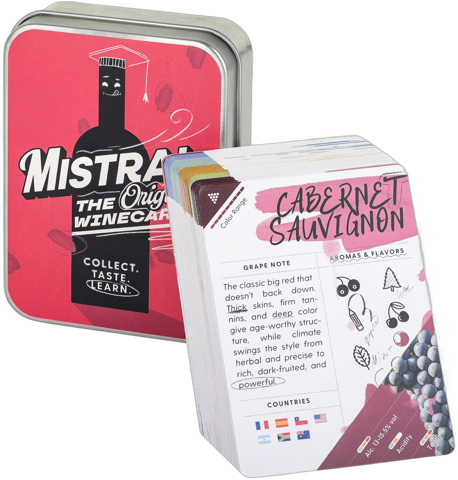
Every concept in this article fits on a card.
Mistral WineCards. Deck ONE: Global. 55 wine education cards covering grapes, regions, terroir, and winemaking. $35.
Get the Deck- WSET SAT palate lines: sweetness, acidity, tannin, alcohol, body, flavor intensity, flavor characteristics, finish. In the Diploma exam, tannin is marked for red wines only; tannin in a white or rosé can go under other observations.
- Finish scale: Level 2 short, medium, long; Levels 3 and 4 short, medium(-), medium, medium(+), long. Count only the pleasant sensations after swallowing or spitting.
- Acidity: the more your mouth waters, and the longer, the higher the acid; high sweetness lessens the perception of acidity. Body: alcohol is the main factor for most wines; sugar and grape extract add, high acidity lightens.
- WSET Diploma guide alcohol bands for wines other than fortified: below 11% abv low; 11 to 11.9% medium(-); 12 to 12.9% medium; 13 to 13.9% medium(+); 14% abv or above high.
- EU label term 'dry' for products other than sparkling wine: up to 4 g/L, or up to 9 g/L when total acidity is not more than 2 g/L below the residual sugar; 'sweet': at least 45 g/L. In the WSET tasting exams, sweetness is judged by taste, not by a g/L estimate.
Put this into practice
Blind tastings, flashcards, and trivia in the Wine with Seth app.
Try the app free