Kistler Vineyards
A Sonoma County Chardonnay and Pinot Noir house founded in 1978 by Steve Kistler and Mark Bixler, bottling twelve single-vineyard Chardonnays and two single-vineyard Pinot Noirs.
Kistler Vineyards was founded in 1978 by Steve Kistler and Mark Bixler on the notion that compelling wines of site should be made in California. Its first vintage, 1979, included a Dutton Ranch Chardonnay. Bill Price, longtime owner of Durell Vineyards, purchased an interest in the winery from Steve Kistler in 2008, and Jason Kesner joined Steve in the cellar the same year. Steve Kistler retired from Kistler Vineyards at the end of 2017, and Kesner is President-Winemaker. The winery farms seventeen vineyards across five appellations, from Carneros to Sonoma Valley, the Russian River Valley and the Sonoma Coast, and has planted one heritage clone across all of its Chardonnay vineyards since the mid-1980s.
Take Kistler Vineyards into the app. Flashcards, trivia and label lookup.
Open the appHistory and Ownership
Steve Kistler met Mark Bixler at Fresno State, where Bixler was teaching chemistry, and in 1975 became the first winemaking assistant at Ridge Vineyards. In 1978 Kistler and Bixler established their own mountain winery, with backing from Kistler's family, at the 1,800-foot level above Sonoma Valley, east of Glen Ellen. The first vintage was 1979, with 3,000 cases made, and it included the Dutton Ranch Chardonnay. Cabernet Sauvignon was dropped from the lineup in 1993. The winery moved to a new building near Graton, completed in 1992; 1991 was the last vintage made at the Glen Ellen site. Bill Price, longtime owner of Durell Vineyards, purchased an interest in Kistler Vineyards from Steve Kistler in 2008. Kistler had worked with Price since 1998, the year Price acquired the 200-acre Durell Vineyard, and the 2008 deal left management and winemaking unchanged. Jason Kesner joined Steve in the cellar in 2008 to begin laying the groundwork for the next forty years. In December 2017 Steve Kistler's departure as CEO and director of winemaking was announced, with the stated plan that he would focus on winemaking at his family's Occidental brand; he retired from Kistler Vineyards at the end of 2017.
- 1978: founded by Steve Kistler and Mark Bixler above Sonoma Valley, east of Glen Ellen
- 1979: first vintage, 3,000 cases, including the Dutton Ranch Chardonnay
- 1992: winery near Graton completed; 1991 was the last vintage at Glen Ellen
- 2008: Bill Price purchased an interest in the winery; Jason Kesner joined the cellar
- End of 2017: Steve Kistler retired from Kistler Vineyards
- Founded in 1978 by Steve Kistler and Mark Bixler (d. 2017); the first vintage, 1979, included a Dutton Ranch Chardonnay.
- Bill Price, longtime owner of Durell Vineyards, purchased an interest in Kistler Vineyards from Steve Kistler in 2008.
- Jason Kesner joined in 2008 and is President-Winemaker; Steve Kistler retired at the end of 2017.
- Seventeen vineyards farmed across five appellations, bottled as twelve single-vineyard Chardonnays and two single-vineyard Pinot Noirs.
- One heritage Chardonnay clone, worked since the mid-1980s, whose parent material was imported from Burgundy in the early 20th century; two heritage Pinot Noir selections.
- All Chardonnays are fermented in subterranean barrel chais with native yeasts, in French barrels made from wood air-dried in St. Romain.
People and Roles
Jason Kesner is President-Winemaker of Kistler Vineyards. He began working with Steve Kistler in the spring of 2000, growing the fruit at Hudson Vineyards for the Kistler bottling, and joined Kistler in 2008. Bill Price was Managing Partner when Steve Kistler's departure was announced in December 2017. Cofounder Mark Bixler (d. 2017) served as business manager, oversaw sales and marketing and ran the winery's lab; he studied chemistry at MIT and the University of California at Berkeley and taught chemistry at Fresno State University for seven years. Steve Kistler studied at UC Davis and Fresno State before starting the winery.
- Jason Kesner: President-Winemaker; joined Kistler in 2008
- Bill Price: longtime owner of Durell Vineyards; Managing Partner as of December 2017
- Mark Bixler (d. 2017): cofounder, business manager and head of the lab
- Steve Kistler: cofounder; retired at the end of 2017
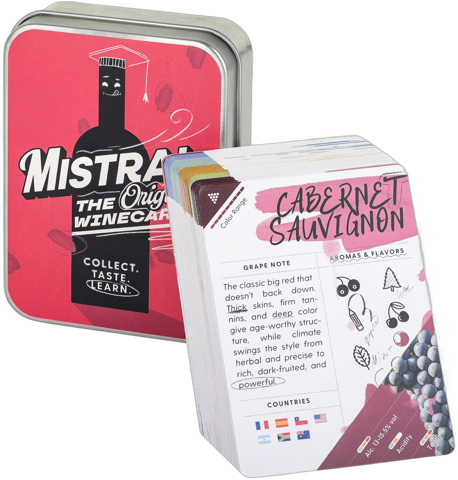
The glasses, tools, and cards I stand behind.
A short list. Nothing I would not recommend to a friend.
Browse the WineShopVineyards and Sources
Kistler farms seventeen vineyards across five appellations, from Carneros to Sonoma Valley, the Russian River Valley and the Sonoma Coast. It plants in partnership with its growers instead of buying fruit, propagating on growers' land the same heritage plant material it uses in its own vineyards; its grower connections go back to the late 1970s, and the youngest of those relationships is over thirty years old. The original Kistler planting, Kistler Vineyard, sits just shy of 1,800 feet in a small bowl on the western edge of the Mayacama Mountains, where dry-farmed vines grow in deep red volcanic soils. Vine Hill Vineyard surrounds the winery just north of Graton, in a pure sand subset of the Goldridge soil series. Dutton Ranch lies where the Russian River Valley and Sonoma Coast appellations intersect, on Goldridge soil, and Kistler has worked with the Dutton family since nearly its inception. Durell Vineyard, in the southern reach of Sonoma Valley where it meets the Sonoma Coast and Carneros appellations, is marine loam crossed by a stony vein; Stone Flat lies directly across from the Durell block on the same soils but a different rootstock. Hudson Vineyard, in the southwestern reaches of Napa County, supplies fruit from its Block E, and Hyde Vineyard sits in the heart of Carneros on marine loam. McCrea Vineyard is on the eastern flank bench of Sonoma Mountain, in a mix of Sonoma volcanics and limestone. Laguna Ridge, on sandstone, granular sediments and shards of petrified wood, is the only site from which Kistler bottles both a Chardonnay and a Pinot Noir, and Silver Belt Vineyard is an uplift of older iron oxide soils mixed with gravel.
- Dutton Ranch: bottled since 1979; Goldridge soil
- Kistler Vineyard and Durell Vineyard: each bottled since 1986
- McCrea Vineyard: Athearn Estate-bottled since 1988
- Vine Hill Vineyard: bottled since 1991; surrounds the winery
- Hudson Vineyard and Hyde Vineyard: each bottled since 1994
- Stone Flat Vineyard: bottled since 2002; Trenton Roadhouse Vineyard: bottled since 2009
- Laguna Ridge Vineyard: Pinot Noir since 2006, Chardonnay since 2015
Plant Material
Kistler has worked with a single clone of Chardonnay since the mid-1980s and has planted it across all of its Chardonnay vineyards. The clone's parent material was imported from Burgundy in the early part of the 20th century, and over decades in California it was selected by farmers and winemakers to ripen well in Californian growing conditions. Kistler has made further selections of the clone, propagating for low yields, small berries, great concentration and the ability to retain natural acidity during ripening. Its Pinot Noirs come from two heritage selections propagated for the last twenty-five years; after years of choosing between them, the winery concluded that it preferred both, and its newer Pinot Noir vineyards are planted with a field mix of the two. Both selections are marked by very low yields, small berries, great concentration and color, and a propensity to hold their natural acids during ripening.
- Chardonnay: one heritage clone across all Chardonnay vineyards since the mid-1980s
- Parent material imported from Burgundy in the early 20th century
- Pinot Noir: two heritage selections, now planted as a field mix in newer vineyards
Winemaking
Fruit is harvested in the cool of the night. All of the Chardonnays are fermented in subterranean barrel chais, where native yeast and biological patinas govern the ecology. The wines are housed in hand-stacked French cooperage that Kistler buys as wood and has air-dried in St. Romain, where it is made into barrels three years later. Fermentations are conducted solely with native yeasts, at moderately cool temperatures and with little to no machination of the fruit, and each Pinot Noir fermentation is watched over manually twenty-four hours a day. As of 2000, grapes were hand-sorted and pressed as whole clusters, and all but one bottling went unfined and unfiltered.
- Night harvest
- Native-yeast fermentation for all wines
- Chardonnays fermented in subterranean barrel chais
- French barrels from wood air-dried in St. Romain
Wines
The lineup comprises twelve single-vineyard Chardonnays and two single-vineyard Pinot Noirs. The Chardonnays are Durell Vineyard, Dutton Ranch, Hudson Vineyard, Hyde Vineyard, Kistler Vineyard, Kistler Vineyard Cuvée Cathleen, Laguna Ridge Vineyard, McCrea Vineyard, Stock Ranch, Stone Flat Vineyard, Trenton Roadhouse Vineyard and Vine Hill Vineyard. The Pinot Noirs are Laguna Ridge Vineyard, formerly labelled as Kistler Vineyard, and the Cuvée Natalie from Silver Belt Vineyard, each made from its site since 2006. Cuvée Cathleen, bottled since 1998, comes solely from one block of the Kistler Vineyard, planted in 1989 on a broken shale uplift that faces the afternoon sun. Stock Ranch comes from a site two ridges in from the coast in western Sonoma County.
- Twelve single-vineyard Chardonnays
- Two single-vineyard Pinot Noirs: Laguna Ridge Vineyard and Silver Belt Vineyard (Cuvée Natalie)
- Cuvée Cathleen: one block of the Kistler Vineyard, bottled since 1998
Open one bottle, taste it for weeks.
The Coravin Pivot+ is the simpler Coravin, for wines you will finish inside a few weeks, which is how I taste a producer across vintages without finishing every bottle. It takes five seconds to use.$199.
See the Pivot+House Style
Kistler frames its approach as 'Old world reverence applied to new world sites,' and its stated goal for nearly fifty years has been to lessen its imprint on every vineyard it works with and on the wines that result. In 2000, Steve Kistler called the French model 'a simple, elegant system that allows for the clearest expression of the vineyard.' Jason Kesner frames the work over a longer horizon: 'We’ll be tasting at the winery and I’ll ponder aloud how great some of these sites will be in a hundred years.'
Visiting
Kistler receives guests at Trenton Roadhouse, at the southern end of the Russian River Valley, a property with a restored farmhouse, barn and outdoor spaces. All visits are by appointment, Tuesday to Saturday, for guests 21 and older, and the number of daily tastings is limited. As of October 2026 the experiences included a Five-Wine Tasting of four single-vineyard Chardonnays and one Pinot Noir from the library, and a Seven Single-Vineyard Chardonnay Tasting.
Sources and last verified
Primary sources (producer's own site): https://www.kistlervineyards.com/, https://www.kistlervineyards.com/wines/, https://www.kistlervineyards.com/press/, https://www.kistlervineyards.com/visit/. Secondary sources: Wine Spectator (31 January 2008; 31 July 2000) and The Press Democrat (13 December 2017). Last verified 2026-10-19. Where the producer's site and a secondary source disagree, the producer's site governs.
Pour one glass. Keep the bottle for months.
Coravin is how I drink the serious stuff on a Tuesday without committing to the whole bottle.
See Coravin- Kistler Kistler Vineyard ChardonnayFrom the original Kistler planting, just shy of 1,800 feet on the western edge of the Mayacama Mountains; bottled since 1986.
- Kistler Dutton Ranch ChardonnayBottled since 1979 from Goldridge soil where the Russian River Valley and Sonoma Coast appellations intersect.
- Kistler McCrea Vineyard ChardonnayAthearn Estate-bottled since 1988 from Sonoma volcanics and limestone on the eastern flank bench of Sonoma Mountain.
- Kistler Hudson Vineyard ChardonnayBottled since 1994 from Block E in the southwestern reaches of Napa County, where volcanic and marine sediment soils mix at the surface.
- Kistler Silver Belt Vineyard Pinot NoirThe source of the Cuvée Natalie Pinot Noir since 2006, on an uplift of older iron oxide soils mixed with gravel.
New to Wine.com? $25 off $350+ with codeJOVIAL25
Wine with Seth may earn a commission on Wine.com purchases at no cost to you. Wine links are for adults 21 and over.
- Founded in 1978 by Steve Kistler and Mark Bixler (d. 2017) above Sonoma Valley, east of Glen Ellen; first vintage 1979; winery near Graton completed in 1992.
- Ownership: Bill Price, longtime owner of Durell Vineyards, purchased an interest from Steve Kistler in 2008; Steve Kistler retired at the end of 2017.
- Jason Kesner joined in 2008 and is President-Winemaker.
- Plant material: one heritage Chardonnay clone, from parent material imported from Burgundy in the early 20th century, planted across all Chardonnay vineyards; two heritage Pinot Noir selections.
- Seventeen vineyards across five appellations; twelve single-vineyard Chardonnays and two single-vineyard Pinot Noirs; native-yeast fermentation, Chardonnays in subterranean barrel chais.
Tasted a Kistler Vineyards wine?
Log it in your Tasting Journal and build your palate over time.
Start your Journal