Lutte Raisonnée (Reasoned Struggle — Sustainable Middle Ground)
loot reh-zoh-NAY
Lutte raisonnée treats vines when monitoring shows a real risk of damage, instead of spraying on a fixed calendar, an approach that contrasts with calendar-based spraying and foreshadows integrated control.
Lutte raisonnée treats vines when monitoring shows a real risk of damage, instead of spraying on a fixed calendar; the treatments are still largely chemical, but fewer of them are applied. Interventions are decided after estimating the real risk in each plot, combining field observations with decision-support tools such as forecast models, and pesticides are chosen for the lowest ecological impact. Lutte raisonnée stands against calendar-triggered "insurance" control and foreshadows integrated control, a separate concept. In France, viticulture raisonnée is the application to viticulture of agriculture raisonnée, defined by a 2002 decree, and the charters of viticulture raisonnée include Terra Vitis.
Take Lutte Raisonnée (Reasoned Struggle - Sustainable Middle Ground) into the app. Flashcards, trivia and label lookup.
Open the appWhat It Is: Definition
Lutte raisonnée treats vines when monitoring shows a real risk of damage, instead of spraying on a fixed calendar; the treatments are still largely chemical, but fewer of them are applied. In lutte raisonnée, the means of control, essentially chemical, are used judiciously, where there is a risk of exceeding the damage threshold. That sets it against lutte d'assurance ("insurance" control), in which treatments are triggered by a calendar, and it foreshadows lutte intégrée (integrated control). The OILB (Organisation Internationale de Lutte Biologique et Intégrée) defines lutte raisonnée as interventions decided after estimating the real risks at the scale of the plot, using appropriate monitoring methods and reference to tolerance or intervention thresholds, with pesticides chosen on criteria of lowest ecological impact in terms of active ingredient, quantity, timing of application and respect for natural enemies. Viticulture raisonnée is the application to viticulture of agriculture raisonnée, which French decree no. 2002-631 of 25 April 2002 defines as overall farm-management approaches that aim, beyond respecting regulation, to strengthen the positive effects of farming practices on the environment and reduce their negative effects, without compromising the economic profitability of farms. Decanter notes that most vineyards rely heavily on preventive spraying of herbicides, fungicides and pesticides to keep disease and pests at bay.
- The risk estimate combines observations in the plot with decision-support tools such as forecast models
- Calendar-triggered "insurance" control (lutte d'assurance) is the opposite approach
- Lutte intégrée, a separate concept, is the rational application of a combination of biological, biotechnological, chemical, physical, cultural or plant-selection measures
- Organic growers commit to using products free of synthetic organic molecules; in lutte raisonnée the means of control are essentially chemical
- In lutte raisonnée, the means of control, essentially chemical, are used judiciously, where there is a risk of exceeding the damage threshold, as opposed to "insurance" control (lutte d'assurance), in which treatments are triggered by a calendar
- The OILB (Organisation Internationale de Lutte Biologique et Intégrée) defines lutte raisonnée as interventions decided after estimating the real risks at the scale of the plot, using appropriate monitoring methods and reference to tolerance or intervention thresholds, with pesticides chosen on criteria of lowest ecological impact
- Lutte raisonnée foreshadows lutte intégrée (integrated control), a separate concept: the rational application of a combination of biological, biotechnological, chemical, physical, cultural or plant-selection measures
- Viticulture raisonnée is the application to viticulture of agriculture raisonnée, which French decree no. 2002-631 of 25 April 2002 defines officially
- Reasoned (level 1) protection is defined by limiting treatments through reasoning on intervention thresholds; the aim is to reduce the number of applications without changing their nature
- In an analysis of France's 2006 "Pratiques culturales" vineyard survey, 77% of plots were classed as reasoned (level 1), with an average treatment frequency index (IFT) of 13.0, 10.1 of it fungicides; 13% were classed as systematic (level 0), with an average IFT of 21.3, mainly from fungicides (18.1)
The Science Behind It: Monitoring and Decision Protocols
The risk estimate at the heart of lutte raisonnée couples observations in each plot with decision-support tools such as disease forecast models. The models the IFV (Institut Français de la Vigne et du Vin) uses against downy mildew, powdery mildew and black rot belong to the "Potentiels Systèmes" family; they are called climatic models because they rest on a weather reference of at least 30 years of data. In the Midi-Pyrénées region, 40 weather stations are queried daily for hourly and daily temperature and rainfall data, and the models feed the risk analysis of the Bulletin de Santé du Végétal (BSV), which is made available to the whole profession free of charge every week. A model cannot replace field observation and knowledge of the plots. In INRAE's Ecophyto R&D study, new decision-support tools such as OPTIDOSES and MILDIUM are presented as very promising for reducing the number of treatments or the doses applied at each pass.
- Potentiels Systèmes models cover downy mildew, powdery mildew and black rot and rest on at least 30 years of weather data
- Midi-Pyrénées: 40 weather stations queried daily; the models feed the weekly, free Bulletin de Santé du Végétal
- A model cannot replace field observation and knowledge of the plots
- Interviewees in the Ecophyto R&D study presented the reasoning of fungicide treatments as a major issue and said systematic treatments are no longer current, for economic and environmental reasons
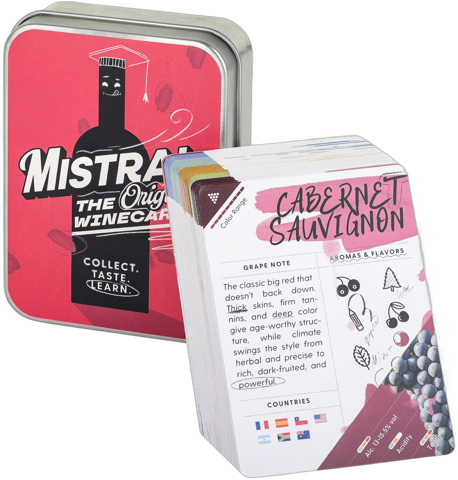
The glasses, tools, and cards I stand behind.
A short list. Nothing I would not recommend to a friend.
Browse the WineShopPesticide Use: What the Numbers Show
French vineyards cover about 3% of agricultural land. Their share of pesticide use is given differently: Decanter puts it at as much as 20%, while INRAE's Ecophyto R&D study gave 15%. An analysis of France's 2006 "Pratiques culturales" vineyard survey classed plots by level of protection. Level 1, reasoned protection, dominated with 77% of plots and an average treatment frequency index (IFT) of 13.0, 10.1 of it fungicides. Level 0, systematic treatment for permanent protection of the vineyard, still accounted for 13% of plots, with an average IFT of 21.3, mainly from fungicides (18.1). Level 1 is defined by limiting treatments through reasoning on intervention thresholds, drawn in particular from agricultural warnings (avertissements agricoles); the risk taken is low, since the aim is to reduce the number of applications without changing their nature.
- Level 0 (systematic): plots at or above a regional reference strategy of one anti-downy-mildew and one anti-powdery-mildew treatment every twelve days between two growth stages
- Level 1 (reasoned): 77% of plots in the 2006 survey, average IFT 13.0
- Level 0 (systematic): 13% of plots in the 2006 survey, average IFT 21.3
- Level 2 is defined by adopting alternatives to pesticides for at least one category of pest or disease
Charters and Certification in France
INRAE's Ecophyto R&D study analysed the specifications of the most used charters of viticulture raisonnée: Terra Vitis (which it describes as a brand grouped in associations and developed by the Chambres d'agriculture), VRC-VITEALYS and Agri-Confiance. Decanter describes Terra Vitis as created by a group of producers and industry associations and independently regulated. The study's text analysis found that recording and control terms are put forward repeatedly in these documents, while concrete techniques for reducing pesticide use are cited little or not at all; terms tied to alternatives to plant-protection treatments (soil work, grassing, mating disruption) appear only 11 times. Interviews in the study described the charters as useful tools supporting a considered strategy for reasoning plant-protection treatments, whose traceability they ensure; without effective support, though, they are only a basis for promotion and marketing and are not a sufficient lever to reach the desired reduction in pesticides.
- Most used charters of viticulture raisonnée analysed: Terra Vitis, VRC-VITEALYS and Agri-Confiance
- Two descriptions of who created Terra Vitis differ: a brand developed by the Chambres d'agriculture and grouped in associations, or a group of producers and industry associations
- The charters ensure the traceability of reasoned plant-protection treatments
- Recording and control terms dominate the charter documents; concrete pesticide-reduction techniques are cited little or not at all
The book I hand to someone starting out.
Wine Folly: Magnum Edition explains wine without reading like a textbook, and the charts do more teaching than most paragraphs.$35.
See Wine FollyThe Practical Reality: Strengths and Limitations
Lutte raisonnée changes how many treatments are applied rather than what is applied: reasoned protection aims to reduce the number of applications without changing their nature, and the means of control remain essentially chemical. It depends on the risk estimate, which couples observations in the plot with decision-support tools, and those tools have limits: exceptional weather events are not always taken into account, weather data must be reliable, and a model must be validated over many vintages before it can be considered robust. Biological control, which the OILB defines as the use of living organisms to prevent or reduce the damage caused by pests, is not restricted to organic viticulture and is also used in viticulture raisonnée. Sustainable viticulture (viticulture durable) is an overall approach at the scale of grape-production systems, combining the economic permanence of farms and territories with quality products, precision-viticulture requirements, environmental risks, product safety and consumer health, and heritage, historical, cultural, ecological and landscape values.
- Reasoned protection reduces the number of applications without changing their nature
- Model limits: exceptional weather events are not always taken into account, weather data must be reliable, and a model must be validated over many vintages
- Biological control techniques are also used in viticulture raisonnée, not only in organic viticulture
- Sustainable viticulture is an overall approach at the scale of grape-production systems
Sources and last verified
Primary sources: https://www.vignevin.com/publications/fiches-pratiques/viticulture-raisonnee-biologique-biodynamique-definitions/, https://www.vignevin.com/publications/fiches-pratiques/les-modeles-de-prevision-des-maladies-cryptogamiques/, https://ephytia.inrae.fr/fr/C/16460/Hypp-encyclopedie-en-protection-des-plantes-imago-lutte-raisonnee, https://www.inrae.fr/sites/default/files/pdf/4737337f04b44cd2735d2d74edf5a0db.pdf. Secondary sources: https://www.decanter.com/learn/sustainability-in-wine-explained-478803/, https://www.decanter.com/learn/wine-sustainable-option-410262/. Last verified 2026-11-02
The map is the lesson
The World Atlas of Wine next to any region article makes the geography click.
See the book- Lutte raisonnée: the means of control, essentially chemical, are used judiciously where there is a risk of exceeding the damage threshold; it is the opposite of calendar-triggered lutte d'assurance and foreshadows lutte intégrée (integrated control).
- OILB definition: interventions decided after estimating the real risks at plot level, using monitoring methods and tolerance or intervention thresholds, with pesticides chosen for lowest ecological impact.
- Reasoned (level 1) protection reduces the number of applications without changing their nature; in the 2006 French vineyard survey analysis, level 1 covered 77% of plots (average IFT 13.0) and systematic level 0 covered 13% (average IFT 21.3).
- Viticulture raisonnée applies the concept of agriculture raisonnée, officially defined in France by decree no. 2002-631 of 25 April 2002.
- Terra Vitis, VRC-VITEALYS and Agri-Confiance are charters of viticulture raisonnée; organic growers, by contrast, commit to products free of synthetic organic molecules.
Put this into practice
Blind tastings, flashcards, and trivia in the Wine with Seth app.
Try the app free