Finish / Length / Persistence
How long a wine's pleasant sensations linger after you swallow or spit, and why tasters read that as a sign of quality.
Finish, length and persistence name the same stage of tasting: what stays on the palate after the wine has gone. WSET's Diploma tasting guide puts it this way: "The finish is the collection of sensations on the palate after you have swallowed or spat the wine out." Only the persistence of positive sensations counts. In its 2021 competition standard the OIV measures persistence in seconds, which it also calls caudalie, starting once the wine has left the mouth.
Structure at Home: Finish
WineSchool Level 1 · free in the app
Take Finish / Length / Persistence into the app. Flashcards, trivia and label lookup.
Open the appDefinition and Terms
Finish, length and persistence are overlapping names for one stage of tasting. WSET's Diploma Candidate Assessment Guide for tasting (Issue 13, August 2018) defines it this way: "The finish is the collection of sensations on the palate after you have swallowed or spat the wine out." Length is a tasting term for the duration of the aftertaste once a wine has been swallowed. It belongs to the final stage of sensory assessment, after appearance, aroma and palate, when the taster looks at balance and length, and some people call this stage the finish. The aftertaste is also known as the caudalie, the persistency or the resonance of a wine, and is more commonly called its length. The OIV uses caudalie as its unit: its 2021 competition standard calculates persistence in seconds (caudalie).
- Finish: the collection of sensations left on the palate after swallowing or spitting
- Length: the duration of the aftertaste once a wine has been swallowed
- Other names for the aftertaste: caudalie, persistency, resonance
- In OIV competition judging, persistence is calculated in seconds, also called caudalie
- The WSET Level 3 Systematic Approach to Tasting Wine (Issue 2, 2022) rates finish on five points: short, medium(-), medium, medium(+), long
- The WSET Level 2 Systematic Approach to Tasting Wine (Issue 2.1, 2026) uses three points for finish: short, medium, long
- The WSET Level 4 Systematic Approach to Tasting Wine (Issue 1.1, 2022) keeps the same five-point finish scale as Level 3
- Only the persistence of positive sensations counts toward the finish: a wine with long lingering bitterness but fruit that fades quickly has a short finish
- Generally, a basic quality wine's pleasant flavours often disappear within a few seconds (short), while a very fine wine's can last a minute or more (long)
- The OIV competition standard (2021 edition) measures persistence in seconds (caudalie), starting once the product has left the mouth
- On the OIV still-wine score sheet (2021 edition), harmonious persistence scores from 8 points for excellent persistence of more than 6 seconds down to 4 points for bad persistence of 1 second
The WSET Finish Scale
WSET's Systematic Approach to Tasting Wine (SAT) includes finish on the palate at Levels 2, 3 and 4. The Level 2 SAT (Issue 2.1, 2026) offers three entries: short, medium, long. The Level 3 SAT (Issue 2, 2022) and the Level 4 SAT (Issue 1.1, 2022) both use five: short, medium(-), medium, medium(+), long. On lines like this the Level 3 SAT requires students to select one and only one of the options, and in WSET Diploma exams giving more than one entry or a range for finish earns no mark, even if one of the entries is correct. Finish carries 1 mark in the Diploma tasting paper. As a rough calibration, for a basic quality wine the pleasant flavours often disappear within a few seconds and the finish is short, while for a very fine wine the flavours can last for a minute or more and the finish is long.
- Level 2 SAT (2026): short, medium, long
- Level 3 SAT (2022) and Level 4 SAT (2022): short, medium(-), medium, medium(+), long
- Pick one entry only; a range such as medium(+) to long gains no mark in WSET Diploma exams
- Basic quality wines: pleasant flavours often gone within a few seconds; very fine wines: a minute or more
The glasses, tools, and cards I stand behind.
A short list. Nothing I would not recommend to a friend.
Browse the WineShopHow to Assess Finish
Assessing finish means counting only what is pleasant. When judging the length of the finish, only the persistence of the positive sensations counts: a wine with a very long lingering bitterness could be described as having a bitter aftertaste, but if the fruit impressions disappear quickly, the finish is short. The OIV competition standard (2021 edition) sets out a counting method: the count starts once the product has left the mouth and is done by chewing, discreetly opening the lips and drawing a little air into the mouth, with slow chewing corresponding to approximately 1 second. Time matters too. The taster always needs to give time to assess length, which can be hard in a busy tasting or in the middle of a meal. A relative scale built through practice helps: does the aftertaste disappear quickly or do flavours linger, and which flavours stick around? Speaking to Jane Anson in Decanter, Jean-Claude Berrouet, winemaker of Pétrus for 40 years, described sweetness arriving after one or two seconds, then acidity and saltiness, with bitterness not perceptible until after eight or ten seconds.
- Count positive sensations only; lingering bitterness alone is a bitter aftertaste, not a long finish
- OIV counting method: start once the wine has left the mouth; slow chewing is roughly 1 second
- Give each wine time, and note which flavours linger and which fade
- Jean-Claude Berrouet: bitterness may not register until after eight or ten seconds
Persistence on the OIV Score Sheet
The OIV Standard for International Wine and Spirituous Beverages of Vitivinicultural Origin Competitions (2021 edition) builds persistence into its judging sheets. Its still-wine score sheet lists harmonious persistence under Taste, scored 8, 7, 6, 5 or 4 points. The descriptor sheet ties those points to seconds for still wines: excellent persistence of more than 6 seconds scores 8, very good persistence of 5 to 6 seconds scores 7, good persistence of 3 to 4 seconds scores 6, fairly good persistence of 2 seconds scores 5, and bad persistence of 1 second scores 4. The standard defines persistence as a measure of the length of residual olfacto-gustatory sensation, a single time measurement that starts once the product has left the mouth.
- OIV still-wine score sheet: harmonious persistence, 8 points at the top, 4 at the bottom
- More than 6 seconds: excellent (8); 5 to 6 seconds: very good (7); 3 to 4 seconds: good (6)
- 2 seconds: fairly good (5); 1 second: bad (4)
Finish as a Quality Indicator
How long the sensations linger is an important indicator of quality. The WSET Wine SAT lists finish among its quality considerations, alongside balance/integration, intensity, complexity, mousse, varietal definition and potential for ageing. Finish is closely linked to intensity: a wine with a pleasant, long finish is likely to have high levels of concentration, while a short or simple finish indicates a wine that lacks intensity. In a WSET Diploma quality assessment, candidates expand on the finish, describing what flavours persist and whether one element is overly dominant on the finish. On WSET's quality scale, a 'very good' wine shows some elements of concentration, length, complexity or expressiveness that lift it above 'good'. Decanter's glossary calls good length a sign of a high-quality wine, and Sarah Jane Evans MW counts length as one indicator of quality. Jane Anson quotes Emile Peynaud's 1983 book The Taste of Wine: ‘If harmony and balance are the hallmarks of a good wine, what distinguishes great wine is the length and aromatic character of its aftertaste.’
- WSET Wine SAT quality considerations: balance/integration, intensity, finish, complexity, mousse, varietal definition, potential for ageing
- Pleasant, long finish suggests high concentration; a short or simple finish suggests low intensity
- A WSET 'very good' wine shows some elements of concentration, length, complexity or expressiveness that lift it above 'good'
- Good length is a sign of a high-quality wine
One glass for everything, Champagne to Barolo.
The Gabriel-Glas StandArt is the one I name when someone asks which single stem to buy. Light, wide bowl, dishwasher safe, and it flatters this grape as much as any other.$67 a pair.
See the StandArtWhat Gives a Wine Length
Sarah Jane Evans MW, answering a reader question in Decanter, holds that length does not depend on the grape variety, the youth of the wine or the use of oak. She traces it to the interaction of many flavour compounds with colloids, tiny particles of pectins, phenolics and tannins that are not removed by fining and filtering; the resulting slow release of flavour compounds creates the perception of length. Balance also plays a part. Jean-Claude Berrouet put it this way to Decanter's Jane Anson: ‘If a wine is too bitter, too acidic, too astringent or too high in alcohol, there will always be a rupture in the aftertaste, which means it will lack persistency’. For Michel Chapoutier, the grapes for Rhône whites are high in sulphur-containing thiols that give an attractive bitterness and bring lift and persistency.
- In Sarah Jane Evans MW's view, length does not depend on grape variety, youth or oak
- Colloids (pectins, phenolics, tannins) slowly release flavour compounds, creating the perception of length
- Berrouet: excess bitterness, acidity, astringency or alcohol breaks the aftertaste
- Chapoutier: thiols in the grapes for Rhône whites bring lift and persistency
Sources and last verified
Primary sources: https://www.wsetglobal.com/media/11766/wset_l3wines_sat_en_may2022_issue2.pdf, https://www.wsetglobal.com/media/11767/wset_l4wines_sat_en_aug2022.pdf, https://www.wsetglobal.com/media/19131/wset_l2wines_sat_en_aug2026_issue21.pdf, https://www.wsetglobal.com/media/6714/wset_l4diploma_cag_tasting_en_aug2018.pdf, https://www.oiv.int/public/medias/7895/oiv-patronage-competition-norme-ed-2021.pdf. Secondary sources: https://www.decanter.com/learn/advice/gives-wine-length-356772/, https://www.decanter.com/learn/length-1-44234/, https://www.decanter.com/wine-news/opinion/news-blogs-anson/anson-on-thursday-tasting-wine-the-space-between-283413/. Last verified 2026-10-05

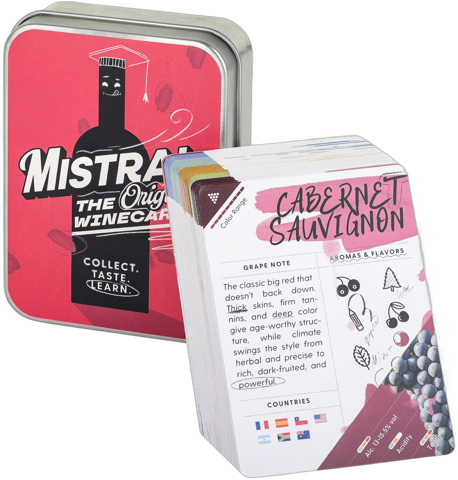
Every concept in this article fits on a card.
Mistral WineCards. Deck ONE: Global. 55 wine education cards covering grapes, regions, terroir, and winemaking. $35.
Get the Deck- WSET finish scales: Level 2 SAT (2026) short, medium, long; Level 3 SAT (2022) and Level 4 SAT (2022) short, medium(-), medium, medium(+), long. Choose one entry only; a range earns no mark.
- In WSET Diploma tasting, the finish is the collection of sensations on the palate after swallowing or spitting; count only positive sensations, so long bitterness with fast-fading fruit is a short finish.
- WSET calibration: basic quality wine, pleasant flavours often gone within a few seconds (short); very fine wine, a minute or more (long).
- Under the OIV competition standard (2021), persistence is measured in seconds (caudalie) from the moment the wine leaves the mouth; still-wine harmonious persistence scores 8 points for more than 6 seconds down to 4 points for 1 second.
- Finish is closely linked to intensity: a pleasant, long finish suggests high concentration; a short or simple finish suggests a wine lacking intensity.
Put this into practice
Blind tastings, flashcards, and trivia in the Wine with Seth app.
Try the app free