Château de Ferrand
Grand Cru ClasséSaint-Émilion Classificationsha-TOH duh feh-RAHN
A Saint-Émilion Grand Cru Classé on the Saint-Hippolyte clay-limestone plateau, founded in 1702 and owned by the Bich family since the late 1970s.
Château de Ferrand is a Saint-Émilion Grand Cru Classé in Saint-Hippolyte. Elie de Bétoulaud created the estate in 1702 and bequeathed it to his great-grandnephews, including the Marquis de Mons, whose line passed it down until 1978. Baron Marcel Bich, founder of the company bearing his name, bought Ferrand in the late 1970s, the only change of ownership in its history, and it is run by his daughter Pauline Bich Chandon-Moët and her husband Philippe Chandon-Moët. Ferrand became a Grand Cru Classé in 2012 after work on the vineyards and cellars that began in 2010, and it is listed among the Grands Crus Classés of the 2022 Saint-Émilion classification. After three years of conversion, 2024 is its first certified organic vintage.
Take Château de Ferrand into the app. Flashcards, trivia and label lookup.
Open the appHistory and Ownership
Château de Ferrand dates from 1702, when Elie de Bétoulaud, a lawyer and poet and an admirer of Louis XIV, created the estate and built it to reflect the elegance of Versailles. Below the château, he turned the lyre-shaped caves that open onto the Dordogne valley into a display of fossils, rare shells and sculptures. Lacking a direct heir, he bequeathed Ferrand through a poetry contest to his great-grandnephews, including the Marquis de Mons, whose line passed it down from generation to generation until 1978. In December 1977 Baron Marcel Bich, the industrialist who founded the company bearing his name, announced to his family that he was going to "turn water into wine," selling his shares in a mineral water brand to purchase Château de Ferrand; the late 1970s sale is the only time Ferrand has changed hands. Ownership has remained in the Bich family. From 2010 the vineyards were restructured and replanted, cultivation methods revamped and the cellars modernized, and in 2012 Ferrand became a Saint-Émilion Grand Cru Classé.
- 1702: Elie de Bétoulaud creates Château de Ferrand
- Until 1978: passed down through the line of the Marquis de Mons
- Late 1970s: bought by Baron Marcel Bich, the only change of ownership
- 2010: restructuring of the vineyards and modernization of the cellars begins
- 2012: Ferrand becomes a Saint-Émilion Grand Cru Classé
- Saint-Émilion Grand Cru Classé since 2012; listed among the Grands Crus Classés of the 2022 Saint-Émilion classification.
- All of the vineyards lie on the Saint-Hippolyte clay-limestone plateau, more than 100 m above sea level, on four soil types.
- Planted to 70% Merlot, 29% Cabernet Franc and 1% Cabernet Sauvignon; replanting raised planting density to 8,300 vines per hectare.
- Founded in 1702 by Elie de Bétoulaud; bought by Baron Marcel Bich in the late 1970s, the only change of ownership in its history.
- Certified Terra Vitis (2012), HVE level 3 (2018) and ISO 14001 (2021); 2024 is the first certified organic vintage, after three years of conversion.
- Second wine since 2007: Le Différent de Château de Ferrand.
People and Roles
Ferrand is run by Pauline Bich Chandon-Moët, Baron Bich's daughter, and her husband Philippe Chandon-Moët, and Gonzague de Lambert is the director of Château de Ferrand. Test blends are created by the owner, the director, the technical director, the cellar master and the consultant oenologist.
- Owners and managers: Pauline Bich Chandon-Moët and Philippe Chandon-Moët
- Director: Gonzague de Lambert
The glasses, tools, and cards I stand behind.
A short list. Nothing I would not recommend to a friend.
Browse the WineShopVineyard and Terroir
All of Ferrand's vineyards lie on the Saint-Hippolyte clay-limestone plateau more than 100 m above sea level, and Ferrand is one of the highest vineyards in the Saint-Émilion appellation. The site looks down onto a curve in the Dordogne valley: rising air currents keep it well ventilated, and all of the plots have slight slopes, so a significant portion of the summer rain runs off. The vineyards have four soil types: brown sandy-clay limestone soils with rocks, brown sandy-clay calcareous soils with rocks, brown calcareous soils over compacted marl, and brown sandy-clay to clayey-sand soils. After mapping the soil and subsoil and regrouping plots, the estate replanted with plant material tailored to each soil type, and planting density rose to 8,300 vines per hectare. The grape varieties are 70% Merlot, 29% Cabernet Franc and 1% Cabernet Sauvignon. Nearly ten hectares of trees, meadows and park surround the vines, and oak trees, most of them two centuries old, cover more than two hectares.
- Saint-Hippolyte clay-limestone plateau, more than 100 m above sea level
- Four soil types, from sandy-clay limestone with rocks to calcareous soils over compacted marl
- 70% Merlot, 29% Cabernet Franc, 1% Cabernet Sauvignon
- Planting density of 8,300 vines per hectare after replanting
Farming and Certification
Ferrand has been committed to seeking environmental balance since 2012. It holds Terra Vitis (2012), HVE level 3 (2018) and ISO 14001 (2021) certifications, and after three years of conversion, 2024 is its first certified organic vintage; 2025 is the second. No insecticides have been used since 2011, with pest management by mating disruption, and no herbicides have been used for more than fifteen years. Grass cover between the rows is controlled by sowing legumes, grasses and mustards plot by plot, plant cover serves as green fertiliser, and organic fertilisers come from a local cattle farm. Vines are pruned in single Guyot.
- Terra Vitis 2012, HVE level 3 2018, ISO 14001 2021
- First certified organic vintage: 2024
- No insecticides since 2011; no herbicides for more than fifteen years
Winemaking
Grape ripeness is monitored daily by tasting and confirmed by technical and phenolic analyses. The harvest is sorted in three steps: by hand at the vine, by hand again on arrival, and by optical sorting before gravity-driven transfer to vats, whose tiered volumes preserve plot origins. The wines mature for 14 to 18 months, depending on the vintage, in fine-grained French oak barrels, and the wine is bottled at the estate and stored in its temperature-controlled cellars.
- Three-step sorting: hand, hand, optical
- Gravity-driven transfer to vats sized for plot-by-plot management
- 14 to 18 months in fine-grained French oak barrels
Wines
The grand vin is Château de Ferrand, Saint-Émilion Grand Cru Classé. Since 2007 the estate has also made a second wine, Le Différent de Château de Ferrand, from the same terroir. The 2025 is a blend of 71% Merlot and 29% Cabernet Franc, from yields of 32 hl/ha, at 14.5% alcohol; it was picked between 2 and 19 September, finishing with the "Caillou" plot, planted in the 1970s. The 2024 vintage carries a new label hand-illustrated with a BIC ballpoint pen. Ferrand's wines are distributed through the Place de Bordeaux.
- Château de Ferrand (grand vin)
- Le Différent de Château de Ferrand (second wine, since 2007)
Open one bottle, taste it for weeks.
The Coravin Pivot+ is the simpler Coravin, for wines you will finish inside a few weeks, which is how I taste a producer across vintages without finishing every bottle. It takes five seconds to use.$199.
See the Pivot+House Style
The estate describes Château de Ferrand as having "a garnet colour and an intense nose of ripe fruit and spice," clean in the attack with smooth tannins, before it "develops very ripe red fruit, blackcurrant, raspberry and blueberry notes and a lingering, elegant finish." It describes Le Différent as a wine that can be enjoyed young, with finesse and aromatic elegance.
The Château Today
After a period in which the château was uninhabited, architects and designers Patrick Jouin and Sanjit Manku were commissioned to renew it, working with Arnaud Boulain's Bordeaux firm BPM. The Orangery reception room can hold up to 300 guests, and the small tasting room carries a mural by Alexandre Doucin, drawn with a Bic Cristal ballpoint pen, of Ferrand's forest and vineyard landscape across the four seasons.
Sources and last verified
Primary sources (producer's own site): https://www.chateaudeferrand.com/en/history/1702-the-bird-of-chateau-de-ferrand/, https://www.chateaudeferrand.com/en/history/the-20th-century-the-first-turning-point/, https://www.chateaudeferrand.com/en/history/2012-ferrand-become-a-saint-emilion-grand-cru-classe/, https://www.chateaudeferrand.com/en/history/today-the-chateau-s-renewal/, https://www.chateaudeferrand.com/en/from-terroir-to-winery/soils-a-natural-heritage/, https://www.chateaudeferrand.com/en/from-terroir-to-winery/the-vineyards-unique-features/, https://www.chateaudeferrand.com/en/from-terroir-to-winery/perfectly-attuned-human-intervention/, https://www.chateaudeferrand.com/en/from-terroir-to-winery/biodiversity/, https://www.chateaudeferrand.com/en/wines-vintages/wines/, https://www.chateaudeferrand.com/en/wines-vintages/vintages/, https://www.chateaudeferrand.com/en/news/a-bold-new-label-for-the-first-certified-organic-vintage/, https://www.chateaudeferrand.com/en/legal-mentions/, https://www.chateaudeferrand.com/en/en-primeur-2025/. Secondary source: Conseil des Vins de Saint-Emilion, classification of the crus of Saint-Emilion 2022, https://vins-saint-emilion.com/bienvenue-dans-le-vignoble/classement-2022-crus-saint-emilion/. Last verified 2026-10-14.

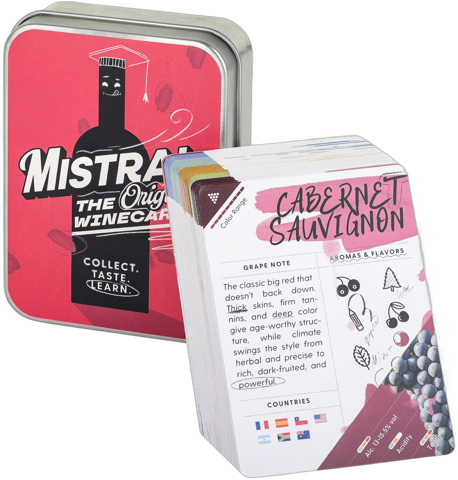
Every concept in this article fits on a card.
Mistral WineCards. Deck ONE: Global. 55 wine education cards covering grapes, regions, terroir, and winemaking. $35.
Get the DeckIn the estate's description, garnet in colour with an intense nose of ripe fruit and spice, clean in the attack with smooth tannins, then very ripe red fruit, blackcurrant, raspberry and blueberry notes and a lingering, elegant finish.
- Château de Ferrand Saint-Émilion Grand Cru ClasséThe estate's grand vin; the 2024 is its first certified organic vintage.
- Le Différent de Château de FerrandThe second wine, made since 2007 from the same terroir as the grand vin.
New to Wine.com? $25 off $350+ with codeJOVIAL25
Wine with Seth may earn a commission on Wine.com purchases at no cost to you. Wine links are for adults 21 and over.
- Saint-Émilion Grand Cru Classé since 2012; listed among the Grands Crus Classés of the 2022 classification.
- Saint-Hippolyte clay-limestone plateau, more than 100 m above sea level; 70% Merlot, 29% Cabernet Franc, 1% Cabernet Sauvignon.
- Founded 1702 by Elie de Bétoulaud; one change of ownership, to Baron Marcel Bich in the late 1970s.
- Certifications: Terra Vitis 2012, HVE level 3 2018, ISO 14001 2021; first certified organic vintage 2024.
- Second wine: Le Différent de Château de Ferrand, made since 2007.
Tasted a Château de Ferrand wine?
Log it in your Tasting Journal and build your palate over time.
Start your Journal