Bionic Wines
Christophe Baron's umbrella for Cayuse Vineyards, No Girls, Horsepower Vineyards, Hors Catégorie and Champagne Christophe Baron.
Bionic Wines is the umbrella for vigneron Christophe Baron's projects, encompassing five brands: Cayuse Vineyards, No Girls Wines, Horsepower Vineyards, Hors Catégorie Vineyards and Champagne Christophe Baron. Baron grew up in his family's Champagne house, Baron Albert, and planted his first vineyard in the Stones of the Walla Walla Valley on March 21, 1997, on the Oregon side of the valley. The US vineyards cover 78 acres farmed with biodynamic methods, and biodynamic practices have been used across the estate since the 2005 vintage.
Take Bionic Wines into the app. Flashcards, trivia and label lookup.
Open the appFounding and Ownership
Christophe Baron grew up among the vineyards and cellars of his family's Champagne house, Baron Albert; as a young boy near the village of Charly-sur-Marne, he walked the family vineyard with his father and grandfather. After studying viticulture in Champagne and Burgundy, an unexpected winery internship brought him to the Walla Walla Valley for the first time in 1993. On an April morning in 1996, back in Walla Walla on a social visit, he spotted an open field littered with softball-sized stones on the Oregon side of the valley that reminded him of Châteauneuf-du-Pape, and he bought the property. He planted his first vineyard there on March 21, 1997, and called the venture Cayuse Vineyards, after a Native American tribe whose name, by the winery's account, was derived from the French word 'cailloux', meaning stones. Horsepower Vineyards followed in 2011, Hors Catégorie in 2013 and Champagne Christophe Baron in 2014, when Baron returned to France to launch a limited-production Champagne project in the Marne Valley. Today Bionic Wines, the umbrella for Baron's projects, encompasses five distinct brands.
- First visit to the Walla Walla Valley: a winery internship in 1993
- First vineyard planted in the Stones of the Walla Walla Valley on March 21, 1997
- Cayuse's first Syrah label, Cobblestone Vineyard Syrah (1998), was renamed Cailloux in 1999
- The stony terroir Baron discovered on the Oregon side of the Walla Walla AVA now falls within The Rocks District of Milton-Freewater AVA
- Umbrella for five brands: Cayuse Vineyards (founded 1997), No Girls (2008), Horsepower Vineyards (2011), Hors Catégorie (2013) and Champagne Christophe Baron (2014)
- Baron's family Champagne house, Baron Albert, has been growing grapes in Champagne's Marne Valley since 1677
- Cayuse farms five vineyards spread over 47 acres in the Walla Walla Valley, all planted in stony soil
- In 2002 Cayuse became the first domaine in the Walla Walla Valley to fully implement biodynamic farming
- Karen Gasparotti is Resident Vigneronne
- Production: Cayuse 5,700 cases, Horsepower 1,900 cases, No Girls 1,700 cases, Hors Catégorie 280 cases, Champagne Christophe Baron 6,000 magnums
People and Roles
Christophe Baron is the founder and vigneron of Cayuse Vineyards and the founder of Horsepower Vineyards. Karen Gasparotti is Cayuse Vineyards Resident Vigneronne and leads the La Paciencia Vineyard, the heart of No Girls; she crafts the No Girls wines as Resident Vigneronne for Bionic Wines. At Champagne Christophe Baron, Baron is assisted by his three cousins, Claire, Lise and Aline of Champagne Baron Albert, and his sister, Isabelle Baron. At Horsepower, the draft horses work the vineyards with their teamsters.
- Christophe Baron: founder and vigneron
- Karen Gasparotti: Resident Vigneronne, Bionic Wines
- Champagne Christophe Baron: assisted by cousins Claire, Lise and Aline of Champagne Baron Albert and sister Isabelle Baron

Every concept in this article fits on a card.
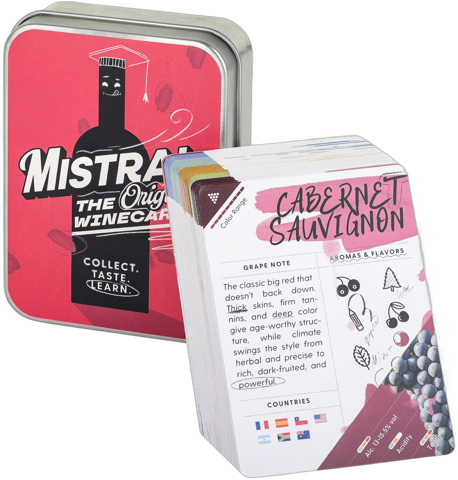
Mistral WineCards. Deck ONE: Global. 55 wine education cards covering grapes, regions, terroir, and winemaking. $35.
Get the DeckEstates and Vineyards
The US vineyards lie in the Walla Walla Valley AVA, Oregon: 78 acres on Freewater very cobbly loam soil, founded 1997 and farmed with biodynamic methods. Cayuse farms five vineyards spread over 47 acres, all planted in stony soil and averaging a yield of only two tons per acre, and all Cayuse wines are made from estate fruit. Baron had seen similar terroir in the Marlborough region of New Zealand and in the 'galets roulés' vineyards of southern France. Horsepower's four vineyards are planted one vine per stake, or 'sur echalas', at 3,555 to 4,840 vines per acre. Baron discovered the Hors Catégorie site in 2005, a steep hillside at the convergence of the north fork and the Walla Walla River where the syrah vines grow in fractured basalt on gradients up to 60 degrees; the two and a half-acre vineyard was planted entirely to Syrah in 2011. No Girls comes from the La Paciencia vineyard, whose tightly spaced vines are planted on an angle in the Stones of the Walla Walla Valley. In Champagne, the estate includes 3 hectares (7.5 acres) around Charly-sur-Marne, Crouttes-sur-Marne and the hamlet of Porteron, made up of Pinot Meunier parcels planted between 1925 and 1969.
- Cailloux Vineyard (Cayuse): 10 acres, planted in 1997, source of the Cailloux Vineyard Syrah
- Coccinelle Vineyard (Cayuse): 4.5 acres, first planted in 1998, source of Bionic Frog Syrah
- En Cerise Vineyard (Cayuse): 10 acres planted in 1998 on a former cherry orchard; En Cerise Vineyard Syrah plus fruit for Flying Pig and Camaspelo
- En Chamberlin Vineyard (Cayuse): 10 acres planted in 2000; The Widowmaker Cabernet-Sauvignon, Impulsivo Tempranillo and En Chamberlin Vineyard Syrah
- Armada Vineyard (Cayuse): 7 acres created in 2001 at 1815 vines per acre; Armada Vineyard Syrah, God Only Knows Grenache and Edith Grenache Rosé
- Sur Echalas Vineyard (Horsepower): 2 acres of Syrah and Grenache at 4,840 vines per acre, which Horsepower calls the highest density planting in the Walla Walla Valley
- The Tribe (3 acres of Syrah), High Contrast (3 acres of Syrah and 1/3 acre of Viognier) and Fiddleneck (3 acres of Grenache and 1 acre of Tempranillo), each at 3,555 vines per acre (Horsepower)
- Champagne parcels: Les Hautes Blanches Vignes, Le Dessus du Bois Marie, Les Alouettes and Les Closeaux
Farming
Cayuse has been farmed organically from the very beginning, without synthetic fertilizers, chemicals, insecticides or fungicides, and in 2002 it became the first domaine in the Walla Walla Valley to fully implement biodynamic farming. Biodynamic practices have been used across the estate since the 2005 vintage. Horsepower is farmed to an astrological sowing and planting calendar and entirely without herbicides, synthetic fertilizers, chemical insecticides or fungicides; five draft horses cultivate its vineyards. The first horse, a Belgian draft horse, arrived in 2008, with the second following a year later, and the horses use specialized equipment crafted by a blacksmith in Burgundy. Horsepower is an homage to the Baron family's use of horses in its Champagne vineyards until 1957, when his grandfather's last horse, Bijou, was retired. Hors Catégorie can be cultivated only by hand or with machinery winched between the rows, and cows, goats, sheep and beehives share the pasture below the vineyard.
- Organic at Cayuse from the beginning; first fully biodynamic domaine in the Walla Walla Valley from 2002
- Biodynamic practices across the estate since the 2005 vintage
- Horsepower: Belgian and Percheron draft horses tend the Syrah and Grenache vineyards
- Apple and cherry trees, tomato and cucumber vines and rows of corn grow alongside the Cayuse vineyards
The Wines
Cayuse makes 14 wines and 5,700 cases, focusing on Syrah alongside Grenache, Tempranillo, Cabernet Franc, Cabernet Sauvignon and Viognier. The current Cayuse wine list comprises Armada Vineyard Syrah, Bionic Frog Syrah, Cailloux Vineyard Syrah, Cailloux Vineyard Viognier, Camaspelo, Edith Grenache Rosé, En Cerise Vineyard Syrah, En Chamberlin Vineyard Syrah, Flying Pig, God Only Knows Grenache, Impulsivo Tempranillo, The Lovers, Widowmaker Cabernet-Sauvignon and the Wallah Wallah Special series. The Wallah Wallah Special is bottled only in magnums and is a blend from multiple sites that changes with the vintage. Horsepower (1,900 cases) lists Grenache Sur Echalas Vineyard, Syrah Sur Echalas Vineyard, Syrah The Tribe Vineyard, Syrah High Contrast Vineyard and a 2018 Grenache Fiddleneck Vineyard. No Girls (1,700 cases) makes La Paciencia Vineyard Grenache, La Paciencia Vineyard Syrah, Tempranillo and Double Lucky #8. Hors Catégorie makes a single Syrah, 280 cases; its first vintage was a 2014 Syrah. Champagne Christophe Baron makes four Grower Champagnes from Pinot Meunier, one from each of its four vineyards, bottled exclusively in magnums, 6,000 magnums in all.
- Cayuse: 14 wines, 5,700 cases; flagship Cailloux Vineyard Syrah, first made in 1999
- Horsepower: 5 wines, 1,900 cases, Syrah and Grenache
- No Girls: 5 wines, 1,700 cases, Grenache, Syrah and Tempranillo
- Hors Catégorie: 1 wine, 280 cases of Syrah
- Champagne Christophe Baron: 4 wines, Les Hautes Blanches Vignes, Le Dessus du Bois Marie, Les Alouettes and Les Closeaux, all zero dosage and all in magnum
House Style
Baron locates the true fingerprints of Cayuse wines in their minerality: "The point is to create an honest wine that has an identity. You want to taste the place." At Wine Spectator's 2023 New York Wine Experience, Baron said the influence of the stony soils is expressed through notes of clay, dust, umami and cured meats; at the 2016 event he said of his Bionic Frog Syrah, "To me, the wine shows a lot of black olive, salt, some brine." The Wallah Wallah Special Syrahs undergo 70 to 100 percent whole-cluster fermentation and age mostly in large, neutral barrels, with not more than 10 percent of the wine in new French oak. Champagne Christophe Baron describes its style as "vinous, dry and gastronomic", with both fermentations on indigenous yeast in demi-muids and barrels, no fining or filtration, and no dosage. Baron insists on blending Hors Catégorie's darker Côte Brune and lighter Côte Blonde, never bottling them separately: "The best wine is always the blend."
- Minerality as the fingerprint of place, in Baron's view
- Wallah Wallah Special: 70 to 100 percent whole cluster, no more than 10 percent new French oak
- Champagne: indigenous yeast, unfined, unfiltered, no dosage
Open one bottle, taste it for weeks.
The Coravin Pivot+ is the simpler Coravin, for wines you will finish inside a few weeks, which is how I taste a producer across vintages without finishing every bottle. It takes five seconds to use.$199.
See the Pivot+Recognition and Visiting
Wine Spectator featured Baron as a Wine Star at its 2016 New York Wine Experience, where he presented Cayuse Syrah Walla Walla Valley Bionic Frog 2007, rated 95 points by the magazine. At the 2023 New York Wine Experience he poured three vintages of Wallah Wallah Special, which Wine Spectator rated 93 points (#4 2012), 94 points (#6 2014) and 93 points (#10 2016). Bionic releases go to mailing list members; as of September 2026 memberships are full, with a waitlist open. Visits are by reservation: The Bionic Lunch at Le Pavillon is a communal lunch for groups of up to 14 guests at $150 per person, typically running approximately two hours.
- Wine Spectator Wine Star feature, 2016 New York Wine Experience
- Wallah Wallah Special vertical at the 2023 New York Wine Experience
- The Bionic Lunch: communal lunch created by chef Matthew Lightner, reservation only
The Rocks District Context
The Rocks District of Milton-Freewater AVA, established by a TTB final rule effective March 11, 2015, covers approximately 3,770 acres in Umatilla County, Oregon, and lies entirely within the Walla Walla Valley AVA. Its distinguishing feature is its soil, largely from the Freewater series, including Freewater very cobbly loam, the soil of the Bionic Wines US vineyards.
Sources and last verified
Primary sources (Bionic Wines and its brand sites linked from bionicwines.com): https://bionicwines.com/, https://bionicwines.com/story, https://bionicwines.com/wines, https://bionicwines.com/experience, https://cayusevineyards.com/static/about.aspx, https://cayusevineyards.com/static/vineyards-overview.aspx, https://cayusevineyards.com/static/vineyards-farming.aspx, https://cayusevineyards.com/static/wines-list.aspx, https://cayusevineyards.com/static/vineyards-geology.aspx, https://horsepowervineyards.com/HorsepowerVineyards/Horses.aspx, https://horsepowervineyards.com/HorsepowerVineyards/Vineyards.aspx, https://horsepowervineyards.com/HorsepowerVineyards/Wines.aspx, https://horsepowervineyards.com/HorsepowerVineyards/Tradition.aspx, https://nogirlswine.com/nogirls/About.aspx, https://horscategorievineyards.com/horscategorievineyards/aboutus.aspx, https://horscategorievineyards.com/horscategorievineyards/vineyards.aspx, https://horscategorievineyards.com/horscategorievineyards/wines.aspx, https://champagnechristophebaron.com/champagnechristophebaron/the-estate.aspx, https://champagnechristophebaron.com/champagnechristophebaron/vineyards.aspx, https://champagnechristophebaron.com/champagnechristophebaron/wines.aspx, https://champagnechristophebaron.com/champagnechristophebaron/people.aspx. Secondary sources: Federal Register final rule establishing The Rocks District of Milton-Freewater viticultural area (govinfo.gov, February 9, 2015); Wine Spectator, The Specialness of Cayuse Syrahs (October 24, 2023); Wine Spectator, Wine Star: Christophe Baron of Cayuse (2016). Where the producer's site and a secondary source disagree, the producer's site governs. Last verified 2026-10-12
Baron ties the stony soils to notes of clay, dust, umami and cured meats, and finds black olive, salt and brine in his Bionic Frog Syrah. The Champagne estate describes its Pinot Meunier Champagnes as having great depth, high complexity and intense minerality, in a vinous, dry and gastronomic style.
- Cayuse Vineyards Cailloux Vineyard SyrahFrom Cayuse's first vineyard, planted in 1997; co-fermented with a small amount of Viognier.
- Horsepower Vineyards Syrah Sur Echalas VineyardFrom a 2-acre, horse-farmed vineyard at 4,840 vines per acre; made since 2012.
- Horsepower Vineyards Grenache Sur Echalas VineyardGrenache from the same ultra-high-density Sur Echalas Vineyard; made since 2011.
- No Girls La Paciencia Vineyard SyrahFrom the La Paciencia vineyard, whose tightly spaced vines are planted on an angle in the Stones.
- Hors Catégorie Vineyard SyrahThe single wine from a steep basalt hillside planted entirely to Syrah in 2011; 280 cases.
- Champagne Christophe Baron Les Hautes Blanches VignesSingle-vineyard Pinot Meunier Champagne, disgorged with no dosage and bottled only in magnums.
New to Wine.com? $25 off $350+ with codeJOVIAL25
Wine with Seth may earn a commission on Wine.com purchases at no cost to you. Wine links are for adults 21 and over.
- Cayuse's first vineyard, Cailloux, was planted on March 21, 1997, in the Stones on the Oregon side of the Walla Walla Valley
- In 2002 Cayuse became the first domaine in the Walla Walla Valley to fully implement biodynamic farming
- The Rocks District of Milton-Freewater AVA took effect March 11, 2015: about 3,770 acres in Umatilla County, Oregon, entirely within the Walla Walla Valley AVA; its distinguishing feature is its soil, largely of the Freewater series
- Horsepower's Sur Echalas Vineyard, at 4,840 vines per acre, is described by the estate as the highest density planting in the Walla Walla Valley
- Champagne Christophe Baron: Pinot Meunier only, single vineyard, single vintage, no dosage, magnums only
Tasted a Bionic Wines wine?
Log it in your Tasting Journal and build your palate over time.
Start your Journal