Albino Rocca
ahl-BEE-noh ROH-kah
A four-generation Rocca family winery on Strada Ronchi in Barbaresco, with Nebbiolo crus in Ronchi, Ovello Vigna Loreto, Cottà and Montersino.
Albino Rocca is a family winery at Strada Ronchi 18 in Barbaresco. Its history starts in the mid-1940s, when Giacomo Rocca, Albino Rocca's father, sold grapes from family vineyards and later made wine sold in demijohn. Albino Rocca started the winery that carries his name after inheriting some of the family's vineyards in the 1960s. His son Angelo Rocca (d. 2012), who started working at the winery in the 1960s, increased its holdings, reduced and then eliminated herbicides, and in the late 1980s began vinifying and aging the crus separately. The family's vineyards cover almost 20 hectares in Barbaresco, Neive and San Rocco Seno d'Elvio (Alba). After 2012, the property was run by Angelo Rocca's daughters.
Take Albino Rocca into the app. Flashcards, trivia and label lookup.
Open the appHistory and Ownership
Albino Rocca is a family business, and its history starts in the mid-1940s, when Giacomo Rocca, Albino Rocca's father, entered the wine business by selling grapes from family vineyards and later making his own wine, sold in demijohn. In the 1960s, after inheriting some of the family's vineyards, Albino Rocca was able to start the winery that now bears his name. The winery grew through the gradual acquisition of vineyards and the production of Dolcetto and Barbera as well as Nebbiolo. Albino's son Angelo Rocca (d. 2012) started working at the winery in the 1960s and steadily increased its holdings, which came to include vineyards in Neive and San Rocco Seno d'Elvio in addition to Barbaresco. The business is registered as Albino Rocca s.s.a. at Strada Ronchi 18, Barbaresco.
- Mid-1940s: Giacomo Rocca sold grapes from family vineyards, then made wine sold in demijohn
- 1960s: Albino Rocca started the winery after inheriting some of the family's vineyards
- 1960s: Angelo Rocca started working at the winery and steadily increased its holdings
- Address: Strada Ronchi 18, 12050 Barbaresco (CN)
- Family history starts in the mid-1940s, when Giacomo Rocca, Albino Rocca's father, sold grapes from family vineyards and later made wine sold in demijohn
- Albino Rocca started the winery after inheriting some of the family's vineyards in the 1960s
- Angelo Rocca (d. 2012) separated the winemaking and aging of the crus in the late 1980s, starting with Bric Ronchi and the Loreto vineyard
- Almost 20 hectares of vineyards in Barbaresco, Neive and San Rocco Seno d'Elvio (Alba), planted to Nebbiolo, Barbera, Dolcetto, Cortese, Moscato and Chardonnay
- Ronchi, almost 3 hectares, is the oldest and largest part of the estate, and the winery sits at the top of the vineyard
- Albino Rocca ages its Barbaresco DOCG exclusively in large oak barrels
- Barbaresco Angelo blends Nebbiolo from vineyards in Barbaresco and San Rocco Seno d'Elvio and matures for about 20 months in oak cask
People and Roles
Angelo Rocca (d. 2012) managed the vineyards to reduce and then eliminate herbicides while working to improve winemaking and aging techniques. In the late 1980s he separated the winemaking and aging of the crus, starting with Bric Ronchi and the Loreto vineyard, and from 2004 the winery increased its use of large 20-hectoliter oak barrels for aging Barbaresco. As of October 2012, Angelo Rocca's three daughters, Daniela, Monica and Paola, all worked at the firm, and after 2012 the property was run by his daughters. Albino Rocca credits the help of Carlo, Angelo's favorite student, in making its wines.
- Giacomo Rocca: began the family wine business in the mid-1940s
- Albino Rocca: started the winery in the 1960s
- Angelo Rocca (d. 2012): Albino's son; separated the crus in the late 1980s
- Daniela, Monica and Paola Rocca: Angelo's daughters, all working at the firm as of October 2012, who ran the property after 2012
- Carlo: Angelo's favorite student, whose help Albino Rocca credits
The glasses, tools, and cards I stand behind.
A short list. Nothing I would not recommend to a friend.
Browse the WineShopVineyards
The family's vineyards cover almost 20 hectares in three of the four productive communes: Barbaresco, Neive and San Rocco Seno d'Elvio (Alba). Nebbiolo comes first, followed by Barbera, Dolcetto, Cortese, Moscato and Chardonnay. Ronchi is the oldest and largest part of the estate, extending almost 3 hectares with south-east exposure on limestone and clay soil layered with tufo; it was planted over 50 years ago, with some vines over 70 years old, and the winery sits at the top of it. Ovello, in the town of Barbaresco, is one of the oldest and largest historic crus of Barbaresco; the family's Vigna Loreto there is only half a hectare of Nebbiolo on the southwest slope overlooking the Tanaro River, planted in 1970 and 2011. Cottà is a historic cru where the family's small parcel, halfway up the south-west slope, faces the Ronchi vineyards and produces no more than 15 hl, mostly from vines more than 50 years old. The Montersino vineyard, about half a hectare at the southern tip of the Barbaresco zone in San Rocco Seno d'Elvio, was planted in 1998.
- Ronchi: almost 3 hectares, south-east exposure, limestone and clay with layers of tufo; some vines over 70 years old
- Ovello Vigna Loreto: half a hectare on the southwest slope above the Tanaro, planted in 1970 and 2011
- Cottà: a small parcel facing Ronchi, no more than 15 hl, vines mostly over 50 years old
- Montersino: about half a hectare in San Rocco Seno d'Elvio, planted in 1998
Wines
The Barbaresco range includes Angelo, Ronchi Riserva, Cottà Riserva, Ronchi, Ovello Vigna Loreto, Cottà, Montersino and a Barbaresco DOCG without a vineyard name. Barbaresco Angelo blends Nebbiolo from several vineyards in Barbaresco and San Rocco Seno d'Elvio, uses submerged-cap vinification in an oak vat with a long maceration, and matures for about 20 months in oak cask. Barbaresco Ronchi Riserva is selected from the Ronchi parcels only in the best vintages and spends about 24 months in oak casks and about 24 months in bottle. The Barbaresco DOCG comes from the family's youngest Nebbiolo vineyards in Barbaresco, Neive and the Meruzzano geographic mention in San Rocco Seno d'Elvio. The rest of the lineup covers Nebbiolo d'Alba, Langhe Nebbiolo Rosso di Rocca, Barbera d'Alba Superiore Gepin, Barbera d'Alba, Dolcetto d'Alba, Langhe Chardonnay da Bertü, Piemonte Cortese La Rocca, Moscato d'Asti and a Grappa di nebbiolo da Barbaresco.
- Barbaresco Angelo: submerged-cap vinification in an oak vat; about 20 months in oak cask
- Barbaresco Ronchi Riserva: best vintages only; about 24 months in oak casks and 24 months in bottle
- Barbera d'Alba Superiore Gepin: named after Gepin, a previous owner of parcels in Ronchi and Cottà; vines planted between 1950 and 1974
- Piemonte Cortese La Rocca: about 10 months in 225-liter French barriques, where part of the fermentation takes place
Winemaking and House Style
Albino Rocca ages its Barbaresco DOCG exclusively in large oak barrels. Barbaresco Ronchi and Barbaresco Montersino each spend 20 months in 20-hectoliter Austrian and German oak barrels, and the 2,600 bottles a year of Ovello Vigna Loreto are aged entirely in one large oak barrel. The winery explains its move to large barrels from 2004 as 'not a choice driven by a nostalgic return to the past,' but the best way 'to increase the true expressive qualities of Nebbiolo.' In its own words, the winery strives 'to produce with purpose and knowledge, without forcing,' and seeks wines that express 'the characteristics, purity and elegance' linked with Barbaresco.
- Barbaresco DOCG aged exclusively in large oak barrels
- Ronchi and Montersino: 20 months in 20-hectoliter Austrian and German oak barrels
- Ovello Vigna Loreto: 2,600 bottles a year, aged in one large oak barrel
- Angelo Rocca reduced and then eliminated herbicides in the vineyards
Open one bottle, taste it for weeks.
The Coravin Pivot+ is the simpler Coravin, for wines you will finish inside a few weeks, which is how I taste a producer across vintages without finishing every bottle. It takes five seconds to use.$199.
See the Pivot+Critical Recognition
Decanter, reporting in October 2012, counted Albino Rocca's Ronchi, Ovello Vigna Loreto and Vigneto Brich Ronchi Riserva among the most acclaimed Barbarescos in the denomination. In a 2015 Decanter feature on Barbaresco, Ian D'Agata placed the wines of Albino Rocca among those that 'rank with the world’s best,' and quoted Angelo Rocca's joke that 'even the phrasing plays against us: people say Barolo and Barbaresco rather than Barbaresco and Barolo, and so we always follow in tow.'
- Ronchi, Ovello Vigna Loreto and Vigneto Brich Ronchi Riserva: among the most acclaimed Barbarescos in the denomination (Decanter, 2012)
- Placed by Ian D'Agata in Decanter (2015) among Barbaresco producers whose wines rank with the world's best
Sources and last verified
Primary sources (producer's own site): https://www.albinorocca.com/en/, https://www.albinorocca.com/en/history/, https://www.albinorocca.com/en/angelo-rocca/, https://www.albinorocca.com/en/today/, https://www.albinorocca.com/en/cellar/, https://www.albinorocca.com/en/vigna-ronchi/, https://www.albinorocca.com/en/ovello-vigna-loreto/, https://www.albinorocca.com/en/vigna-cotta/, https://www.albinorocca.com/en/vigna-montersino/, https://www.albinorocca.com/en/wines/, and the wine pages https://www.albinorocca.com/en/vini/barbaresco-angelo-docg/, https://www.albinorocca.com/en/vini/barbaresco-ronchi-docg/, https://www.albinorocca.com/en/vini/barbaresco-ovello-vigna-loreto-docg/, https://www.albinorocca.com/en/vini/barbaresco-docg/, https://www.albinorocca.com/en/vini/barbera-dalba-superiore-gepin-doc/, https://www.albinorocca.com/en/vini/piemonte-cortese-la-rocca-doc/, https://www.albinorocca.com/en/vini/barbaresco-ronchi-riserva-docg/. Secondary sources: Decanter feature by Ian D'Agata (published 14 April 2015), https://www.decanter.com/features/barbaresco-first-among-equals-245550/, and Decanter's review of Albino Rocca Cottà 2016, https://www.decanter.com/wine-reviews/italy/piedmont/albino-rocca-cotta-barbaresco-neive-piedmont-2016-28158/. Last verified 2026-10-19. Where the producer's site and a secondary source disagree, the producer's site governs.

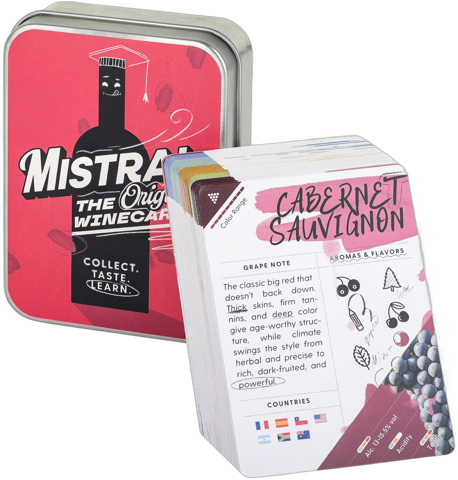
Every concept in this article fits on a card.
Mistral WineCards. Deck ONE: Global. 55 wine education cards covering grapes, regions, terroir, and winemaking. $35.
Get the Deck- Albino Rocca Piemonte Cortese La Rocca DOC100% Cortese from the hills of Barbaresco and San Rocco Seno d'Elvio, matured about 10 months in 225-liter French barriques where part of the fermentation takes place.
- Albino Rocca Barbera d'Alba Superiore Gepin DOCNamed after Gepin, a previous owner of parcels in Ronchi and Cottà; Barbera from vines planted between 1950 and 1974, matured about 12 months in oak casks.
- Albino Rocca Barbaresco DOCGBlended from the family's youngest Nebbiolo vineyards in Barbaresco, Neive and Meruzzano, matured about 20 months in oak casks.
- Albino Rocca Barbaresco Ronchi DOCGFrom the Ronchi geographical mention, the family's most historical vineyard, with east to south-east exposure; about 20 months in oak casks.
- Albino Rocca Barbaresco Ovello Vigna Loreto DOCGFrom a small parcel on the west side of Ovello, first vinified separately in the 1980s; about 20 months in oak casks.
- Albino Rocca Barbaresco Angelo DOCGNebbiolo from vineyards in Barbaresco and San Rocco Seno d'Elvio, with submerged-cap vinification in an oak vat and about 20 months in oak cask.
New to Wine.com? $25 off $350+ with codeJOVIAL25
Wine with Seth may earn a commission on Wine.com purchases at no cost to you. Wine links are for adults 21 and over.
- Family history starts mid-1940s with Giacomo Rocca selling grapes, then wine in demijohn; his son Albino Rocca started the winery in the 1960s
- Angelo Rocca (d. 2012) separated the crus in the late 1980s, starting with Bric Ronchi and the Loreto vineyard; eliminated herbicides
- Almost 20 ha in Barbaresco, Neive and San Rocco Seno d'Elvio; Ronchi (almost 3 ha) is the oldest and largest part of the estate
- Crus: Ronchi, Ovello Vigna Loreto (0.5 ha), Cottà, Montersino (planted 1998); Barbaresco DOCG aged exclusively in large oak barrels
- Barbaresco Angelo: Nebbiolo from Barbaresco and San Rocco Seno d'Elvio, submerged-cap vinification in an oak vat; Barbaresco Ronchi Riserva made only in the best vintages
Tasted a Albino Rocca wine?
Log it in your Tasting Journal and build your palate over time.
Start your Journal